
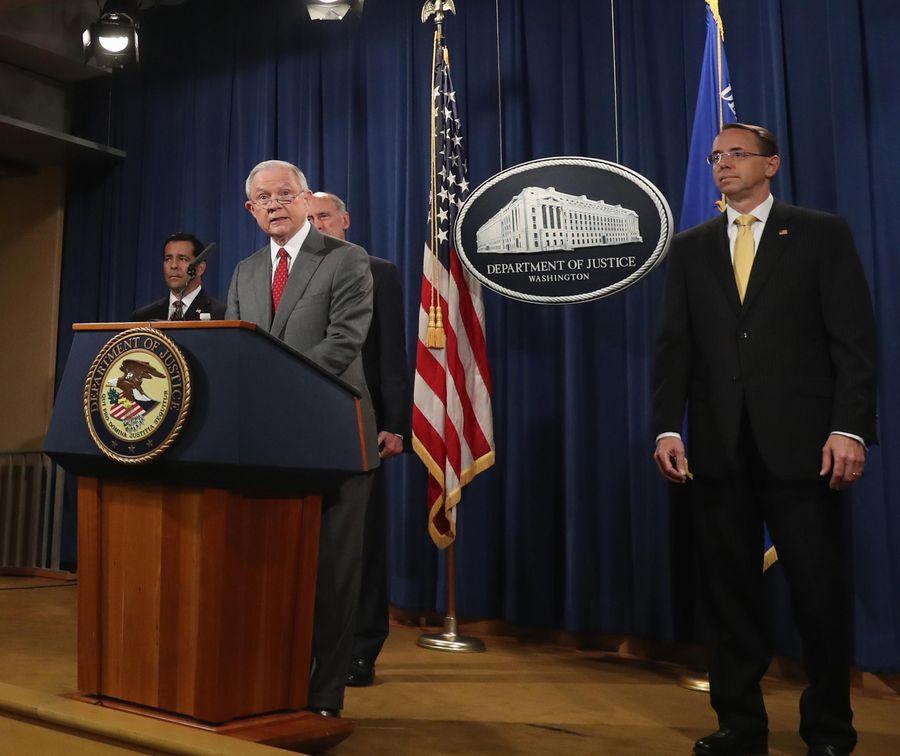
Attorney General Jeff Sessions, accompanied by, from left, National Counterintelligence and Security Center Director William Evanina, Director of National Intelligence Dan Coats, and Deputy Attorney General Rod Rosenstein, speaks during a news conference at the Justice Department in Washington, Friday, Aug. 4, 2017, on leaks of classified material threatening national security. (AP Andrew Harnik)
Sessions: FBI Has Stepped Up Efforts to Find Leakers
Published Aug. 4, 2017 • Read time: 6m
Join the Conversation
0Days after President Trump again admonished his attorney general (via Twitter) to crack down on leaks, Jeff Sessions announced on Friday that the Justice Department has been doing just that.
At a Department of Justice news conference alongside Dan Coats, the director of national intelligence, Sessions said criminal referrals to his department alleging unauthorized disclosure of classified information have “exploded.” And to tackle the problem, he said the FBI is creating a beefed-up investigative team, while the department reviews existing policies to determine when or whether to subpoena journalists as a tactic to aid the government as it attempts to find and prosecute suspected leakers.
Following a review that began in February of referrals, ongoing investigations and manpower, the attorney said his department had made the protection of classified national security information a priority.
“We tripled the number of active leak investigations,” Sessions said. “In response, the FBI has increased resources devoted to leak cases and created a new counterintelligence unit to manage these cases. Simultaneously, this department is reviewing policies that impact leak investigations.”
The attorney general, speaking to an audience of reporters on the seventh floor of the Justice Department, said the Trump administration had charged four people since January under criminal statutes with leaking classified material or with concealing contacts with federal agents. One such case, disclosed in June, involves an intelligence contractor’s suspected disclosure to The Intercept of National Security Agency information about Russia’s interference with the 2016 U.S. election.
The government charged Reality Leigh Winner, 25, under the Espionage Act.
After surveying FBI agents and prosecutors about how to improve the government’s track record of apprehending and prosecuting leakers who seek out journalists, Sessions said the department is reviewing guidelines governing the issuance of subpoenas that impact journalists, their news outlets, and their newsgathering.
The existing DOJ policy covering the news media was reworked in 2015 by former Attorney General Eric Holder following sharp protests when it was revealed that the Obama administration subpoenaed information from communications carriers linked to more than 20 home and cell phone lines used by Associated Press reporters and editors.
President Obama, who boasted of an “open and transparent” administration, was less public about his headaches over leaks than is his successor, but he was aggressive. Eight of the 13 people ever prosecuted for leaks were arrested during the Obama years. One journalist was named a co-conspirator. The 44th president defended his record during an interview last year, arguing that his crackdown represented “a really small sample” during a presidency that supported “maximum freedom of the press.”
Neither Sessions nor his deputy, Rod Rosenstein, provided details about possible expansion of subpoenas affecting journalists and news outlets either directly or through third parties, such as communications carriers. Rosenstein said he would consult with news media representatives, including during a meeting scheduled next week, before decisions are reached.
“We respect the important role that the press plays and will give them respect,” Sessions said without specifically mentioning the First Amendment. “But it is not unlimited.”
Holder’s revised policy said the nation’s attorney general must sign off on all subpoenas and warrants associated with the news media during the government’s investigations. Sessions said Friday he put Rosenstein and newly confirmed FBI Director Christopher Wray in charge of overseeing “all classified leak investigations.”
Criminal referrals to the department regarding leaks are made by the creators or custodians of classified information, usually from within the intelligence community. Coats emphasized that leaks of classified information are not always traced back to the intelligence community or its contractors and detailees.
“They come from a wide range of sources within the government, including the executive branch and including the Congress,” the former senator said.
Asked if the Justice Department had educated and briefed the White House staff and Trump, who had no government experience before stepping into the Oval Office, about the nature of classified information and the laws governing disclosure, Rosenstein said, “I’m not the right person to ask that.”
Trump’s public keening about “leaks” is often for political effect and paired with his professed animus about the news media. His supporters embrace the president’s theatrical hostility toward the Fourth Estate, including his frequent blasts about “fake news.” But the president’s handwringing about leaks is also targeted at disclosures that are unflattering or confidential, rather than actually classified. But presidents have wide latitude to classify and declassify information under the law.
The president, who is nursing a grudge against Sessions for his recusal from the Russia probe – a decision that spawned Special Counsel Robert Mueller’s expanding investigation under the aegis of the department – has accused the former Alabama senator of being “weak” when it comes to prosecuting the tipsters who offer government and other information to the news media under the cloak of anonymity.
“Only crime so far is LEAKS against us,” Trump tweeted July 22. “FAKE NEWS.”
Three days later, the president complained again about his attorney general:
— Donald J. Trump (@realDonaldTrump) July 25, 2017Attorney General Jeff Sessions has taken a VERY weak position on Hillary Clinton crimes (where are E-mails & DNC server) & Intel leakers!
Americans say they are concerned about unauthorized leaks of classified information that pose risks to the intelligence community, the military and U.S. national interests, but according to surveys conducted over time, they are also wary of the government’s record of using classification as a means to prevent public debate about controversial information and events.
Only 32 percent of Americans say they trust the news media to report fully, accurately and fairly, according to a Gallup survey released last fall. Concurrently, Trump has encouraged voters to distrust the intelligence community, the executive departments, Congress, his attorney general, and journalists, to name a handful of his targets since January.
Americans have for decades been divided when it comes to trusting the government’s warnings about national security breaches, weighed against the public’s right to know, represented by the news media. From publication of the Pentagon Papers in 1971, to publication of Edward Snowden’s disclosures about the NSA’s classified web of surveillance programs, Americans have remained torn. And in the case of the NSA’s surveillance, the opinions fractured based on age: 57 percent of those 18 to 29 years old said the leaks and publication served the public interest, while 53 percent of those age 65 or older believed the leaks were harmful.
But there’s another wrinkle in public opinion that could have implications for the Russia probes, which are examining interference in the 2016 election and whether the Trump campaign or the president’s associates colluded or cooperated to win an election. Trump has repeatedly denied any collusion. But polls show that Americans throughout recent history weighed their general disapproval of news media disclosures of leaked information against what they learned.
Sessions’ warning Friday that press freedoms are limited did not directly address how the American people defend their right to know what elected leaders and the government have been up to.



RCP Today
Top stories on RealClearPolitics
The Takeaway
Polling intelligence and analysis delivered to your inbox
World News
Featuring the latest world news
Policy
Featuring the latest policy news
Support Our Mission
As part of RealClearPolitics, authors aim to provide balanced, non-partisan analysis by presenting top reporting and commentary from all sides of the political spectrum.
Trusted by policymakers and citizens alike since 2000