
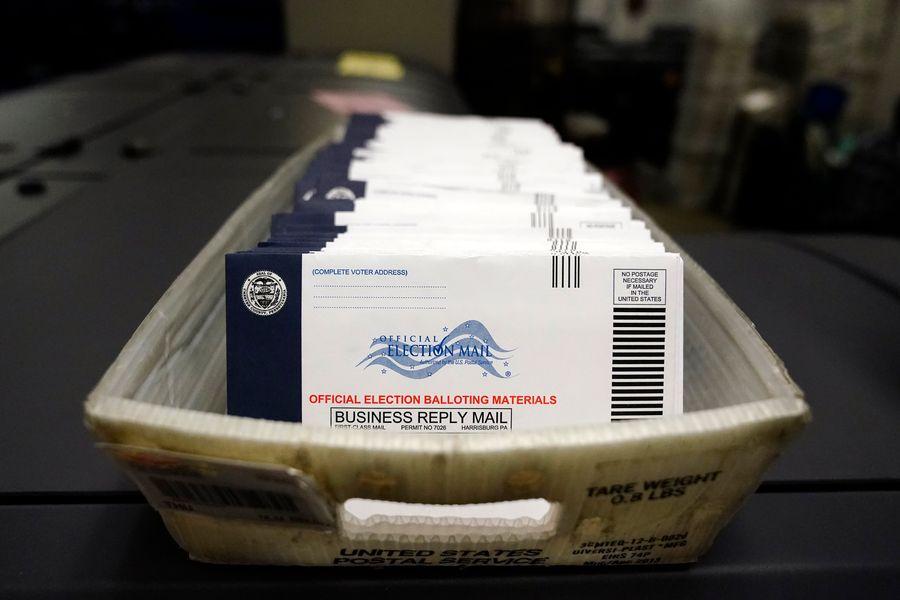
Election 2020 Pennsylvania Mail-in Voting
Election Integrity Hysteria Betrays Weakness
COMMENTARY
Published Sept. 7, 2026 • Read time: 6m
The Democrats’ hysteric reaction to the Supreme Court’s decision staying premature litigation against a presidential order that might eventually regulate mail-in ballots is unsurprising. From Justice Ketanji Brown Jackson’s over-wrought dissent alleging the result will be “chaos” and Time magazine’s twaddle that the high court is “rigging” the elections, to blather about Trump subverting the Constitution, the reactions are unmoored from reality.
The Supreme Court’s decision in Trump v. California reinforces the separation of powers, while the underlying dispute brings to the fore legal questions about administration of federal elections, and political questions about Democratic Party leaders’ refusal to stop noncitizens from voting.
The Constitution imposes on states the duty to prescribe the time, place, and manner of federal elections. It confers on Congress the power to preempt those regulations. However, neither Congress nor the president may decide who can vote. Rather, the Constitution requires that each state align eligibility to vote in federal elections with its requirements for its state legislature. So far, no state permits noncitizens to vote in these elections.
In the National Voter Registration Act of 1993 and the Help America Vote Act of 2002, Congress delegated to the executive branch certain powers to regulate how the states implement their elections. Citing those powers, President Trump issued an Executive Order in March that directed, to the extent feasible and lawful, the Department of Homeland Security to compile and deliver to states lists of citizens eligible to vote. It also instructed the U.S. Postal Service to develop uniform standards for mail-in and absentee ballots.
No changes would be made until the agencies completed their deliberations, issued proposed rules, and the rules became effective. The order did not impose any requirements on states or anyone outside of the executive branch. In the litigation that ensued, the parties and the Supreme Court agreed that even if rules were later promulgated, states would not be required to utilize the DHS lists.
Led by California, 23 states under Democratic control immediately sued, claiming the order unconstitutionally infringed on their authority to administer elections. Boston-based U.S. District Court Judge Indira Talwani enjoined the federal government from proceeding. The First Circuit Court of Appeals refused to stay the injunction. The government then filed an emergency appeal to the Supreme Court. The Supreme Court reversed the lower courts, granting the stay. It held that the lawsuit was premature; in legal parlance, Talwani lacked jurisdiction because the states lacked standing and their claims were not ripe.
The ruling is not important for its impact on election integrity, which is almost nil. Its importance lies in reminding states and federal judges that they may not intrude into the executive branch’s internal deliberations. If and when an unlawful or unconstitutional rule is actually issued, those harmed may sue.
That this simple, reasonable and obvious conclusion caused such panic underscores that many Democrats believe the legitimacy of our courts is predicated on rulings that favor their progressive agenda. The lower court rulings demonstrate how activist federal judges will reflexively oppose Trump administration policies, no matter how sensible they may be. The dispute also reveals Democrats’ deep concern that the 2030 reapportionment will strip them of congressional representation and electoral votes following the depopulation of blue states in favor of the warm embrace of conservative regions.
Even as the Supreme Court was issuing its ruling, the Post Office published a final rule, officially released on Aug. 26. California and other states again sued. The next day, Talwani issued a new order blocking implementation on the grounds that states lack sufficient time to comply. The administration appealed to the First Circuit and is seeking an emergency stay from the Supreme Court. Immediate action is critical because many states will begin printing mail-in ballots within the next few weeks.
Talwani is a stalwart cog in the anti-Trump resistance who previously enjoined the government from implementing a duly enacted federal statute to temporarily defund Planned Parenthood. In that case and numerous orders blocking the administration, Talwani gamed the system to run out the clock, achieving her political objectives even when her rulings were overruled on appeal. Talwani is among a score of federal judges in Massachusetts, California, and Washington, D.C., who routinely abuse their power to thwart the administration. Secure in the knowledge that Democrats will obstruct impeachment, these district court judges shrug off the condemnation of appeals court judges and even liberal Supreme Court justices.
Their spiritual leader is Justice Jackson, whose incendiary opinions substitute political diatribes dripping in the intersectional patois of the radical left for anything resembling prudent constitutional analysis. The other liberal justices often shun her dissents.
The president likely has the power to order DHS to publish lists of citizens. Whether Congress has delegated to the executive branch authority to regulate mail-in ballots is a closer question. Talwani and Democrats may win this round because it will soon become impossible for uncooperative states to comply. Then the case will proceed on the substance of its statutory and constitutional merits for the 2028 election.
Although legal questions about the executive branch’s right to deliberate and whether Congress has delegated authority to the executive branch to regulate the format of mail in ballots are important, the central question is political. As with the Save America Act’s requirements for proof of citizenship and voter ID – both of which have overwhelming approval from Americans of all political stripes – why are Democratic leaders hellbent on making it easier for ineligible voters to vote?
Each week we learn of thousands of noncitizens on state election rolls, with an unknown number actually voting. Tens of thousands of people who relocated, vote in multiple jurisdictions, or died remain on voter rolls. For many years I have been receiving mail-in ballots for the couple from whom I purchased my house, both of whom passed long ago.
Democratic Party resistance is not about states’ rights. Instead of a coherent judicial or constitutional philosophy, they have an endlessly malleable pragmatism that favors whatever position, candidate, or claim advances their position. To maintain power they will invite self-identified communists into their “big tent,” defend rabid antisemites and alleged rapists on the left (but not the right), and insist that married women and African Americans are too hapless to get IDs.
For those who can’t stand Trump’s comportment, or disagree with some of his policies, the alternative is not who they pretend to be. It is, instead, the radical, America-hating globalists who are taking control of the Democratic Party. Think about why the Democrats’ leadership opposes secure elections, and believe what their candidates said before they announced their candidacies. That’s who they really are.
Support Our Mission
The Internet provides an endless stream of content. Not all of it is worth your time. That's why, every day, RealClearPolitics curates the most essential news and information—from all sides and across mediums. The links, videos, and podcasts curated here are the product of human judgment, not algorithms or AI. Please help power our mission of presenting a thoughtful, balanced public discourse through a tax-deductible donation.
Would you consider supporting us today?
Contributing to RealClear Politics through the RealClear Media Foundation supports essential initiatives that drive meaningful change.






RCP Today
Top stories on RealClearPolitics
The Takeaway
Polling intelligence and analysis delivered to your inbox
World News
Featuring the latest world news
Policy
Featuring the latest policy news
Support Our Mission
As part of RealClearPolitics, authors aim to provide balanced, non-partisan analysis by presenting top reporting and commentary from all sides of the political spectrum.
Trusted by policymakers and citizens alike since 2000