
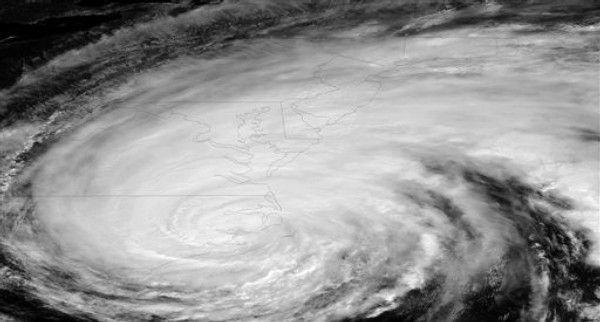
In this image released by NOAA, Saturday, Aug 27, 2011, Hurricane Irene from the NOAA GOES-13 satellite is shown in its native format: grayscale and unprojected. Hurricane Irene opened its assault on the Eastern Seaboard on Saturday by lashing the North Carolina coast with wind as strong as 115 mph and pounding shoreline homes with waves. Farther north, authorities readied a massive shutdown of trains and airports, with 2 million people ordered out of the way.
For Disaster Recovery, the Best Knowledge Is Local Knowledge
Published Oct. 13, 2016 • Read time: 4m
As residents all along the Southeastern coast start to put their lives back together after a devastating visit by Hurricane Matthew, these communities will face unique challenges. Not surprisingly, the calls for billions of dollars in federal government aid are already coming out loud and clear. In states affected by storms, government is often thought of as the only answer to reconstruction. However, research on the aftermath of natural disasters reveals that more often than not, local residents are better-suited to efficiently address these challenges than government on the local, state and federal levels.
Even if the federal government could increase the funding to help these communities above and beyond the $5 billion available in FEMA's disaster relief fund, the money would have to come from an omnibus bill passed by Congress in a lame-duck session, meaning it could be months before they receive an increase in funds. Even if Congress were to approve unlimited funds for rebuilding, it would most likely be surrounded by the type of bureaucracy that benefits a few while undermining true recovery of getting people back into their homes and communities.
Take a recent investigation by PBS' "Frontline" and NPR into flood insurance and aid distribution in the aftermath of Superstorm Sandy. They found that disaster victims' flood insurance claims were systematically underpaid, while the insurance companies selected by the feds to handle these claims were busy finding ways to increase their profits and limit payouts. Meanwhile, aid programs were slow to distribute funds while punishing homeowners with mountains of red tape and unqualified contractors, which ultimately prevented them from returning to their homes and communities.
BART Is Not a Homeless Shelter
Thank Gridlock for Economic Turnaround
Infrastructure Is Not the Problem
Take the Public-Private Road to Efficiency
Brad Gair, a disaster recovery manager in New York, said during the "Frontline" episode: "Did we put a bunch of money out? Yes. Is everybody mad? Yes. Did people get what they needed to get back into a home? No." These horrifying stories were unfortunately a repeat of previous governmental responses to disasters -- for example, after Hurricane Katrina and Hurricane Andrew.
In a recent book titled "Community Revival in the Wake of Disaster," three of my colleagues at the Mercatus Center -- Virgil Henry Storr, Stefanie Haeffele-Balch and Laura E. Grube -- explain in detail why we shouldn't be surprised that governmental responses to disasters lead to high administrative overhead costs and little relief to those who need it the most. They also show how entrepreneurs, "conceived broadly as individuals who recognize and act on opportunities to promote social change," end up filling this critical role.
They reveal how in general, these entrepreneurs promote community recovery by providing necessary goods and services and restoring and replacing disrupted social networks. The entrepreneurs also provide signals to indicate that a community is rebounding. These signals are essential to incentivize people and businesses to stay in the community or, in the event they deserted it during or after the hurricane, come back.
Just as importantly, they argue that creating space for entrepreneurs to act after disasters is essential for promoting recovery and fostering resilient communities. They tell many uplifting stories of communities that didn't wait for the various government agencies to rescue them and instead took matters into their own hands, finding ways to obtain funding, clean up and rebuild -- which resulted in getting people back into their homes faster.
Storr and his co-authors link the success of these local entrepreneurs to people's knowledge of one another's needs, which allows them to find creative ways to overcome adversity. As opposed to the top-down approach of a distant government bureaucracy, the best knowledge is local knowledge. Those who have lived and worked in these communities know them best and are paramount to revival.
When it comes to the recovery after Hurricane Matthew, policymakers should remember that when social networks are broken by disasters, local knowledge is particularly powerful and holds an even bigger advantage over bureaucrats than usual, no matter how well-intentioned the public officials are. In fact, bureaucratic red tape will only cause more people more pain.
COPYRIGHT 2016 CREATORS.COM

The GOP Majority Should Go Out in Glory
Daniel McCarthy • RealClearPolitics
Republican Majorities Could Return Sooner Than Expected
J.T. Young • RealClearPolitics
The Danger Before the Attack
Leslie J. Sullivan • RealClearPolitics
Jon Finer’s Old and Dangerous ‘New Approach’ to Israel
Peter Berkowitz • RealClearPolitics
The President Deserves Better
John Ullyot • RealClearPolitics
Congress Doesn’t Need Another Blame Game. It Needs To Find What’s Broken
Jarrod Bernstein • RealClearPolitics
RCP Today
Top stories on RealClearPolitics
The Takeaway
Polling intelligence and analysis delivered to your inbox
World News
Featuring the latest world news
Policy
Featuring the latest policy news
Support Our Mission
As part of RealClearPolitics, authors aim to provide balanced, non-partisan analysis by presenting top reporting and commentary from all sides of the political spectrum.
Trusted by policymakers and citizens alike since 2000