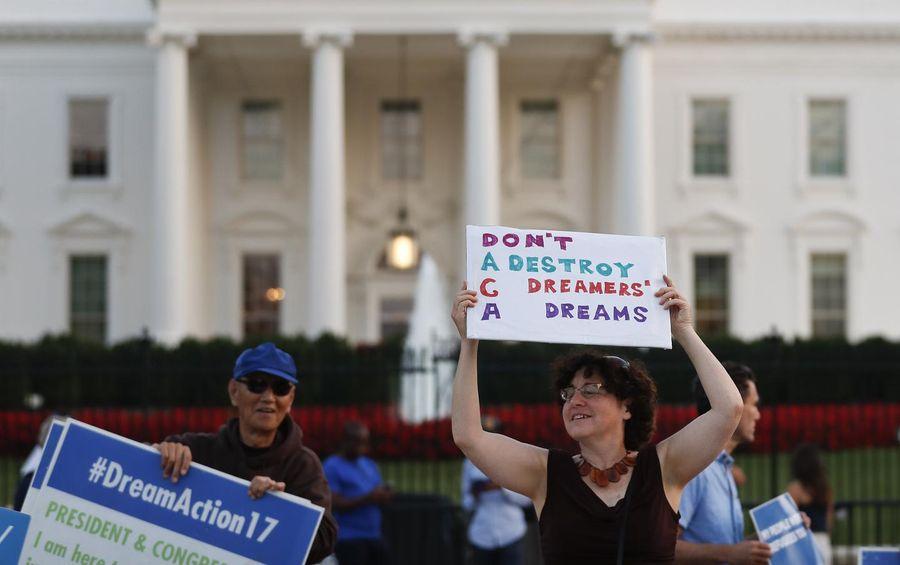
Julia Paley, of Arlington, Va., with the DMV Sanctuary Congregation Network, dances with a sign that reads
The Dreamers Deserve Compassion -- and a Legislative Compromise
Published Sept. 8, 2017 • Read time: 4m
"The last temptation is the greatest treason: To do the right deed for the wrong reason."
-- T.S. Eliot
WASHINGTON -- We have every reason to assume the worst when it comes to President Trump's motivation in rescinding DACA -- the program allowing undocumented immigrants to live and work openly if they came to the United States as children. Trump's public justification is that President Obama's creation of DACA by executive action was unconstitutional. A usurpation of Congress. A process violation.
Yet Trump didn't give a fig for constitutional niceties in his initial order to keep people from certain Muslim-majority countries out of the U.S. Now, to potentially send Hispanics out of the country, he has discovered an appreciation for process and precedent. There is a theme here, and it is not respect for the rule of law. Trump does not deserve the benefit of the doubt when it comes to issues of race and ethnicity. Recently, and with increasing frequency, he has displayed malevolent prejudice for political reasons. His action on DACA is another installment in this disturbing series.
But, apart from Trump's motivations, was his action on DACA the right deed? Not, certainly, by the measure of its outcome. Trump has removed reasonable protections from a sympathetic group. It would be a grave injustice to send the Dreamers "home" to countries where many have hardly visited.
A democracy, however, considers more than outcomes, or else the American system of government would be the Chinese system of government. And the constitutional case concerning DACA is not obvious.
The Rise and Fall of Marco Rubio
An Invasion of Artificial Outrage
Obama Administration Tells Agents to ID Which Immigrants Not to Deport
Green Shoots of Sanity?
The legal matter at issue: Does the executive branch have enough discretion and authority to interpret immigration laws in the manner set out by Obama -- essentially as a new pseudo-program that grants benefits to a group that Congress did not mark out for benefits? The courts have granted broad discretion to immigration officials in determining who to deport and who not to deport. The fact that the law is not applied equally in every case does not invalidate the just application of the law in any case. But the further question is: Can that discretion be applied to an entire class of undocumented people who are then granted a package of benefits (including work permits, advance parole to travel in and out of the country and, eventually, Social Security and Medicare)?
For most of his presidency, Obama maintained that creating such a program by executive action would be improper overreach. In 2012, out of frustration with congressional inaction, he changed course and created DACA. At the time, Obama frankly admitted that this was a substitute for legislation -- a measure taken in "the absence of any immigration action from Congress."
There is little question that the president can prioritize immigration enforcement in a variety of ways -- say, to focus on deporting convicted felons rather than Dreamers. This is the manner in which the law was generally enforced before DACA, and in which it could still be enforced without DACA.
At some point, however, the systematic organization of this discretion into a new legal status, bringing a series of public benefits, becomes the equivalent of legislating. And the courts might focus particular scrutiny on forms of executive action that Congress could have legislated but didn't. Given the more conservative composition of the Supreme Court, it is likely that DACA would have been struck down.
Whatever the merits of the constitutional case on DACA, the Dreamers should now be protected by law. For the last few decades, Congress has pliantly surrendered a number of roles -- particularly on social policy and national security -- to the courts and the president. A shortage of institutional ambition is a problem that America's founders did not even contemplate. This is an opportunity for Congress to reclaim its proper constitutional role.
This is also a debate -- given that few Republicans actually want to deport the Dreamers, and most Democrats seem to prioritize their welfare -- on which compromise is particularly ripe. The obvious deal: stronger border enforcement (though not the surpassingly silly wall) for a new version of DACA.
If Republicans can't accept such a deal, they have no heart and a severely limited political future in an increasingly diverse country. If Democrats can't accept such a deal, their rhetoric on the Dreamers is empty. On this issue, compromise is now the evidence of compassion.
(c) 2017, Washington Post Writers Group

Newsom Defies Voters, Juries and Lawmakers To Spare Murderers While Defending Abortion
Curtis Hill • RealClearPolitics
The Algorithmic Tilt
Frank Filingeri • RealClearPolitics
A RealClear Thanksgiving: Investing in a Better Future
David DesRosiers • RealClearPolitics
Trump’s Newsom Problem: Antagonist-in-Chief
Carolina Lumetta • RealClearPolitics
America’s Free Spirit
John Maxwell Hamilton • RealClearPolitics
The GOP Majority Should Go Out in Glory
Daniel McCarthy • RealClearPolitics
RCP Today
Top stories on RealClearPolitics
The Takeaway
Polling intelligence and analysis delivered to your inbox
World News
Featuring the latest world news
Policy
Featuring the latest policy news
Support Our Mission
As part of RealClearPolitics, authors aim to provide balanced, non-partisan analysis by presenting top reporting and commentary from all sides of the political spectrum.
Trusted by policymakers and citizens alike since 2000