
Congress Border
The Border Bill Meets Its Predicted Demise
Published Feb. 7, 2024 • Read time: 6m
The precise time of death is still difficult to determine, but it was clear from the moment President Biden walked in front of the cameras that he had abandoned hope. “All indications,” he said Tuesday afternoon of a border security deal, “are this bill won’t even move forward to the Senate floor.”
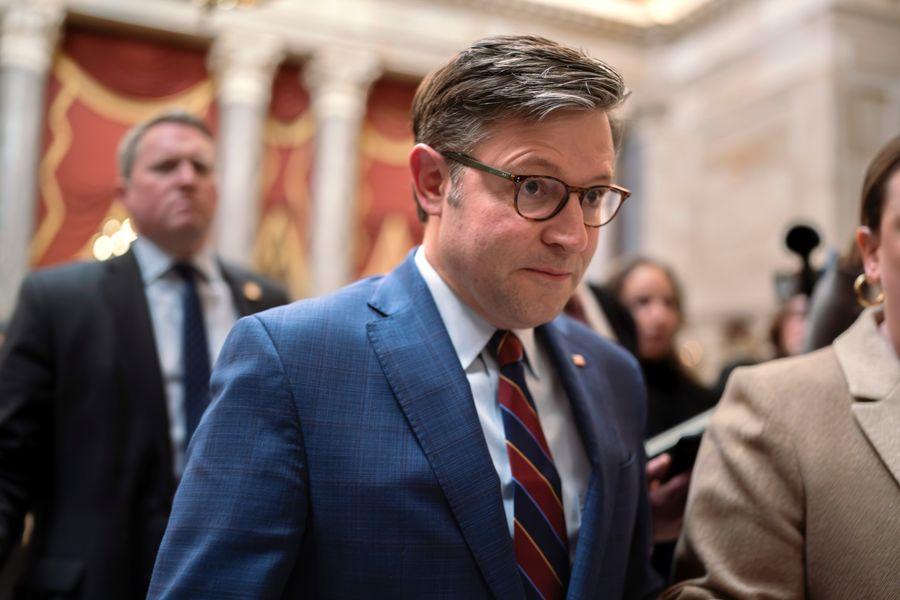
Speaker Mike Johnson had already warned the deal didn’t do enough to secure the border and, therefore, wasn’t long for this world. “If this bill reaches the House,” he said three days prior, “it will be dead on arrival.”
But with the blessing of Senate Minority Leader Mitch McConnell, Oklahoma Sen. James Lankford went ahead anyway Monday – to no avail. Less than 48 hours after the text was released, McConnell admitted, “Most of our members feel that we’re not going to be able to make a law here.”
Blame, or perhaps credit, for dooming the border bill belongs in large part to the former president. Donald Trump warned that making the deal law ahead of an election would “absolve” Democrats of their record on the border and be “a death wish” for the GOP. The reason: The compromise Lankford made with Democrats was too lax and therefore unacceptable in the eyes of the conservative base.
“This whole debate comes down to a very simple question,” former Trump advisor Stephen Miller said in a Fox News interview Tuesday. “The Trump policy: cross illegally, get deported. The Biden policy: cross illegally, get resettled.”
For weeks before the text was public, Lankford said the opposite, arguing that the final product would be “by far, the most conservative border security bill in four decades.” Trump allies, like New York Rep. Elise Stefanik, argued the opposite. Anything short of a complete shutdown of the border, Stefanik wrote on X Monday, “further incentivizes more illegal immigration.”
The Rise and Fall of Marco Rubio
An Invasion of Artificial Outrage
Obama Administration Tells Agents to ID Which Immigrants Not to Deport
Green Shoots of Sanity?
Trump worked the phones, lobbying allies on Capitol Hill to oppose it. And in the end, Trump won out over GOP Senate leadership backing the bill. South Dakota Sen. John Thune, the minority whip, told reporters that he expects the motion to proceed on the bill “will fail.”
That procedural vote to begin consideration of the bill is planned for Wednesday, and when the legislation is defeated, the border compromise will officially flatline. The problem isn’t going anywhere, though. U.S. Border Patrol reported 2.4 million encounters there last year, and Biden called the situation “a crisis” for the first time in his presidency last month. Asked if the president was considering any new executive actions to address the challenge, the White House demurred, pointing instead to a compromise in tatters.
“We have a bipartisan agreement that the Senate put forth. Republicans and Democrats came together. There is actually a piece of legislation, the text came out on Sunday, folks have been working on that for two months and it is the toughest and the fairest piece of legislation that we’ve seen in decades,” White House Press Secretary Karine Jean-Pierre told RealClearPolitics, before adding that “it is unfortunate that politics is getting in the way.”
Hours earlier, Sen. Chris Murphy, the Democrat leading the negotiation, had told reporters “No” there wasn’t any hope of passage. “Republicans have definitively sided with Donald Trump. They’ve decided they want to keep chaos at the border because it is a political winner for them.”
Once the inevitable occurs and the bill fails, will Biden move on his own to address the border crisis? Jean-Pierre reiterated that the White House wanted the border deal to pass but added, in terms of executive action, “I don’t have anything to speak to.”
The border bill would have granted the Department of Homeland Security power to shut down the border if an average of 4,000 migrants tried crossing the border illegally each day for a week. A border closure would become mandatory, according to the text of the doomed bill, if that weekly average reached 5,000 or if Border Patrol encountered 8,500 in a single day.
Some Republicans argued that number should be closer to zero, and Lankford repeatedly insisted that the bill “is not designed to let 5,000 people in, it is designed to close the border and turn 5,000 people around.” He was backed up by the likes of the conservative Wall Street Journal editorial board, the corporate-friendly Chamber of Commerce, and in the 11th hour, the union that represents border patrol agents. In the end, it was all for naught.
In the flames of the doomed bill, conservatives saw an ideological, anti-establishment turning in Washington. “Despite efforts from institutional forces like the Chamber of Commerce and the WSJ to proclaim that this bill represented serious border security reforms,” Wade Miller, executive director of Citizens for Renewing America, told RCP, “the American people knew better and their voices were louder and more numerous. The American people want border security, not bills that would make the border less secure.”
Conservatives, fortified by Trump, scuttled the legislation. Some now want an end to the current GOP leadership in the Senate.
Led by Sen. Ted Cruz, six Republicans said at a press conference that the deal, an exchange of border security for Ukraine funding, was stillborn from the start. Asked if it was time for McConnell to step down from leadership, Cruz replied, “I think it is.”
For his part, McConnell dismissed the criticism by saying that Cruz was not “a fan” of his. Simmering resentment lingers all the same.
“Everyone here also supported the leadership challenge to Mitch McConnell in November,” Cruz added of a failed effort to oust the leader after the 2022 midterms. He was flanked by Sens. Rick Scott of Florida, Mike Lee of Utah, Ron Johnson of Wisconsin, JD Vance of Ohio, Roger Marshall of Kansas, and Eric Schmitt of Missouri. He added, “I think a Republican leader should actually lead this conference and should advance the priorities of Republicans.”
Those priorities will be the subject of the coming election. The border failure lays bare rifts within the Republican party while also further certifying the center of the conservative universe. Why did the bill fail? Biden asked rhetorically. “A simple reason, Donald Trump. Because Donald Trump thinks it’s bad for him politically.”
“But if the bill fails,” the president said of an outcome that was all but guaranteed the moment he spoke, “I want to be absolutely clear about something, the American people are going to know why it failed. I’ll be taking this issue to the country.”
As obituaries for the bill were being written, Speaker Johnson brought two provisions up for a vote. The first, an effort to impeach DHS Secretary Alejandro Mayorkas over his handling of the border. The second, a stand-alone bill to provide security aid to Israel that would have otherwise been included in the border compromise. Both failed.
The GOP Majority Should Go Out in Glory
Daniel McCarthy • RealClearPolitics
Republican Majorities Could Return Sooner Than Expected
J.T. Young • RealClearPolitics
The Danger Before the Attack
Leslie J. Sullivan • RealClearPolitics
Jon Finer’s Old and Dangerous ‘New Approach’ to Israel
Peter Berkowitz • RealClearPolitics
The President Deserves Better
John Ullyot • RealClearPolitics
Congress Doesn’t Need Another Blame Game. It Needs To Find What’s Broken
Jarrod Bernstein • RealClearPolitics
RCP Today
Top stories on RealClearPolitics
The Takeaway
Polling intelligence and analysis delivered to your inbox
World News
Featuring the latest world news
Policy
Featuring the latest policy news
Support Our Mission
As part of RealClearPolitics, authors aim to provide balanced, non-partisan analysis by presenting top reporting and commentary from all sides of the political spectrum.
Trusted by policymakers and citizens alike since 2000