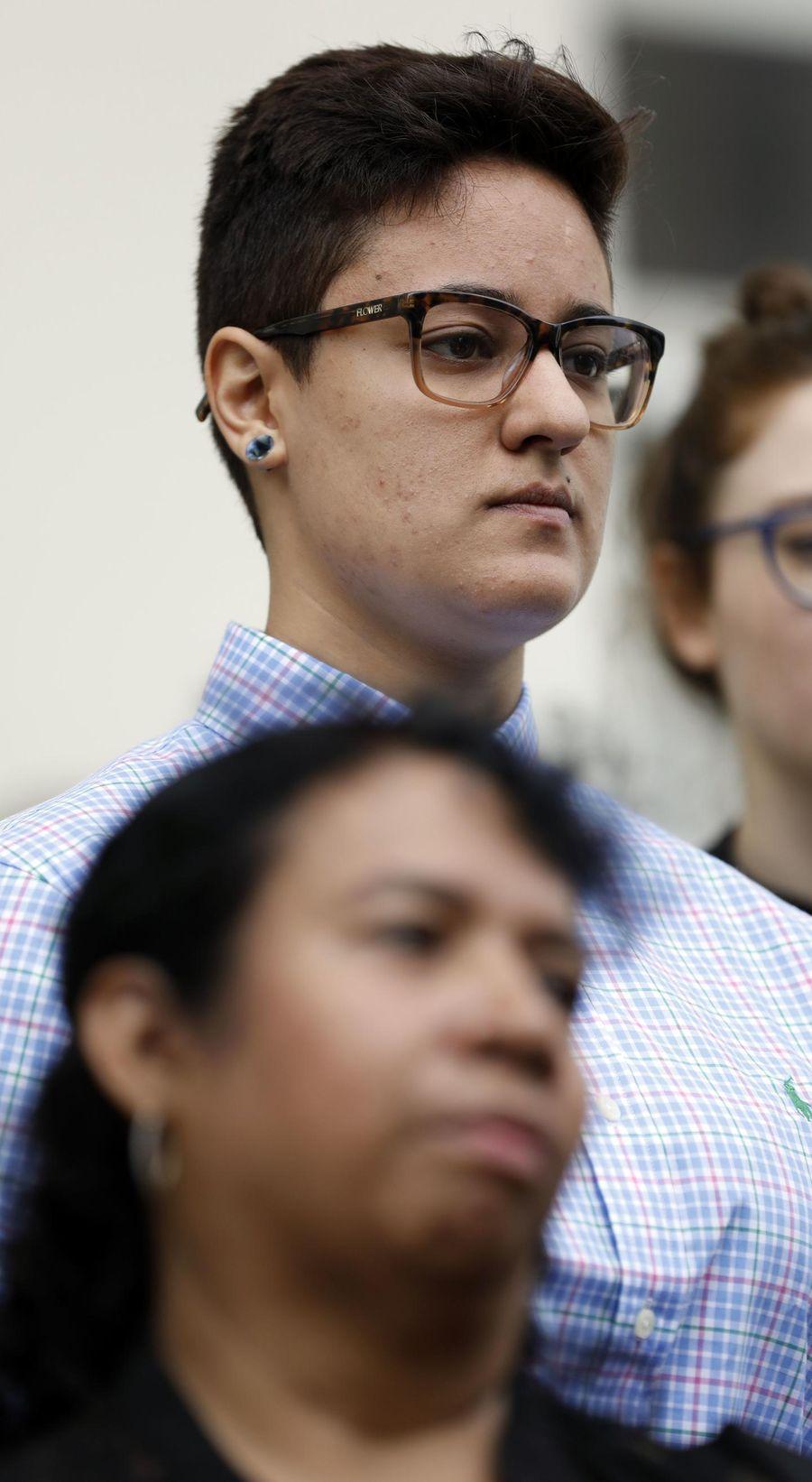
Daniela Vargas, whose father and brother were picked up during a recent immigration raid of undocumented immigrants listens as speakers discuss the series of raids that also picked up other undocumented immigrants across the state during a news conference at the Jackson, Miss., city hall, Wednesday, March 1, 2017. Vargas was detained by ICE agents following the news conference. A college student, Vargas hopes to continue her education but fears for the fate of other undocumented immigrant families. (AP Photo/Rogelio V. Solis)
Daniela Vargas Is Free, But DREAMers' Status Still Muddy
Published March 14, 2017 • Read time: 7m
Although Daniela Vargas was released from federal detention on March 10, her fate in the United States is still up in the air, highlighting the uncertainty immigrants face under the new administration.
The 22-year-old college student was detained by Immigration and Customs Enforcement (ICE) March 1. She was born in Argentina and has been in the United States since the age of 7. Vargas had been protected from deportation under the Deferred Action for Childhood Arrivals (DACA) initiative, an Obama-era policy with an uncertain future under President Trump. But her protection lapsed in November, although she had reapplied for and received pending DACA status when she was arrested.
Her lawyers see her release as an initial step toward freedom, but she can still be deported at any time due to the Department of Homeland Security’s administrative order of removal against her.
Vargas’ lawyers blame the looming uncertainty on a messaging problem within the administration, saying there is an “intentional lack of clarity” regarding just how DREAMers – immigrants brought over without documentation as children – fit into Trump’s larger immigration plan.
Her release also raises a lot of questions, particularly for DREAMers in similar situations, such as the case of Daniel Ramirez Medina, another deferred action recipient who has now spent over a month in ICE detention.
Immigration advocates have criticized the administration for failing to protect deferred action recipients like Vargas and Ramirez from ICE raids, despite public statements and a memorandum indicating they would not be a priority for deportation.
Vargas’ lawyers and immigration advocates, however, are proceeding with caution.
The Rise and Fall of Marco Rubio
An Invasion of Artificial Outrage
Obama Administration Tells Agents to ID Which Immigrants Not to Deport
Green Shoots of Sanity?
Karen Tumlin, legal director for the National Immigration Law Center and a member of Vargas’ counsel, said this case does not set a legal precedent for how deferred action cases may be handled in the future. Though Vargas has been released, she stressed that “Daniel Ramirez is facing his 24th birthday in detention.”
It does, however, “really sharpen the question to the Trump administration who has very much tried to have it both ways, saying they have a lot of love and heart for DACA recipients and immigrant youth, people who have built a life here, but have refused to make clear to immigration officers that it is not in fact open season on DACA recipients.”
This discrepancy has been one of the chief concerns among immigration advocates. Vargas’ case, Tumlin said, creates an opportunity to clear up some of those matters. “Is the Trump administration ready to act and say that DACA is a program that has overwhelming value to our country and must be protected?" Tumlin asked.
The burden will largely fall on the Trump administration to set the tone for ICE moving forward.
White House Press Secretary Sean Spicer ruled out the president meeting with DREAMERs in his briefing last week. But, he noted, “The president's actions that he's taken in taken in terms of his executive order and other revamping of immigration policy have focused on our border security, keeping our country safe, our people safe.”
Under DACA, young adults who came to the United States before their 16th birthday can apply for deferred action status. They must stay out of trouble with the law and be in school, or have graduated from high school or served in the U.S. military, and regularly reapply for deferred action status.
Avideh Moussavian, a policy attorney for the National Immigration Law Center, said accounts of ICE’s behavior have been “really disturbing,” and the administration has so far failed to provide clear guidance to redirect ICE agents’ actions or reassure those whom the agency targets.
“The administration has offered no encouragement for DREAMers. It’s that deafening silence that is really noticeable to the community at large,” Moussavian said. “…There is a randomness to the ICE enforcement because the administration’s memo is so broad. ICE is acting seemingly on their own accord with no need for transparency.”
Moussavian pointed to ICE’s Twitter account, saying the agency often uses the platform to bolster support for its tactics and “reinforce the idea that they can target DACA recipients.”
ICE’s most recent tweets around the Deferred Action for Childhood Arrivals policy reminded users that the status “may be revoked anytime, especially when someone commits a crime or poses a national security of public safety threat.” The agency followed that up by tweeting: “Since the start of DACA in 2012, DHS has terminated deferred action for approximately 1,500 recipients due to criminality or gang affiliation.”
The main problem, Moussavian said, starts from the administration and trickles down: “This idea that the president wants to treat DACA recipients with care is disingenuous at this point. If we look at the actions of the administration itself – that they want to separate immigrant children from their mothers at the border, for instance – none of this speaks to a compassionate, rational approach. There is a radical inconsistency that will have the collateral effect of making people fearful.”
While Vargas’ case will move to the U.S. Fifth Circuit Court of Appeals, her lawyers agree that deferred action status as a whole should be addressed by Congress. “They need to make DACA the law so there’s not as much questioning and uncertainty,” said Abigail Peterson, one of Vargas’ attorneys. As it stands, deferred action is a temporary measure and does not grant a pathway to full legal status.
At times, there has been bipartisan effort to put deferred action on the books. The Deferred Action for Childhood Arrivals policy was partially inspired by the DREAM Act, a bill which would have eventually granted conditional permanent residency to a similar group of young, undocumented immigrants.
The DREAM Act failed to pass, but in an effort to retain the benefits of President Obama’s deferred action policy should the current administration revoke it, several Democratic and Republican lawmakers have introduced bills that would grant young undocumented immigrants a pathway to legal status.
Rep. Ileana Ros-Lehtinen is a co-sponsor of the Recognizing America’s Children (RAC) Act and The Bar Removal of Individuals who Dream and Grow our Economy (BRIDGE) Act, two such bills. The Republican lawmaker remains optimistic that the current administration will recognize the need for these bills, as well as the overall contributions of DREAMers.
“I am hopeful that the Administration’s comments on DREAMers, including the preservation of the DACA program, reflects its desire to protect these young men and women, who have come to our country with no fault of their own,” Ros-Lehtinen said in a statement to RealClearPolitics. “I have been working with my colleagues in Congress … by co-sponsoring the RAC Act and BRIDGE Act to ensure that our DREAMers can continue to positively contribute to our nation without fear of deportation.”
For now, however, more than 750,000 DREAMers will remain in legal limbo.
Vargas, having been released from detention on an order of supervision, could still be deported back to Argentina at the DHS’ discretion so long as the order of removal stands. The threat of deportation will still be present even if she is granted a renewed deferred action status. Though her lawyers are confident her status will be renewed, they will continue to fight to have the removal order revoked so she can confidently remain in the United States.
Despite the legal challenges ahead, immigration attorney Moussavian recognizes the symbolic impact Vargas’ release may have on DREAMers: “We would like to think that her release speaks to the power of the community outcry and legal challenge to ICE’s actions. That combination is very vital moving forward.”

Newsom Defies Voters, Juries and Lawmakers To Spare Murderers While Defending Abortion
Curtis Hill • RealClearPolitics
The Algorithmic Tilt
Frank Filingeri • RealClearPolitics
A RealClear Thanksgiving: Investing in a Better Future
David DesRosiers • RealClearPolitics
Trump’s Newsom Problem: Antagonist-in-Chief
Carolina Lumetta • RealClearPolitics
America’s Free Spirit
John Maxwell Hamilton • RealClearPolitics
The GOP Majority Should Go Out in Glory
Daniel McCarthy • RealClearPolitics
RCP Today
Top stories on RealClearPolitics
The Takeaway
Polling intelligence and analysis delivered to your inbox
World News
Featuring the latest world news
Policy
Featuring the latest policy news
Support Our Mission
As part of RealClearPolitics, authors aim to provide balanced, non-partisan analysis by presenting top reporting and commentary from all sides of the political spectrum.
Trusted by policymakers and citizens alike since 2000