
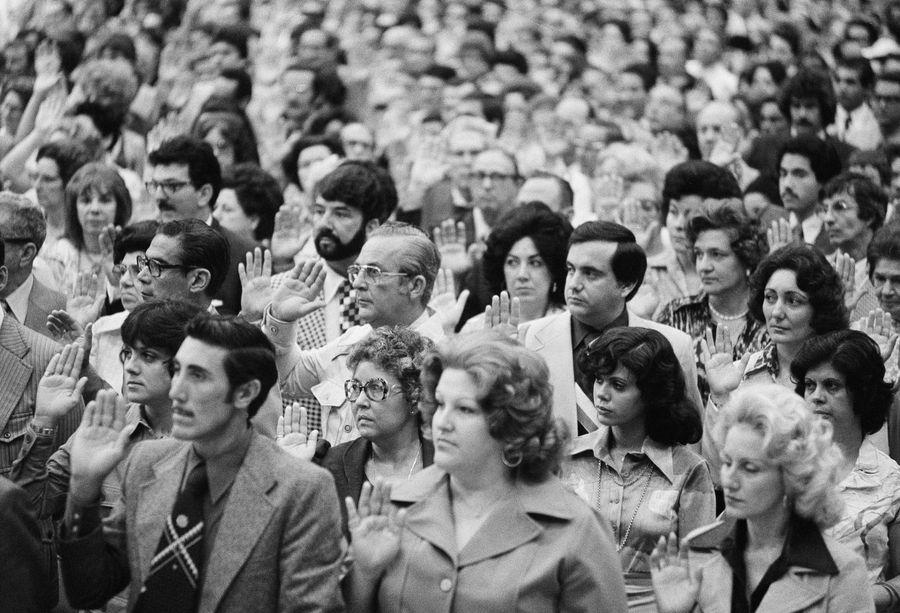
US Citizenship Ceremony 1976
Born Again in Liberty: What Immigrants Teach Us About Citizenship
Published July 10, 2025 • Read time: 5m
MOUNT VERNON, Va. — On the Fourth of July, beneath a sun that seemed to soften just in time for the ceremony, one hundred immigrants reminded the crowd of the enduring allure of American citizenship as they swore their allegiance to the United States.
George Washington’s home hosted a July 4 naturalization ceremony for new American citizens. Former California governor, actor, businessman, and professional bodybuilder Arnold Schwarzenegger delivered the keynote speech, praising the immigrants as “action heroes” for coming to America and working to achieve citizenship.
The immigrants taking their oaths represented every region of the world. One woman, originally from Iran, became a citizen mere weeks after President Trump ordered the bombing of her home country’s nuclear facilities. She struck a delighted tone, telling me after the ceremony that becoming an American citizen “means everything” to her.
Photo: James Eustis
The newly minted Americans, with Washington’s iconic mansion behind them and an American flag waving in front, watched as Schwarzenegger enthusiastically told them that they were “born again in liberty.” While the spirit was generally uplifting, the ceremony carried the unmistakable undertone that such privilege does not come without duty and responsibility.
“You did not take that oath for what you would get,” Schwarzenegger told them, echoing John F. Kennedy’s famous formulation. “You took that oath for what you could do for America.” The movie star emphasized the importance of personal responsibility and discussed the societal contributions that the new citizens should hope to make as stewards of their country’s ideals.
Schwarzenegger compared the new citizens to America’s first president, saying “I always considered Washington as the first American action hero.”
Like the immigrants, Washington was not born an American citizen. He started life as a British subject and later risked everything to help America achieve independence. Following in this tradition, the newly naturalized citizens swore an oath that included the promise to “bear arms on behalf of the United States when required by the law.” While they understood that being drafted was unlikely, saying those words aloud emphasized the ceremony’s central message that citizenship comes with obligations.
The former governor’s message landed at a time when immigration policy sits at the forefront of national debate. President Trump’s policy of mass deportations, according to a CBS News/YouGov poll, has the support of a majority of Americans. Similarly, Americans believe that immigration into the United States should be decreased at levels not seen since 2001 according to Gallup polling trends. Against this backdrop of partisan division and shifting national sentiment, the immigrants made the momentous decision to become naturalized citizens.
While citizenship does make certain public benefits more easily accessible, most immigrants become eligible for the majority of programs long before they’re eligible to naturalize. The right to vote, serve on a jury, or hold elected office are civic duties more than personal perks.
Other than voting, the practical rewards of citizenship may be modest, but the symbolic weight is immense. Becoming a citizen is more about adopting a personal policy of loyalty than it is about gaining formal rights and privileges. Despite the limited material benefits, more than 800,000 immigrants chose to become naturalized citizens in 2024 alone, with more than 7.9 million raising their hands in the last decade. Those numbers speak not only to what citizenship offers, but to what it represents.
The pledge of loyalty that naturalized immigrants take, verbalized before a crowd that includes their families and government officials, is something citizens born in the United States are never asked to make. Nor are they asked to seriously weigh the value of citizenship against its responsibilities. Yes, birthright citizens may (or may not) be aware that selective service laws are still on the books. That said, there is a key difference. The decision of these immigrants to become citizens reflected a consequential choice to carry on the American legacy. It was a moment of devotion that most birthright citizens never encounter. American citizenship does not simply mean benefitting from America’s economy or enjoying the civil and political freedoms we often take for granted. It was a consequential commitment to uphold the values of the country they chose to make their home.
At times, feeling pride in America is controversial. Some approach it with skepticism, mistakenly viewing it as an endorsement of the current party in control of the government. But true patriotism isn’t rooted in politicians. It’s rooted in principle, a commitment to the ideals behind what Washington called the “great experiment for promoting human happiness.” As Schwarzenegger said, “You do not just deserve to be in America. You are needed here!”
On Independence Day, at the home of the nation’s first president, one hundred immigrants affirmed their loyalty to the country they chose to call home – not by accident of birth, but through effort, conviction, and sacrifice. Those of us born into citizenship would do well to reflect on what they reminded us: that to be an American is not simply to inherit a legacy, but to keep it alive.


RCP Today
Top stories on RealClearPolitics
The Takeaway
Polling intelligence and analysis delivered to your inbox
World News
Featuring the latest world news
Policy
Featuring the latest policy news
Support Our Mission
As part of RealClearPolitics, authors aim to provide balanced, non-partisan analysis by presenting top reporting and commentary from all sides of the political spectrum.
Trusted by policymakers and citizens alike since 2000