
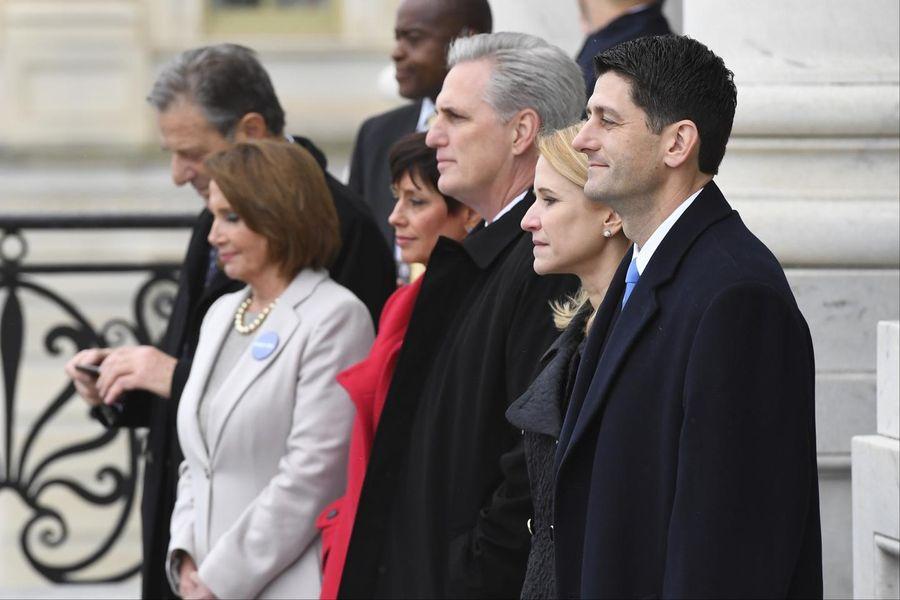
From left, Paul Pelosi, his wife, House Minority leader Nancy Pelosi of Calif., Judy McCarthy, her husband, House Majority Leader Kevin McCarthy of Calif., Janna Ryan, and her husband House Speaker Paul Ryan of Wis. watch as former President Barack Obama and Michelle Obama depart Capitol Hill in Washington, Friday, Jan. 20, 2017, for Andrews Air Force Base, Md. (Jack Gruber/Pool Photo via AP)
With Health Bill Failure, Ryan May Be on Pelosi's Midterm Path
Published March 28, 2017 • Read time: 5m
Join the Conversation
0Democratic Leader Nancy Pelosi bet the House in March 2010 when she oversaw the vote to pass President Obama’s health-care law.
She lost.
Did Speaker Paul Ryan just make a similar wager with last week’s failed vote to repeal and replace the Affordable Care Act?
“Republicans need to have a long conversation about what they want to be because they’re going to be a minority party if they can’t do better than this pretty quick,” said former Republican Rep. Tom Davis of Virginia.
House Democrats passed the controversial ACA without a single Republican vote. And while Democrats would argue it was not the sole cause of their 2010 midterm defeat, given that the economy was in tough shape with unemployment at 9 percent, the health-care law is seen as the straw the broke the Democrats’ hold on the lower chamber.
Republicans picked up 63 seats that year, which Obama called a "shellacking.”
Now Republicans are showing signs of concern that 2018 could bring a shellacking of their own.
President Trump warned GOP lawmakers that the midterms would be a “bloodbath” for them if the repeal effort failed. Ryan himself agreed with that when he appeared on CBS’ “Face the Nation” a few days later.
"I do believe that if we don't keep our word to the people who sent us here, yes,” he said when asked about the president’s warning.
"Look, the most important thing for a person like myself, who runs for office and tells the people we are asking to hire us, ‘This is what I will do if I get elected.’ And then, if you don't do that, you are breaking your word."
It is, of course, too early to tell. For one thing, Democrats face an uphill battle with the math – they need to pick up 24 seats – and the map is against them. Also, the midterms are still 18 months away, compared to 2010 when the election took place a mere eight months after the Affordable Care Act passed.
But the history of midterm elections is on the Democrats’ side. Their party took the House back two years after President Eisenhower swept the GOP into power with his White House victory. Republicans snatched it back in 1994, two years after Bill Clinton became president. Democrats returned again in 2006, six years after George W. Bush came to 1600 Pennsylvania Avenue, before Republicans won in 2010, two years after Obama was first elected.
“It’s still so early,” said National Republican Congressional Committee spokesman Jesse Hunt, adding that “we come into the cycle eyes wide open, knowing what the history is behind midterm elections for a party whose president occupies the White House.”
The first test for both parties will be in the special election for Georgia’s 6th Congressional District seat. Tom Price won with 62 percent of the vote in 2016 before leaving to become the secretary of Health and Human Services. But Trump only won it by 1.5 percent thanks to a large swath of college-educated voters who broke for Hillary Clinton.
All eyes are now on the district to see if Republicans can hold it. The first round of voting takes place on April 18 and, if no candidate receives more than 50 percent, the top two candidates advance to a June 20 runoff.
Candidates and outside groups have already spent more than $3.7 million on the contest, the Atlanta Journal-Constitution reported.
If Democrats pick up the suburban Atlanta district, they would only need 23 votes to retake the lower chamber, which happens to be exactly the number of Republican-held districts Clinton won in 2016. Trump, however, won 12 Democratic-held seats, including that of Rep. Tim Walz, who announced he’s running for Minnesota governor, leaving his party an incumbent down.
But one area where the failed health-care vote could hurt the GOP is turnout. Republican lawmakers held over 60 votes to repeal Obamacare when Obama was in office. Now, in their first vote out of the box with a Republican sitting in the White House, they failed.
“Midterm turnout is about who shows up. And my experience is that angry people show up. And right now that anger element is with the Democrats,” said Davis.
“Right now the Republican base is depressed. That’s a formula for disaster.”
Another factor is the president himself. Trump is unpredictable, fickle and inclined to tweet first, think later. Can the GOP count on their leader to rally his base and support the troops in the 2018 contest?
Trump threatened House Freedom Caucus Chairman Mark Meadows, whose group’s vocal opposition to the bill brought it down, in his Capitol Hill meeting earlier this month.
The president said the lawmaker was “breaking my ass” with his opposition, three sources in the room told RealClearPolitics.
“Trump told Meadows, ‘I’m going to come after you’” for not supporting the bill, a source said.
The president’s job approval rating won’t help his party either. In the RCP average, Trump is at a negative 9.9 percent.
Republicans are doing their best to shift the narrative, casting blame on Democrats in the aftermath of the canceled health-care vote.
“I think it’s going to be difficult for Democrats,” said one GOP operative who works on House races. “You look at a law collapsing right in front of us.”
The strategist added: “Democrats do not want to change Obamacare. That’s the bottom line. It’s clear that we didn’t have any Democratic support.”
Republicans also have time on their side and plenty on the legislative agenda, including a push for tax reform and funding infrastructure projects.
“They need a win,” Davis said. “If Republicans get their act together and get tax reform done, infrastructure done and the economy improves, they could have a decent midterm.”
And no matter what, Ryan may be safe as head of the House Republicans.
“They don’t have anybody else but Ryan. If Ryan can’t pull it together, who can?” Davis said.


RCP Today
Top stories on RealClearPolitics
The Takeaway
Polling intelligence and analysis delivered to your inbox
World News
Featuring the latest world news
Policy
Featuring the latest policy news
Support Our Mission
As part of RealClearPolitics, authors aim to provide balanced, non-partisan analysis by presenting top reporting and commentary from all sides of the political spectrum.
Trusted by policymakers and citizens alike since 2000