
New Hampshire to Make History With Nominees in First District Race
Published Sept. 12, 2018 • Read time: 4m
CONCORD, N.H. (AP) — New Hampshire is set to elect either its first black member of Congress or first openly gay representative.
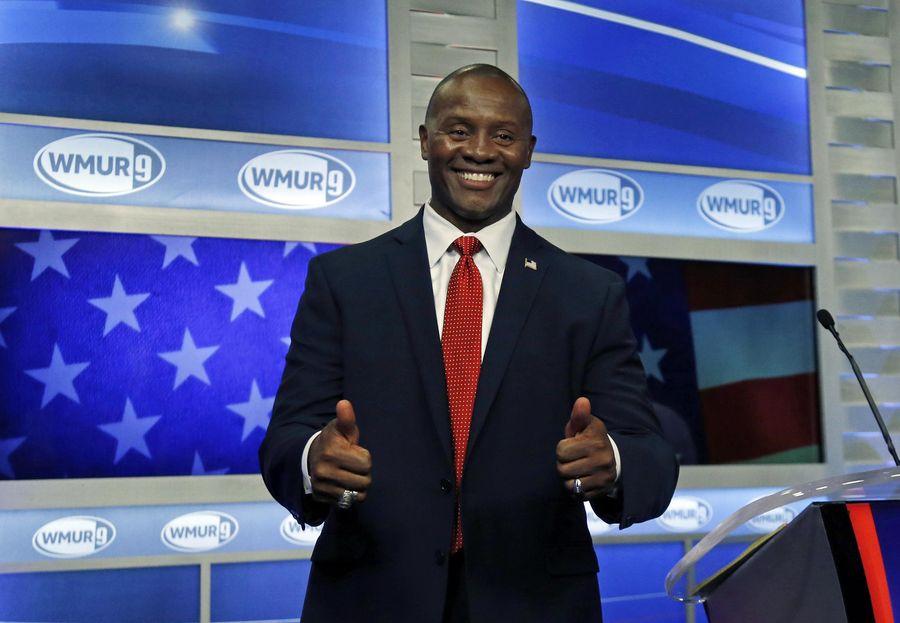
Eddie Edwards, an African-American former police chief backed by the Trump administration, won the Republican nomination Tuesday in the state’s toss-up congressional district. He will face Chris Pappas, an establishment-backed Democrat, in November.
In the governor’s race, former state Sen. Molly Kelly defeated former Portsmouth Mayor Steve Marchand and will face Republican Gov. Chris Sununu, who faced no primary opposition.
New Hampshire Democratic gubernatorial hopeful Molly Kelly, middle, greets supporters at her primary night victory party, Tuesday, Sept. 11, 2018, in Keene, N.H. (AP Photo/Elise Amendola)
Edwards, who was endorsed by Trump attorney Rudy Giuliani, defeated six Republican opponents in the 1st Congressional District, which covers the eastern half of the state. A Navy veteran who also served as enforcement chief for the state liquor commission, Edwards is the second African-American to be nominated to a U.S. House seat in New Hampshire.
The district, which covers the eastern half of the state, was once reliably Republican but has flipped in each of the past four cycles. In 2016, it returned Democrat Carol Shea-Porter to Congress but backed President Donald Trump.
Shea-Porter’s decision to step down after four nonconsecutive terms resulted in a swarm of candidates seeking to replace her, including Levi Sanders, son of Vermont senator and former presidential hopeful Bernie Sanders. He came up far short Tuesday in an 11-way race won by Pappas, a restaurateur who would be New Hampshire’s first openly gay member of Congress.
Where "Obama Republicans" Split With Party
Curbelo Gives Spanish-Language Response to State of the Union
Rep. Bachmann Says She Won't Run For Re-Election
No, We Don't All Sin Like Mark Sanford
Former Obama administration official Maura Sullivan raised more money than the 10 other candidates combined, but she faced criticism for being both new to the state and voting in general, having just moved to New Hampshire last year and acknowledging she failed to vote in several recent elections.
Pappas is a former state lawmaker who is serving his third term on the governor’s Executive Council and runs a family restaurant in Manchester. He had the backing of the state’s two Democratic U.S. senators, and said he was proud that most of the money he raised came from within the state.
Pappas told supporters Tuesday evening his campaign will be about decency, unity and progress. He described meeting an LGBTQ student in Manchester who said she was unsure of her place in the community.
“She needs a role model and a champion, too, and I hope this historic victory tonight has some small impact in making her understand this fact: You, too, are welcome here, and regardless of who you are or who you love, the sky’s the limit,” he said.
Edwards had sought to make the race about character, and said he’d refuse to support his rival, state Sen. Andy Sanborn, as the nominee after he was accused of sexual harassment at the Statehouse.
“People demand change in Washington,” Edwards said. “They yearn for honesty, integrity, and leadership. They want to vote for someone who has served our country and understands the honor that comes with that responsibility.”
Kelly, the Democratic nominee for governor, said the party’s strong turnout should send a message to Sununu that voters want someone who will put the people first, not corporate special interests. A five-term senator from Harrisville, she frequently emphasized her experience as a single mother who raised three children while putting herself through college.
“The people of New Hampshire know that I will fight for them every single day because I understand their struggles,” she said in a statement Tuesday night. “Chris Sununu should not underestimate me. I’ve been underestimated before.”
Stewart Levenson, a whistleblower doctor who had flagged abuses at the state’s veterans hospital, conceded victory early Wednesday to Republican rival Steven Negron, a state lawmaker, in a hard-fought primary to face Democratic U.S. Rep. Annie Kuster in the 2nd Congressional District. Kuster, too, faced no opposition in the primary.
Accustomed to going first in the presidential primary, New Hampshire voters were among the nation’s last to nominate candidates for November, providing one of the final measures of the country’s mood before the midterm election.
Rhode Island holds its primary on Wednesday, and New York follows a day later.

The GOP Majority Should Go Out in Glory
Daniel McCarthy • RealClearPolitics
Republican Majorities Could Return Sooner Than Expected
J.T. Young • RealClearPolitics
The Danger Before the Attack
Leslie J. Sullivan • RealClearPolitics
Jon Finer’s Old and Dangerous ‘New Approach’ to Israel
Peter Berkowitz • RealClearPolitics
The President Deserves Better
John Ullyot • RealClearPolitics
Congress Doesn’t Need Another Blame Game. It Needs To Find What’s Broken
Jarrod Bernstein • RealClearPolitics
RCP Today
Top stories on RealClearPolitics
The Takeaway
Polling intelligence and analysis delivered to your inbox
World News
Featuring the latest world news
Policy
Featuring the latest policy news
Support Our Mission
As part of RealClearPolitics, authors aim to provide balanced, non-partisan analysis by presenting top reporting and commentary from all sides of the political spectrum.
Trusted by policymakers and citizens alike since 2000