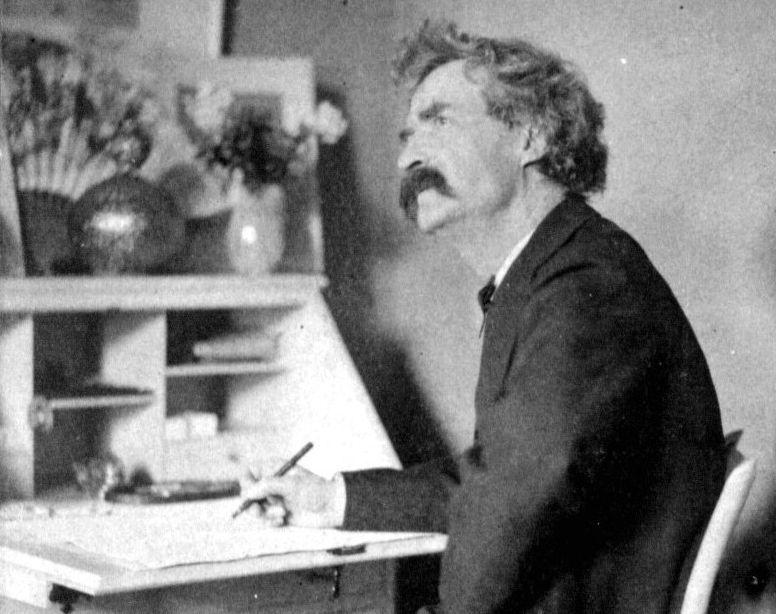
Twain Out West: The Birth of a Literary Icon
Published Aug. 29, 2019 • Read time: 5m
Join the Conversation
0On this date in 1863, while newspaper readers in the Midwest and East were still digesting news of the carnage Quantrill’s Raiders had visited upon Lawrence, Kan., out in San Francisco, subscribers to the Daily Morning Call were treated to a less gruesome dispatch from its Nevada correspondent.
It seems that a fire had broken out in the mining town of Virginia City and two rival fire companies had responded. This led to ill will, apparently, the result being a near-riot, a miner being shot, and one of the firemen under arrest. All of this, including the ostensible reason for the trouble, was contained in two brief paragraphs.
The newspaper writer didn’t quite play the story for laughs -- a man was dead, after all -- but even 156 years later, you can almost see the reporter smiling under his bushy mustache as he ends the item with a terse sentence conveying his view of the underlying reason for the melee: “All stores and liquor shops have been closed by order of the City Marshal.”
Perhaps you ask: How do I know that the writer of this unsigned item even had a mustache? I’m tempted to reply, in the spirit of the author himself: Didn’t all Nevadans sport facial hair in those days? The correct answer, though, is that the Daily Morning Call’s Virginia City correspondent was none other than Mark Twain.
* * *
As the Civil War began in the spring of 1861, 25-year-old Samuel Clemens enlisted in his local militia. This being Missouri, we’re talking about a unit soon to be subsumed into the Confederate Army. By the time that happened, wanting no part of rebellion or war, Clemens was on his way to the West. There, he would try his hand first at silver mining, and then at newspapering. He employed various pen names, settling by 1863 on the one the world knows him by today.
Rethinking the Pledge; Trump and Women; One Last Egg Roll; Eulogizing Ike
2016: A Repeat of the 1960s
An Apology, Fashioned for Nancy Reagan
Nancy Reagan, Guardian of a Legacy
Long before he penned the classic coming-of-age, anti-racism novel that made him rich and famous, Mark Twain honed his puckish, insightful writing style in San Francisco and the mining camps that spawned the growth of the great port city.
The biographer who has studied Twain’s contributions to the San Francisco Daily Morning Call most extensively is Edgar M. Branch, author of “Clemens of the Call: Mark Twain in San Francisco.” Branch estimated that in a tenure lasting less than five months, Twain filed some 5,400 local news items for the paper. It’s a prolific output, the problem for scholars being that none were bylined. Branch identified 471 of them as being unmistakably Twain, 206 of which he reprinted in his book. Barbara Schmidt, a meticulous compiler of Twain quotes, has added a few more to her indispensable website.
The first Daily Morning Call dispatch we encounter was published on July 9, 1863, in which our correspondent describes the stagecoach ride from San Francisco to Virginia City. In the opening sentence he permits himself a little white lie – pretending to be a native of those parts -- in a line that is vintage Twain: “After an absence of two months, I stand in the midst of my native sage-brush once more; and in the midst of bustle and activity, and turmoil and confusion, to which lunchtime in the Tower of Babel was foolishness.”
Later in life, Twain would describe the task of filling a local broadsheet with a near-endless stream of local items as "killingly monotonous and wearisome … soulless drudgery.” Maybe that was true on many days, but not all. Sometimes, especially in the beginning, you can see a man enjoyably practicing a vocation that may have equaled the drudgery of soldiering, but without the danger and the blood and the suffering.
Describing his trip from San Francisco by stage, he named a few of his follow passengers, who, he noted, “created a famine at every station we stopped at.”
“They fell upon the Barnum Restaurant in Sacramento, and ate the proprietor out of house and home; then they attacked the [next] station … and brought ruin and desolation upon it,” Twain wrote. “I am a mighty responsible artist at a dinner table myself, when I get a chance -- but I never got one until we arrived at Lake City, on Wednesday evening. … The only man among the wounded who was seriously hurt was a Mr. Tomlinson, from Humboldt Bay -- shoulder dislocated. They gave us a fish breakfast at Hunter's, on the Truckee -- trout, Uncle John said, but it was hardly tender enough for that -- I expect it was whale.”
It’s as though, as P.G. Wodehouse would do eight decades later with Europe in flames, Twain had turned deliberately from the horrors of war. He had a job to do, yes, and that was to fill a local paper with local news, most of it quite trivial. But his real purpose, as he saw it, was to make us laugh at the human condition. President Lincoln himself approved.
On Sept. 22, 1862, Lincoln was reading something by humorist Artemus Ward and laughing aloud. In a story told by Edward M. Stanton, Lincoln’s mirth apparently surprised those in his war council, whereupon Lincoln said, “Gentlemen, why don’t you laugh? With the fearful strain that is upon me night and day, if I did not laugh I should die, and you need this medicine as much as I do.”
The following year, the same Artemus Ward (born Charles Farrar Browne) made his way out to San Francisco, and then out to Virginia City. Did he meet Mark Twain there? The answer is: of course. The two men apparently went drinking -- for breakfast. Hijinks ensued. They became friends for life, which in Artemus Ward’s case wasn’t long. He died two years after Lincoln, at age 32. But Twain remembered him fondly for decades. You can’t make this stuff up. Well, I guess you could, but when it comes to American history there’s little need.

Newsom Defies Voters, Juries and Lawmakers To Spare Murderers While Defending Abortion
Curtis Hill • RealClearPolitics
The Algorithmic Tilt
Frank Filingeri • RealClearPolitics
A RealClear Thanksgiving: Investing in a Better Future
David DesRosiers • RealClearPolitics
Trump’s Newsom Problem: Antagonist-in-Chief
Carolina Lumetta • RealClearPolitics
America’s Free Spirit
John Maxwell Hamilton • RealClearPolitics
The GOP Majority Should Go Out in Glory
Daniel McCarthy • RealClearPolitics
RCP Today
Top stories on RealClearPolitics
The Takeaway
Polling intelligence and analysis delivered to your inbox
World News
Featuring the latest world news
Policy
Featuring the latest policy news
Support Our Mission
As part of RealClearPolitics, authors aim to provide balanced, non-partisan analysis by presenting top reporting and commentary from all sides of the political spectrum.
Trusted by policymakers and citizens alike since 2000