
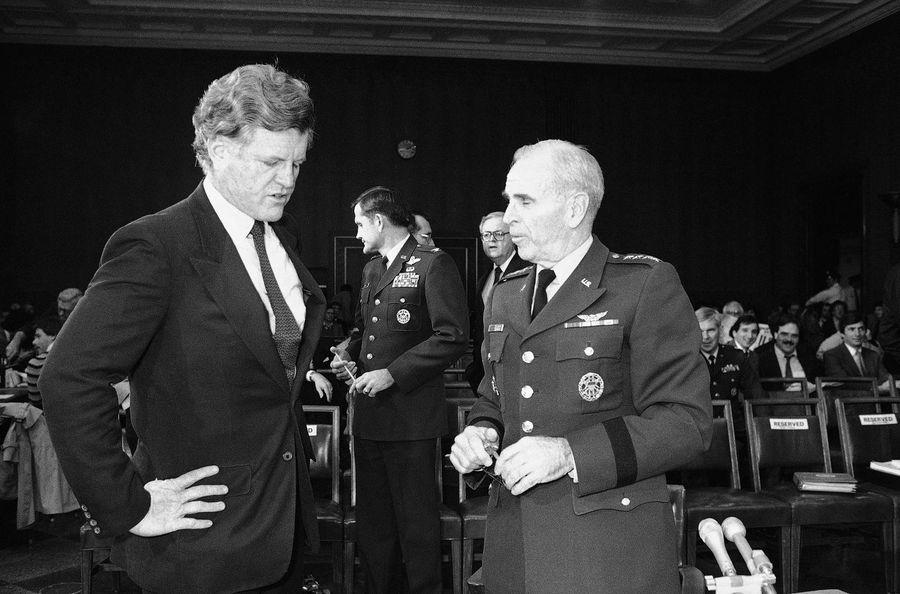
FILE - In this Feb. 1, 1983 file photo, Sen. Edward Kennedy, D-Mass, left, a member of the Senate Armed Services committee, talks with the chairman of the Joint Chiefs of Staff, Gen. John W. Vessey, on Capitol Hill, Washington, during a break in the hearing concerning the proposed 1984 federal budget. Retired Army Gen. John W. Vessey, who rose through the ranks in a 46-year military career to become chairman of the joint chiefs of staff under President Ronald Reagan, has died. He was 94. (AP Photo/Charles Tasnadi, File)
The Quiet Virtues of Gen. John Vessey
Published Aug. 31, 2016 • Read time: 6m
Humility isn’t a common virtue among power players in Washington any more than it is on Wall Street or in Silicon Valley -- or anywhere else successful people congregate. Big egos aren’t bigger here, though given the public’s low regard for the place, they’re apparently more of a general irritant.
In their defense, politicians at least appreciate the value of the appearance of humility, which they demonstrate while beguiling constituents and reassuring peers. Most successful pols can convincingly tug a forelock and proffer an “aw, shucks” when receiving undeserved praise.
There are exceptions. Neophyte politician Donald J. Trump is one. It’s as hard to imagine a humble-acting Trump as it is a contemplative Trump or a generous Trump.
But my subject today isn’t The Donald. It’s someone as different from him as Christmas is from National Trail Mix Day (which happens to be today, if you’re wondering).
In my time in Washington, I have known a few powerful people who had genuine humility, and they’re hard to forget. One of them passed away earlier this month.
He wasn’t a politician. He was a career U.S. Army officer, and chairman of the Joint Chiefs of Staff under President Reagan. His name was John William Vessey Jr. -- “Jack” to his friends and peers. I was neither, only an acquaintance and admirer.
It’s hard to become the president’s principal military adviser without possessing considerable political skills. But Gen. Vessey must have been a master practitioner because you couldn’t see him play the game. Or maybe he was just so genuine and able that he could remain above politics. Either way, he appeared at all times to be modest, honest, free of artifice, and averse to self-dealing.
He joined the Minnesota National Guard during his junior year in high school. He was 18 when his unit was called to active duty in February 1941. He fought in some of the bloodiest battles in North Africa and Italy. He was promoted to first sergeant, the toughest job he ever had, in his telling.
Vessey received a battlefield commission during the fighting at Anzio. He stayed in the Army after the war. Attended staff colleges, returned to occupied Germany, served in Korea. As a 41-year-old lieutenant colonel, he earned a bachelor’s degree after years of night school. He was 48 when he attended Army helicopter school, the oldest man there and “the first to solo.”
He led a battalion in Vietnam, and was wounded in action while successfully defending an Army firebase at Suoi Tre that was outnumbered and partially overrun by the Viet Cong. He received the Distinguished Service Cross for his actions there, the Army’s second highest award.
He didn’t earn his first star until 1971, thirty-two years after he first put on the uniform. But five years later he had four stars and commanded U.S. forces in the Korea. He argued against President Carter’s intention to withdraw ground forces from the Korean Peninsula, and prevailed. But his opposition is believed to have cost him the Army Chief of Staff job.
He served as vice chief, which he expected to be his last assignment before retirement. But in a surprise move, Carter’s successor, Ronald Reagan, who admired Vessey’s unaffected manner, quiet competence and integrity, selected him chairman of the Joint Chiefs of Staff.
In that post, he oversaw the Reagan era defense buildup, the modernization of nuclear forces in Europe, and the intervention in Grenada. He recommended developing a space-based ballistic missile defense capacity that would come to be called Reagan’s “Star Wars” program and helped hasten the Cold War’s end. He unsuccessfully advised against the calamitous deployment of U.S. Marines to Beirut. And he avoided the spotlight.
The New York Times reported in his obituary that he “was entitled to wear seven rows of battle decorations and campaign ribbons, but kept most of them in a drawer.”
Most JCS chairmen serve at least two and often three two-year terms. But Vessey, at the top of his profession and one of the most powerful people on earth, promised his wife, Avis, that they would return to Minnesota before the first snowfall in 1985. He kept his word and they went home to Little Whitefish Lake a year before his second term was finished.
Reagan called him out of retirement two years later to serve as his special emissary to the Vietnamese government, tasked with resolving the fates of the over 2,000 Americans from the war still listed as POW/MIAs. The issue was contentious, roiled by conspiracy theorists, would-be Rambos, and fundraising grifters preying on grieving families. They abused almost everyone actually working to provide an honest accounting of the missing, including my boss at the time, John McCain.
Jack Vessey was undeterred. No one worked harder on this issue. Ultimately he was responsible for resolving as many as a thousand MIA cases, and he suffered some of the worst abuse for his efforts. He never uttered a word of complaint or refused an assignment.
I traveled to Vietnam with Senator McCain and the general. I saw him frequently in the years leading up to the Clinton administration’s normalization of relations with Vietnam, which he supported. I encountered him occasionally after that.
He was kind to me, professing an imaginary kinship because my father’s people came from the Minnesota River Valley. I watched him work, always calm and affable, but all business, blunt and unflappable, too, when negotiating for his country. Over meals and on long flights, he was an entertaining storyteller and good company.
He never told war stories that involved his experiences in combat. I don’t think he was capable of bragging, even the type that comes dressed up in false modesty. He told funny stories of carousing GIs in occupied Germany, described some of the more difficult personalities in Washington, and saw the humor in little things like the time he noticed an air conditioner in a senior Hanoi official’s office was stamped “MACV,” the acronym for the U.S. military command in Saigon during the war.
The story I think he delighted most in telling was his and Avis’ first Sunday church service after he came home to Minnesota. He heard an elderly lady in the pew behind them whisper to her companion, “His name is Vessey, and he used to be somebody in government.”
There aren’t any Ronald Reagans on the ballot this year—or even Jimmy Carters. There certainly aren’t any Jack Vesseys. We’re not likely ever to find the former again. But Gen. Vessey would tell you that people like him are everywhere.



RCP Today
Top stories on RealClearPolitics
The Takeaway
Polling intelligence and analysis delivered to your inbox
World News
Featuring the latest world news
Policy
Featuring the latest policy news
Support Our Mission
As part of RealClearPolitics, authors aim to provide balanced, non-partisan analysis by presenting top reporting and commentary from all sides of the political spectrum.
Trusted by policymakers and citizens alike since 2000