
Trump Queen Etiquette
Queen Elizabeth's Reign Spans 14 US Presidents
Published June 7, 2022 • Read time: 6m
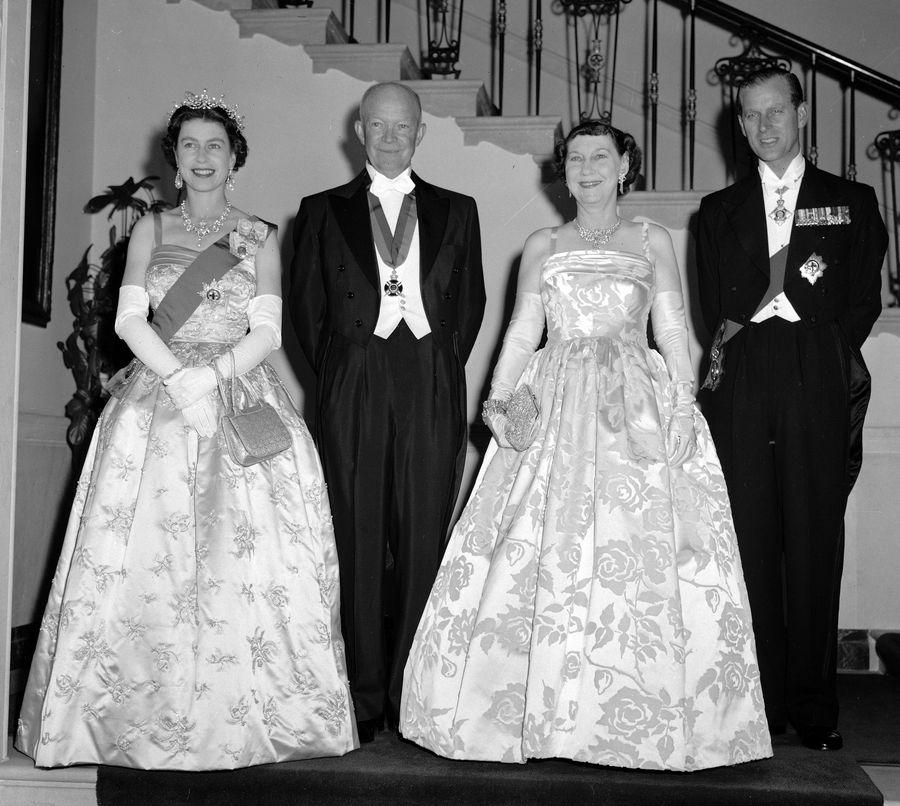
Queen Elizabeth II is celebrating her Platinum Jubilee marking 70 years as Britain’s royal monarch – the longest reign of any king or queen of that island nation.
Most people who were alive when she ascended to the throne in 1952 are now dead. I was alive back then – a mere lad of 10, going on 11 – and last I checked I am alive now. So, I decided to outline the sweeping changes in U.S. political history since then.
I still remember the day the queen was coronated. I was a fifth grader at Albany Street School in Utica, New York. We listened to the ceremony live in Miss Sattes’ class on a big console radio. Television, still in its early years, was not yet able to broadcast live across the Atlantic, so radio it was.
The broadcast was staticky as we listened from our classroom desks. Those tuned to TV heard the audio of the broadcast, but only saw fuzzy still wirephotos of the ceremony beamed from Britain to the U.S. Americans who watched TV newscasts later that evening saw film of the coronation flown from London to New York.
While Britain has had just one queen over 70 years, America has seen 14 presidents, five wars, and sweeping political, social, and technological changes.
As we listened to the coronation, President Harry Truman was bogged down in the Korean War. Republicans were about to nominate former World War II Army general Dwight Eisenhower for president. His opponent was Democrat Adlai Stevenson.
Ike pledged to end the Korean War. He delivered in 1953 with a truce that still nervously holds nearly seven decades later. South Korea is now a U.S. ally and economic power. North Korea is an isolated communist state.
Eisenhower’s successor, Democrat John F. Kennedy, and wife Jacqueline, brought youth, vigor, and style to the White House. Kennedy spurred the early U.S. space program, the botched Bay of Pigs invasion, the beginnings of U.S. military involvement in Vietnam, and the successful Cuban missile showdown with Soviet leader Nikita Khrushchev. Kennedy was assassinated in Texas in 1963, his third year in office.
Lyndon Johnson succeeded the fallen Kennedy and escalated U.S. military involvement in Vietnam. He declared War on Poverty and created a series of federal social, civil rights, urban renewal, health, and education programs still around today, including Medicaid. He also pushed racial integration in the South.
But the unpopular Vietnam War, which killed 58,000 American troops, led to Johnson’s demise. The war triggered massive protests in the U.S. The turmoil convinced Johnson to not seek reelection in 1968.
The civil unrest encouraged his successor, Richard Nixon, to end the unpopular military draft in 1973. Nixon, who eventually wound down the Vietnam War, resigned in 1974 over his involvement in the Watergate scandal. Its televised hearings gripped the nation for more than a year.
Gerald Ford, our only president unelected to either the vice presidency or the presidency, took over for Nixon. Ford was hurt by his pardon of Nixon and his own economic woes. He lost his 1976 election bid to Democrat Jimmy Carter.
The Carter years brought high inflation, energy shortages, and the Iran hostage crisis. Carter lost in 1980 to Republican Ronald Reagan. His tenure was marked by an early economic downturn, an intense arms race with the Soviet Union, the Iran-Contra arms-for-hostages scandal, and disarmament negotiations with Soviet leader Mikhail Gorbachev.
The arms race culminated in the fall of the Berlin Wall and the collapse of the Soviet Union in 1989, the first year of George H.W. Bush’s presidency.
Bush led an allied military coalition to drive Iraq dictator Saddam Hussein’s army from Kuwait and saw his job approval soar to 89%. But he lost his reelection bid in 1992 largely due to an economy gone bad. His opponent, Arkansas Democrat Gov. Bill Clinton, ran an effective campaign that hung the faltering economy around Bush’s neck.
The Clinton years were highlighted by a robust economy triggered by the “dot-com” boom which brought the rise of the Internet, the explosion of personal computers, and the creation of millions of jobs. The innovative technology triggered the decline of print newspapers and changed the world’s communication habits, not always for the better.
Clinton was impeached in the House of Representatives for lying under oath in a sexual harassment complaint brought against him from behavior dating to his free-wheeling years in Arkansas. It turned out he hadn’t left it all behind in the White House. He escaped removal in the Senate thanks in part to a strong economy.
The disputed 2000 presidential election between Vice President Al Gore and Texas Gov. George W. Bush was settled in Bush’s favor by the U.S. Supreme Court, a decision that still rankles Democrats. Bush, in his first year, was hit with the September 11 attack on the World Trade Center and the Pentagon. His early management of the crisis won him 90% job approval – the highest presidential approval ever measured by the Gallup Poll.
Bush’s response to the attack – wars in Afghanistan and Iraq – was initially popular. But public support waned as the battles dragged on and the casualty list grew. Yet, Bush was narrowly reelected in 2004 over Massachusetts Sen. John Kerry.
However, Bush’s slow response to Hurricane Katrina in 2005, and continued lack of progress in the wars, further dragged down his popularity. He spent most of 2008, his final year in office, with job approvals in the 30s, which aided Illinois Democratic Sen. Barack Obama’s election over Republican Sen. John McCain in 2008.
Obama, the nation’s first African American president, focused in his early years on reforming health care and winding down U.S. involvement in Iraq. But he escalated the U.S. presence in Afghanistan to the point where three times more Americans were killed there in his term – 1,724 – than while Bush was president – 564.
In 2016, Donald Trump defeated Hillary Clinton and is remembered mostly for a turbulent four years which featured a good economy, low unemployment, bitter battles with the news media, two impeachments, a chaotic response to the coronavirus pandemic, and the Jan. 6 Capitol riot.
And now, as Queen Elizabeth II enters her 71st year on the throne, President Biden is off to a rough start: Inflation is high, the Afghanistan withdrawal was a mess, there’s a war in Ukraine, coronavirus lingers, and midterm elections are looming.
God Save the Queen.



RCP Today
Top stories on RealClearPolitics
The Takeaway
Polling intelligence and analysis delivered to your inbox
World News
Featuring the latest world news
Policy
Featuring the latest policy news
Support Our Mission
As part of RealClearPolitics, authors aim to provide balanced, non-partisan analysis by presenting top reporting and commentary from all sides of the political spectrum.
Trusted by policymakers and citizens alike since 2000