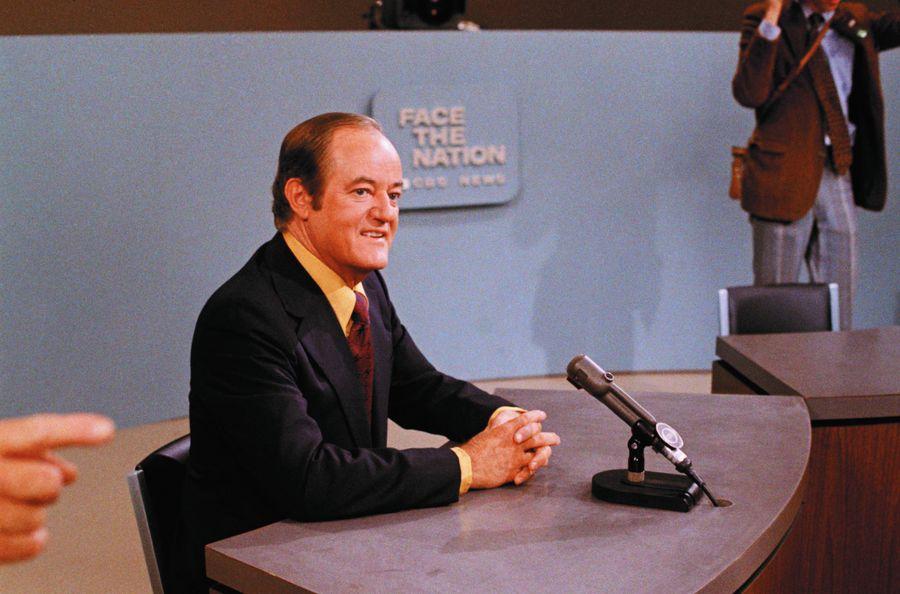
Face The Nation TV Show
Minnesota's 'Happy Warrior' Defined America. Would Anyone Listen Today?
RETROSPECTIVE
Published Jan. 25, 2026 • Read time: 12m
Forty-eight years ago this month, Hubert Horatio Humphrey died.
At the time I was a young reporter at the Sioux Falls Argus Leader, the largest newspaper in South Dakota, the state where Humphrey was born. In 1978, my editors sent me 152 miles northwest to his hometown of Doland, a typical Midwestern hamlet of 430 people to find out what its citizens would say about the man they still called “Pinky.”
The honor guard walks down the steps of the Capitol in Washington Sunday, Jan. 15, 1978, with the casket containing the remains of Sen. Hubert H. Humphrey. Accompanying the guard: President Jimmy Carter and First Lady Rosalynn Carter, Mrs. Muriel Humphrey, Vice President Walter Mondale and Mrs. Joan Mondale, and former First Lady Bird Johnson. (AP Photo)
It was a bitterly cold day in the deep freeze of a Great Plains January. Pinky died during one of the coldest winters on record in the Upper Midwest. The high temperature in Sioux Falls the day I set out for Doland was 1 degree above zero.
But Doland, like most small towns of that era, greeted this visitor in pockets of warmth. Townsfolk invited this stranger in from the cold to extol their favorite son. At one stop, a banker and community leader named Gordon Twiss gave me a tape of a speech the former vice president had delivered at a class reunion 18 months earlier in the Doland High School gymnasium named after him.
Twiss (who died six years later) told me this speech would tell people everything about what Doland thought of Humphrey, and what Humphrey thought of Doland. It was more than that. It remains one of the greatest political speeches I’ve ever heard.
Almost 50 years later, in the throes of a national crisis in Minneapolis, the city where Humphrey was once mayor and in a state he represented in the United States Senate, I listened to the speech again.
Rethinking the Pledge; Trump and Women; One Last Egg Roll; Eulogizing Ike
2016: A Repeat of the 1960s
An Apology, Fashioned for Nancy Reagan
Nancy Reagan, Guardian of a Legacy
It seemed strange and foreign in the bitter-cold atmosphere of the way we talk to, and about, one another today. As we prepare to celebrate the 250th anniversary of America’s Declaration of Independence, hearing it made me terribly sad.
Not over anything Pinky said on June 12, 1976. In fact, even with the Watergate hangover and Cold War threats swirling in the greater world outside the gymnasium, his message was bright and funny and uplifting. HHH, as the newspapers headlines called him, talked in that mile-a-minute Midwestern rasp, the rhetorical style that got him labeled the Happy Warrior. Starting with his mayorship of Minneapolis in the late 1940s, his starring role at the 1948 Democratic convention, to U.S. senator from Minnesota, vice president under Lyndon Johnson, 1968 Democratic presidential nominee – the boy from Doland had sat one seat from the pinnacle of American democracy.
Sen. Humphrey and Rep. Eugene McCarthy greet Harry Truman as he arrives for Truman Day speech at St. Paul on Nov. 3, 1949. (AP Photo)
And now he was back home, delivering an endearing, touching, personal speech, woven around that American dream of small-town kids doing big things, the memories of high school hijinks, and the names of childhood buddies or adult guides he recognized and called out in the crowd or feted in memory.
Of teachers who had nurtured and guided. Of boyhood friends, like twin brothers Marvin and Melvin McNickle, both of whom became Air Force generals and who are buried in Arlington National Cemetery. Of Doc Sherwood, who had cared for the community for 40 years. Of Tip Miles, who ran the local newspaper and who, Pinky claimed, deserved a Pulitzer Prize. Or Deschler Welch, a builder and farmer – “ol’ Desch” he called him – “the smartest man who ever came to Doland High School when he wanted to be.”
Of childhood buddy and lifelong friend Julian Hartt, son of the Methodist minister, who taught at Yale Divinity School for three decades. And Walter Hofer, Doland’s former mayor, who joked with Humphrey that presiding over Doland was a harder job than anything Humphrey had faced as Minneapolis’ mayor.
There was Leslie Coats, who had driven his two-door sedan all the way from Doland to Minneapolis in 1929 to visit Humphrey while he was studying at the University of Minnesota. Driving down Nicollet Avenue, they ran into a horse.
Pinky said he was glad that the head of the horse, not the other end, crashed through the windshield. Waves of gentle, knowing laughter pulsed through the audience.
A makeshift memorial for Renee Good, who was fatally shot by an ICE officer on Jan. 7, is seen Friday, Jan. 23, 2026, in Minneapolis. (AP Photo/Angelina Katsanis)
That accident of nearly a century ago happened six blocks from where an agent of the federal government would this month shoot a woman protesting the treatment of immigrants – a killing that would set off yet another national crisis. It happened after a former governor of Humphrey’s home state, Kristi Noem, had surged 3,000 federal agents to remove immigrants who had come to America without legal permission, and where street protests in bitter cold provoked a president to threaten to send in federal troops.
In that context, Humphrey’s memorializing of his late mother, Ragnild, an immigrant born in Norway, is all the more striking. Humphrey had given speeches all over the world, but his knees were quivering that night in Doland a half century ago.
“To talk to hometown folks, Good Lord I feel nervous as all get out,” he said. “Because you all know me all too well.”
He knew them, too. He knew people of both political parties were in the crowd. And that the national politics outside was hot and, at times, bitterly divisive.
It was less than four years after Richard Nixon had resigned the presidency. A closely contested presidential campaign between the incumbent Gerald R. Ford and an upstart governor from Georgia named Jimmy Carter was ramping up amidst America’s bicentennial celebrations. Then, as now, while we observe the nation’s semi-quincentennial, Americans were discussing the meaning and obligations of the American Revolution. Five months after Hubert’s speech, Carter won the presidency with Spink County, where Doland resides, gave him 56.6% of its vote. But Humphrey spoke for nearly an hour without uttering the words Republican or Democrat. He talked to them as family. He basked in the warmth of community.
Vice President Humphrey talks with New York Archbishop Terence J. Cooke while his Republican opponent for president Richard Nixon, far right, joins Lyndon Johnson at the Alfred E.Smith Memorial Dinner on Oct.16, 1968, in New York. (AP Photo)
“Doland High School didn’t make me rich,” said the man who struggled with financial security much of his life. “It didn’t add a lot of big honors. Doland High School just gave me an understanding about people. It gave me a sense of caring. It gave me some kind of desire to do better. And the people of this community helped me. So I come back here tonight as your neighbor, as your friend, just to say thank you, and let’s try from here on out to do better than we already have done.”
I cannot remember the last time a politician said something like that. Anyone with the audacity to say it today would be picked apart on social media as naïve, as weak, as a sellout.
Before you argue that it was different times, different media, different problems, the truth is that Pinky was not all Pollyanna in that speech. He recognized that politicians make mistakes. He’d made a big one himself, doubling down on the Vietnam War in the 1968 campaign against Nixon. The Democratic convention that nominated him in Chicago in 1968 had been torn with violence. He knew he had come home with baggage.
So Humphrey talked about the “hard lessons” of the Depression that most in the room had lived through together. And of the parched landscape of one of the worst droughts since the 1930s wilting the farm fields he’d seen on the drive in. A familiar challenge they could all see as one. But one they’d endured together through Dirty Thirties dust storms. They’d worked through differences.
“Doland was like one great big family,” Humphrey said. “Lots of times trouble, but don’t we have that in families? Sometimes bitter arguments, but we have that in families. People very different, but that is true in families. But there was a sense of being and belonging. Everybody knew everybody, so there was no place to hide. There was always a place to be, and you had the feeling that you were wanted.”
In this 1936 photo, Works Progress Administration (WPA) workers build a new farm-to-market road along Knob Creek in Tennessee. The New Deal was a try-anything moment during the Great Depression that remade the role of the federal government in American life. (AP Photo, File)
Nostalgia aside, Humphrey made a bold claim. He said America was a better place than when he graduated in 1929, when a year later he had to quit classes at the University of Minnesota because his family couldn’t pay the tuition. He knew that some men in the room had sustained their families and the community working for the W.P.A. He said the county poorhouse he remembered as a child had been replaced with a government more attuned to the poor and the forgotten.
“It is a very different country. It is a much more humane and decent country, believe me,” the Happy Warrior said. “Today, we are concerned about a person without a job. Today, we are concerned that people do not have enough to eat, and we have learned that a good diet means a chance for a good life. We know more about how to care for people, and I ask you to give of your time and attention to these things.”
Why would hearing this make one so sad today?
Because ideals have turned into bitterly cold, unforgiving ideologies. Because fear of the other has been exploited by craven politicians and infected the body politic into a fever of vitriol and violence. Because we elect a president who says he hates his political enemies and that only “my own morality” restricts him from doing anything he wants. Because politicians fill their campaign coffers with big donations from the wealthy while blaming “deplorables” for the country’s problems. Because name-calling has replaced legislating, because mercy and justice has become equated with weakness, and because “social” media has become a cesspool of disinformation and animosity that enriches the most spiteful and outrageous voices while distant moguls stand back and profit from the mayhem.
“What is America?” Humphrey asked in Doland.
“America is another word for humanity. America, how do you define it? You define it by the words freedom and people. America is not a piece of geography between two oceans and two borders. America is an idea. It is an idea about God-given rights, that God Almighty gave us in soul and spirit, of life and liberty and the pursuit of happiness.”
He extolled the duties of citizenship, quoting British philosopher John Stuart Mill, who said: “Let a person have nothing to do for his country and he shall not care for it.”
U.S. President Lyndon B. Johnson and his wife, Lady Bird, left, and Vice President-elect Humphrey and his wife, Muriel, acknowledge a salute from cheering Democrats at the inaugural gala in Washington, D.C., Sunday, Jan. 18, 1965. (AP Photo)
“I want the people of Doland to know that America’s greatness is not because it produces massive weapons, even though we do,” Humphrey said. “That America’s greatness is not because we put a man on the moon, even though we have. America’s greatness is not only because we have championed the cause of nations and [that] we have been generous as a victor even to the vanquished, because, indeed, all of that, we have. America’s greatness is because it cares about people. Maybe not as much as we could. But we are growing, and we are doing better all the time.”
Who thinks today that America is growing and doing better all the time? Who thinks that a trillion-dollar military, or threats to allies, or appeasement of warmongering dictators, or shady deals with oil sultans defines us best to the world, or to ourselves?
Humphrey longed for “not only America being number one in military power, but, dear friends, to be number one for caring for each other. To be number one in cleaning up our cities. To be number one in trying to have a community that is free of violence and crime. To be number one in health and health care. To be number one in education for everyone. To be number one in housing of our people, to be number one in jobs for our people. These are the things we ought to aspire to.
“Dear friends,” he said, building to a crescendo. “if we can be number one in caring for one another, if we can be number one in breaking down prejudice and bigotry, if we can be number one in cleaning up the cities that are rotting from within, if we can be number one in education for all of our people, and health care for all of our people, I tell you we will be the strongest nation the world ever knew.”
And the friends applauded.
Support Our Mission
The Internet provides an endless stream of content. Not all of it is worth your time. That's why, every day, RealClearPolitics curates the most essential news and information—from all sides and across mediums. The links, videos, and podcasts curated here are the product of human judgment, not algorithms or AI. Please help power our mission of presenting a thoughtful, balanced public discourse through a tax-deductible donation.
Would you consider supporting us today?

Newsom Defies Voters, Juries and Lawmakers To Spare Murderers While Defending Abortion
Curtis Hill • RealClearPolitics
The Algorithmic Tilt
Frank Filingeri • RealClearPolitics
A RealClear Thanksgiving: Investing in a Better Future
David DesRosiers • RealClearPolitics
Trump’s Newsom Problem: Antagonist-in-Chief
Carolina Lumetta • RealClearPolitics
America’s Free Spirit
John Maxwell Hamilton • RealClearPolitics
The GOP Majority Should Go Out in Glory
Daniel McCarthy • RealClearPolitics
RCP Today
Top stories on RealClearPolitics
The Takeaway
Polling intelligence and analysis delivered to your inbox
World News
Featuring the latest world news
Policy
Featuring the latest policy news
Support Our Mission
As part of RealClearPolitics, authors aim to provide balanced, non-partisan analysis by presenting top reporting and commentary from all sides of the political spectrum.
Trusted by policymakers and citizens alike since 2000