
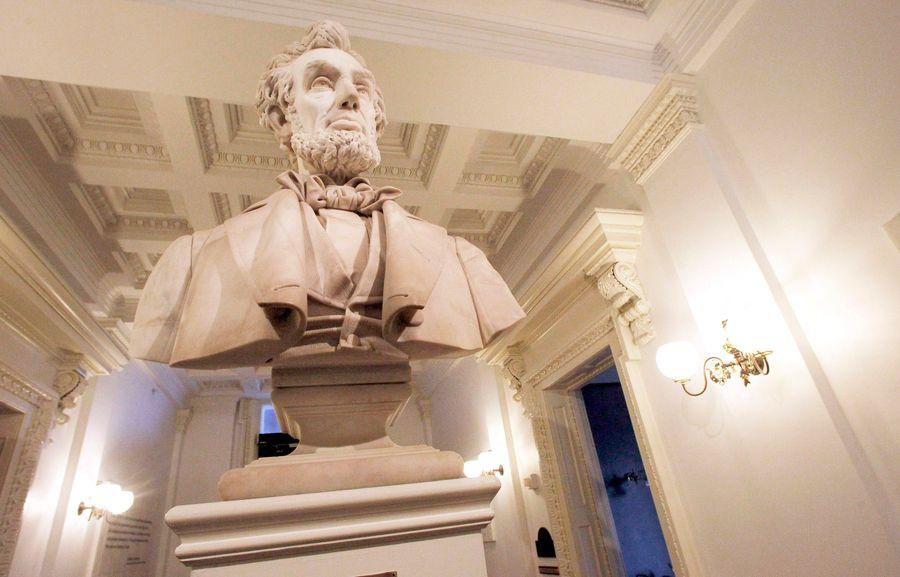
Lincoln Bust
'Lincoln in the Bardo' and Our Own Ghosts
COMMENTARY
Published Oct. 22, 2026 • Read time: 6m
“Lincoln in the Bardo” is such a compelling ghost story – one I struggled with at first, and then fell hard for – that when I saw that the novel by George Saunders was being made into an opera by the composer Missy Mizzoli and librettist Royce Vavrek, I knew I had to see it and did at the Met premiere on Monday night.
RCP
This is not a review, but if it were, it would be a rave, because the singing, the living-and-breathing set, and the adaptation of this wildly imaginative work were no magic trick but that other thing: a near-miracle. And it’s some of the near-miracles in our lives – brushes with the bardo, I guess you’d say – that I want to talk about.
Saunders built his narrative around something true: A year into the Civil War, in 1862, a heartbroken Abraham Lincoln sneaked out of the White House at night on several occasions to physically hold the body of his 11-year-old son Willie, who had just died of typhoid fever.
For several months before the boy’s body was taken to Springfield, Illinois, where he was buried, it was kept in a crypt down some steep stone steps at Oak Hill Cemetery in Georgetown, where the president privately grieved his loss, and where a bunch of “Bardo” lovers like me have since been to better imagine the scene.
The “bardo” is the Tibetan Buddhist concept of that place between life and death. In the Oak Hill of the novel and opera, Willie is surrounded by ghosts in denial about being dead – the “sickyard” they call their graveyard – choosing to believe that they are waiting to be revived. Willie also struggles to “move on” because his father, who loves him in a way that astonishes the other shades, can’t let him go. You shouldn’t tarry here, the other ghosts tell him, because they’ve seen what has happened to other young innocents who have done so. But brave Willie says “No, I must wait, because my father said he was coming back.”
Maybe you see the whole concept of a bardo as pure fantasy, though you don’t have to be a Buddhist, or a believer of any kind, really, to feel pretty sure that there is such a place.
Tibetan Buddhists generally believe in reincarnation, so their bardo is more of a time-out between lives. Non-Buddhist Saunders has described his own bardo as a place before judgment – “somewhat like Purgatory, but less strict.” Catholics like me believe that judgment happens before that period of purification, not after, because otherwise, wouldn’t that be like serving your sentence before even getting a court date?
Really, though, all I think I know about that in-between place is that sometimes, the veil between there and here is “some thinnish thing,” like the wedding night negligee worn by the bride of the unfortunate ghost we meet first in the Saunders novel and opera.
RCP
This Saturday, at the wedding of my young cousin Graham to his new bride Emily, on the Kentucky farm where they’ll live and his parents live and before them his grandfather and his great-grandmother who we all adored lived, too, Jettie was so much a part of the day that she might as well have been pouring the sweet tea. Just as in life, she never drew attention to herself; we all knew she’d never do anything so ostentatious as to make herself visible. (OK, one of my relations did go around back to her garden just to make sure.) But it’s not so rare for the line between this world and that to be crossed far less subtly.
A Monday story in the Washington Post about “after death communications” says that a “2023 Pew Research study found 34 percent of Americans report having felt a dead family member’s presence in the past year, and 15 percent report having received a more straightforward communication from the dead.”
When my mom died in February, her wonderful hospice nurse talked about patients describing a bardo-like place to her many times, there and even more regularly in the ER, after resuscitation.
Sometimes, the curtain between life and death just melts, and my question has always been, what’s the meaning of those moments? Sometimes, they are easy to understand: When my husband saw his dead grandfather peek into his room and wink at him as a kid, or when I caught a split-second glimpse of my younger brother in his baseball uniform at the foot of our stairs right after he died in an accident at age 16, those “after death communications” were surely meant to comfort us. Just our minds soothing ourselves, many would say.
Other times when the curtain is pierced, it makes no particular sense. Years ago, I had a dream that I was at a picnic with a bunch of kids I had grown up with and, tactful as always, I told someone there who I had not known at all well that he looked just terrible. Oh no, he said, I am great. In fact, I am so much better than I’ve ever been.
Then I woke up, because the phone was ringing, and it was my mom asking if I remembered so-and-so from my grade school class, because he had died the night before. Since we had no connection, why? Had he knocked on thousands of doors before mine?
Years later, I ran into his mother, who I’d never known, either, at a not well-attended daily Mass in our small hometown, and she talked very openly about her grief. OK, I thought, this is why I had that dream, so that in this moment I’d tell her about it and she’d feel better. Nope, she ran out of there so fast that how much I’d scared her scared me; just because we believe in an afterlife doesn’t necessarily mean we want it intersecting with this one.
My husband and I saw “Lincoln in the Bardo” with our aunt, who at intermission told me about all of the unmistakable signs, some of them very funny, that she’s received from both of her husbands since they died. “They stop after a while, though,” she said. Maybe after they’ve “moved on.”
Great art addresses the big questions, and “Lincoln in the Bardo” will never be accused of failing to have done that. Centered as it is on our most fully human president, it deserves many retellings.
Support Our Mission
The Internet provides an endless stream of content. Not all of it is worth your time. That's why, every day, RealClearPolitics curates the most essential news and information—from all sides and across mediums. The links, videos, and podcasts curated here are the product of human judgment, not algorithms or AI. Please help power our mission of presenting a thoughtful, balanced public discourse through a tax-deductible donation.
Would you consider supporting us today?
Contributing to RealClear Politics through the RealClear Media Foundation supports essential initiatives that drive meaningful change.






RCP Today
Top stories on RealClearPolitics
The Takeaway
Polling intelligence and analysis delivered to your inbox
World News
Featuring the latest world news
Policy
Featuring the latest policy news
Support Our Mission
As part of RealClearPolitics, authors aim to provide balanced, non-partisan analysis by presenting top reporting and commentary from all sides of the political spectrum.
Trusted by policymakers and citizens alike since 2000