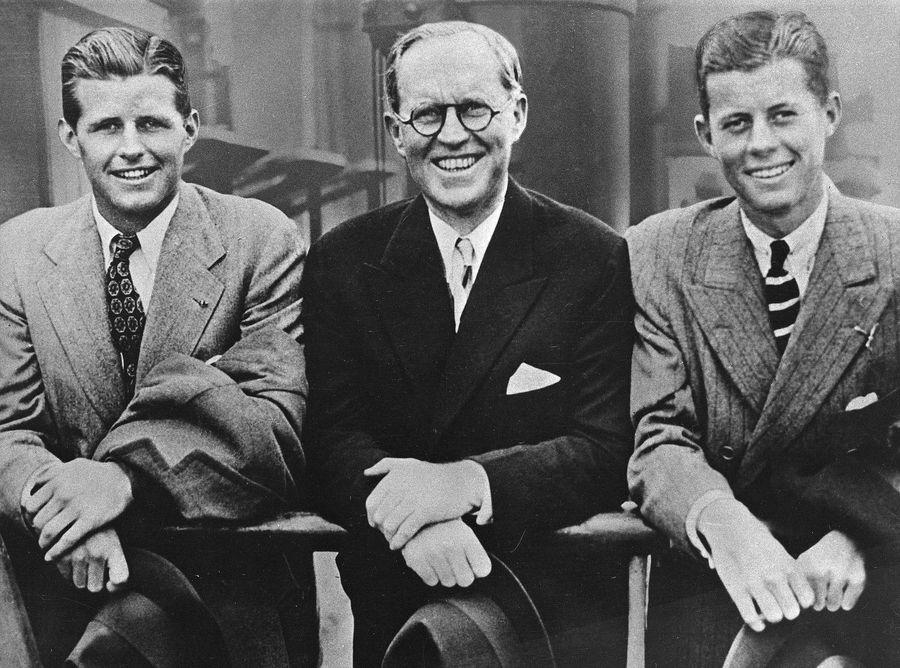
John F. Kennedy, Joseph P. Kennedy
Cutting Into the 'Natural Order of Things'
Published Aug. 12, 2022 • Read time: 5m
Join the Conversation
0It’s Friday, the day of the week when I like to pass along a quotation intended to be uplifting or enlightening. Today’s words, poignant and sad, serve as a reminder of the cost of war, especially to families of the fallen. They come from John F. Kennedy, years before he became commander in chief, in a touching observation about his older brother Joe.
Most U.S. presidents have believed that national interests sometimes require military action in the cause of freedom. In his State of the Union address to Congress on January 6, 1941, nine weeks after assuring America’s mothers and fathers that their “boys are not going to be sent into any foreign wars,” Franklin D. Roosevelt delivered a more ominous message:
I find it unhappily necessary to report that the future and the safety of our country and of our democracy are overwhelmingly involved in events far beyond our borders.... No realistic American can expect from a dictator’s peace international generosity, or return of true independence, or world disarmament, or freedom of expression, or freedom of religion – or even good business. Such a peace would bring no security for us or for our neighbors. Those who would give up essential liberty to purchase a little temporary safety deserve neither liberty nor safety.
This was the address in which Roosevelt articulated what he called the “Four Freedoms” – freedom of expression, freedom of worship, freedom from fear, and freedom from want, “everywhere in the world.”
Rethinking the Pledge; Trump and Women; One Last Egg Roll; Eulogizing Ike
2016: A Repeat of the 1960s
An Apology, Fashioned for Nancy Reagan
Nancy Reagan, Guardian of a Legacy
It was that evocative phrase, everywhere in the world, repeated after the enunciation of each “freedom,” that gave the speech its loft and rhetorical power. FDR’s call was answered, in time, by 18 million Americans, among them Joseph P. Kennedy Jr., and his younger brother John, who served heroically in the South Pacific and who would succeed the supreme allied commander, Dwight D. Eisenhower, in the White House.
John F. Kennedy espoused and epitomized the values of a generation that had seen its nation attacked and assumed the necessity of protecting liberty on foreign shores. President Kennedy’s 1961 inaugural address became the gold standard for interventionist rhetoric among 20th century presidents. The United States, JFK told the world, would “bear any burden, support any friend, oppose any foe to assure the survival and success of liberty.”
On December 10, 1898, the Spanish-American war officially ended with a cease-fire bringing independence to Cuba, and with Spain ceding Guam, Puerto Rico, and the Philippines to the United States. The short and decisive armed conflict, which began in April of that year, was effectively over by the mid-July surrender of Santiago de Cuba, ending Spain’s reign as a colonial power in this hemisphere and signaling the rise of American international influence.
“[A] splendid little war,” Secretary of State John Hay wrote to Theodore Roosevelt, “begun with the highest motives, carried on with magnificent intelligence and spirit, favored by that Fortune which loves the brave.”
In truth, neither fates nor fortune always favor the brave, which was underscored in 1944, when U.S. Navy aviators Joseph P. Kennedy Jr. and Wilford John Willy volunteered for a highly dangerous, top-secret mission to attack German V-2 rocket launching sites in France.
The Allies had no rockets of their own, so in a desperate gambit, aging B-24s were loaded with volatile explosives and directed, in a precursor of today’s unmanned drones, by radio signals. But because the bombers couldn’t get off the ground on their own, two-man crews were to get them airborne and then parachute out of the cockpit.
On the evening of August 12, 1944, the Kennedy-Willy airplane exploded minutes after takeoff with both pilots still aboard. The sheer gallantry of those two men takes your breath away, although the officers who authorized such a dangerous scheme would probably be court-martialed today. In any event, in mere seconds the oldest Kennedy scion, handsome as a movie star, brave as they come, and groomed for greatness, was dead at age 29.
When he heard the news, his younger brother John, known to family and friends as “Jack,” was recuperating in Chelsea Naval Hospital from injuries suffered when his PT boat was sunk in the Pacific. Jack knew intuitively what his brother’s death meant for him: Their father, Joseph P. Kennedy Sr., had told the local newspapers upon the birth of his oldest son that Joe Jr. would grow up to be America’s first Roman Catholic president. “Now,” Jack confided to a friend, “the burden falls on me.”
First, however, he created a memorial book for his family, “As We Remember Joe.” In it, Jack Kennedy wrote about his older brother, “His worldly success was so assured and inevitable that his death seems to have cut into the natural order of things."
In a sense this is true when any mother or father buries one of their children, a reminder not only of the debt owed to all Gold Star families, but also of the loss anyone feels when they lose a child or a sibling.
And it’s our quote of the week.

Newsom Defies Voters, Juries and Lawmakers To Spare Murderers While Defending Abortion
Curtis Hill • RealClearPolitics
The Algorithmic Tilt
Frank Filingeri • RealClearPolitics
A RealClear Thanksgiving: Investing in a Better Future
David DesRosiers • RealClearPolitics
Trump’s Newsom Problem: Antagonist-in-Chief
Carolina Lumetta • RealClearPolitics
America’s Free Spirit
John Maxwell Hamilton • RealClearPolitics
The GOP Majority Should Go Out in Glory
Daniel McCarthy • RealClearPolitics
RCP Today
Top stories on RealClearPolitics
The Takeaway
Polling intelligence and analysis delivered to your inbox
World News
Featuring the latest world news
Policy
Featuring the latest policy news
Support Our Mission
As part of RealClearPolitics, authors aim to provide balanced, non-partisan analysis by presenting top reporting and commentary from all sides of the political spectrum.
Trusted by policymakers and citizens alike since 2000