
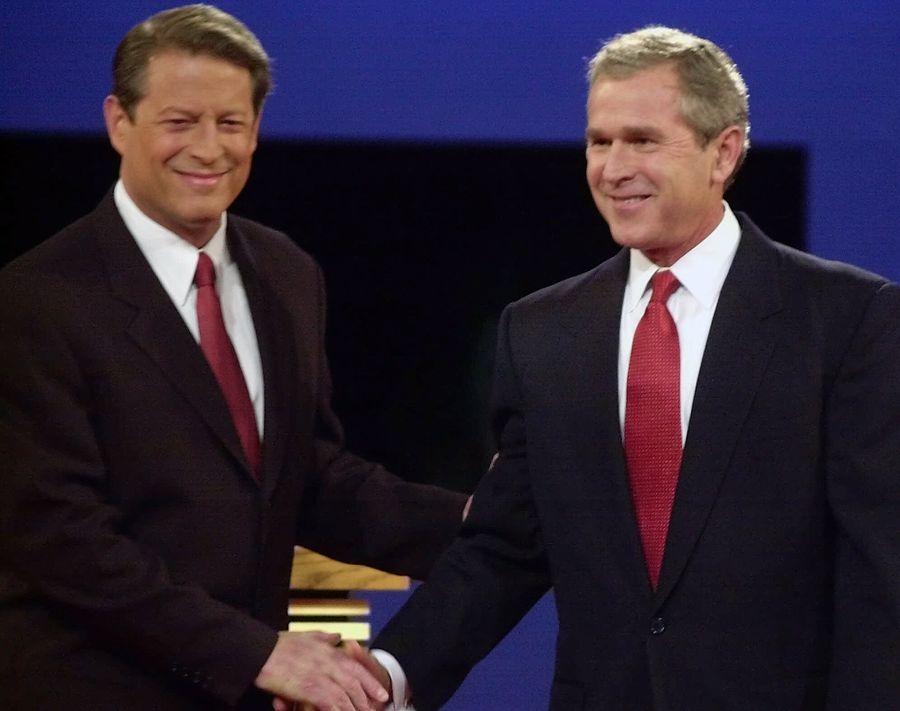
GORE BUSH DEBATE 2000
Al Gore Could Have Won in 2000 Without a Single Additional Vote
ANALYSIS
Published Oct. 31, 2026 • Read time: 4m
What if Al Gore had won the presidential election of 2000 without receiving a single additional vote?
It sounds implausible. After all, the election was decided by a bitter recount in Florida, culminating in a Supreme Court decision that effectively secured George W. Bush’s victory. But there is another way the election could have produced a different winner – one that has nothing to do with hanging chads, butterfly ballots, or disputed votes.
The answer lies in a mathematical formula used to distribute seats in the U.S. House of Representatives.
Every 10 years, the federal government counts the population and reapportions the 435 seats in the House among the states. The Constitution requires this process but does not specify the mathematical formula for carrying it out. Congress has used several methods over American history, each of which translates state populations into congressional seats somewhat differently.
These differences matter because each state’s electoral votes equal its number of representatives plus its two senators. Change the distribution of House seats, and you change the distribution of electoral votes – even if no one changes how they vote.
In 2000, Bush won the Electoral College by a razor-thin margin, 271 to 266, with one elector abstaining. The allocation of electors was based on the Hill-Huntington method, which Congress adopted in 1941.
But suppose Congress had used Jefferson’s method, named for Thomas Jefferson, instead. Jefferson’s method generally favors larger states, giving additional representation to populous states such as California and Texas. Applying that method to the same population figures, while holding state election results constant, would have given Gore 270 electoral votes and Bush 267.
Gore would have become president without changing a single vote cast by the public.
Even more remarkably, another method – Hamilton’s – would have produced a third outcome. Neither Bush nor Gore would have received a majority of the electors. Under the Constitution, the House of Representatives would have selected the president, with each state delegation receiving one vote.
The same voters, the same candidates, the same election results. Three different outcomes, depending on the mathematical rule used to distribute congressional seats.
This is not merely a curiosity about the 2000 election. In “Shifting Seats: The Congressional Apportionment Game,” I examine how apportionment has shaped political power throughout American history.
For example, apportionment shaped many of the struggles over slavery and representation. The Constitution’s Three-Fifths Clause counted enslaved people as three-fifths of a person for apportionment, increasing the representation of slaveholding states even though enslaved people could not vote.
My calculations show that without this provision, John Adams would have defeated Thomas Jefferson outright in the election of 1800, rather than leaving the decision to the House of Representatives. The implications for American history are difficult to overstate.
Of course, changing an apportionment rule, or metric of apportionment, does not usually change the winner of a presidential election. Across 59 elections examined in my book, alternative apportionment methods would have changed the winner only twice. Eliminating the Three-Fifths Clause would have affected only one or possibly two elections out of 18. Most elections simply are not close enough for relatively small shifts in electoral votes to matter.
But the rarity of these outcomes makes them no less important. Indeed, it raises a deeper question: Why have politicians fought so fiercely over apportionment rules when their consequences for the electoral college are typically modest?
The answer is that congressional seats translate into political power. They determine which states have greater influence over legislation, which constituencies gain or lose representation, and occasionally which party controls Congress or wins the presidency.
The struggle over those seats has repeatedly produced surprising political outcomes. Following the 1920 census, Congress failed to reapportion the House for nearly a decade, largely because representatives from states that stood to lose power resisted change. When Congress finally acted in 1929, it fixed seats at 435 and established the automatic reapportionment process, largely to avoid such infighting. That number remains in place today.
Americans rightly pay close attention to elections, campaigns, and voting rules. But we devote far less attention to the mathematical formulas that determine how political representation is distributed before an election even begins. Those formulas may appear neutral, technical, and inconsequential. However, history tells a different story.
Sometimes the path to the White House begins not at the ballot box, but with the mathematics of congressional apportionment.
Support Our Mission
The Internet provides an endless stream of content. Not all of it is worth your time. That's why, every day, RealClearPolitics curates the most essential news and information—from all sides and across mediums. The links, videos, and podcasts curated here are the product of human judgment, not algorithms or AI. Please help power our mission of presenting a thoughtful, balanced public discourse through a tax-deductible donation.
Would you consider supporting us today?
Contributing to RealClear Politics through the RealClear Media Foundation supports essential initiatives that drive meaningful change.






RCP Today
Top stories on RealClearPolitics
The Takeaway
Polling intelligence and analysis delivered to your inbox
World News
Featuring the latest world news
Policy
Featuring the latest policy news
Support Our Mission
As part of RealClearPolitics, authors aim to provide balanced, non-partisan analysis by presenting top reporting and commentary from all sides of the political spectrum.
Trusted by policymakers and citizens alike since 2000