
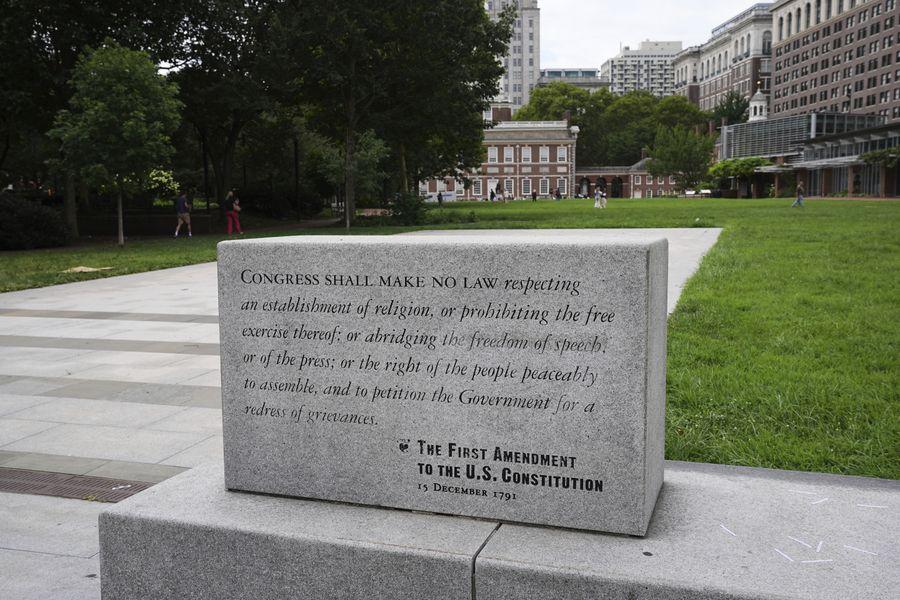
Independance Mall
The Founders' Vision Was Religious Liberty for All
COMMENTARY
Published Nov. 9, 2026 • Read time: 7m
The First Amendment’s Establishment and Free Exercise clauses seem clear: They guarantee the free exercise of religion while prohibiting the state from endorsing a particular religion. In the words of the late Antonin Scalia, “The state may not discriminate among religions, and a favor available to one must be made available to all.”
Yet some on the far right are shifting away from this widely accepted interpretation. Bo French, 2026 Republican nominee for Texas Railroad Commissioner, posted a photo of Muslims praying and asked, “When the Founders drafted the First Amendment, did they mean different variations of Christianity or all ‘religions?’” Others say that the First Amendment was written only with various Christian denominations in mind, and that the Founders meant for the First Amendment to protect only the free exercise of Christian faiths.
This group has attached themselves to a reactionary view of our founding. We cannot afford to compromise on religious liberty. It is time to reject the ahistorical idea that the First Amendment doesn’t protect all faiths and emphasize that the Founders would not be members of the Christian Nationalist Right, but were visionaries who envisaged a republic of religious liberty.
The religious freedom clauses of the First Amendment trace their roots to the Virginia Statute for Religious Freedom, drafted by Thomas Jefferson in 1777 and passed by the Virginia legislature in 1786. During the debate over the statute, some in the chamber proposed inserting the phrase “a departure from the plan of Jesus Christ, the holy author of our religion” to clarify that Virginia is a Christian state with a Christian government. The inserted clause found little support among state representatives and, in the words of Jefferson, “... was rejected by a great majority, in proof that they meant to comprehend, within the mantle of its protection, the Jew and the Gentile, the Christian and the Muslim, the Hindu, and infidel of every denomination.”
James Madison, a fellow Virginian and an ardent supporter of the statute’s passage, the Virginia law to draft the religious freedom clauses of the First Amendment. There was no question about the intent of the First Amendment in Madison’s eyes; his first draft of the religious freedom clauses made that quite clear: “The civil rights of none shall be abridged on account of religious belief or worship, nor shall any national religion be established, nor shall the full and equal rights of conscience be in any manner, or on any pretext, infringed.” The federal government, and later the state governments, were to be neutral on the matter of religious differences and permit the exercise of all faiths.
But this Madisonian promise of religious liberty was not just a parchment guarantee; it was a blessing. The individual’s conscience to worship as they believed was meant to be a sacred labyrinth, untouched by the state. Madison, in response to attempts to have Virginia establish a state church, said, “that Religion or the duty which we owe to our Creator and the manner of discharging it, can be directed only by reason and conviction, not by force or violence.” He articulated that the nation could not be a bastion of virtue if said virtue was forced upon the conscience of its citizens. The citizenry must be virtuous on their own. But could a virtuous citizenry only be achieved through government coercion? That certainly fits the Christian Nationalist notion of religious freedom, wherein Christ stands as the only path to virtue.
Some Christian Nationalists cite John Adams in their defense. “Our Constitution,” Adams says, “was made only for a moral and religious people. It is wholly inadequate to the government of any other.” But Adams also helped author the 1780 Massachusetts Constitution, which said, “And no subject shall be hurt, molested, or restrained … for worshipping God in the manner and season most agreeable to the dictates of his own conscience.” It is clear that Adams did not believe “a moral and religious people” exclusively meant “a Christian people.”
Moreover, President Washington makes no mention of Christian morality in describing the citizenry. For him, the only requirement for an American, Christian or non-Christian, was to fashion themselves as good citizens. His famous missive to the Hebrew Congregation of Newport states, “For happily the Government of the United States, which gives to bigotry no sanction, to persecution no assistance requires only that they who live under its protection should demean themselves as good citizens …” The exact meaning of “good citizen” is up for historical debate, but Washington did not send this letter to a Jewish congregation by accident. Being a good citizen in his eyes did not require being Christian. The Founders methodically outlined a resonant Republic with a moral citizenry and religious freedom; the two are not mutually exclusive.
Three decades after the First Amendment’s ratification, the commitment to religious liberty endured. All states had abolished their state churches in accordance with Madison’s vision (later being bound to said abolishments by the 14th Amendment). However, the Founders’ resonant Republic faced new opposition. In 1827, famed Pastor Ezra Ely proposed a different vision for America. He called for a Christian Party to form to prevent pagans and Muslims from holding political office. In his America, Christianity would be an essential part of America’s politics.
But President Andrew Jackson did not concur. He reaffirmed the Founders’ view that America was not a Christian nation, stating that “Among the greatest blessings secured to us under our Constitution, is the liberty of worshipping God as our conscience dictates.”
The historical record could not be more clear. So then why the rise of influencers who say that the Founders actually wanted to restrict religious freedom? It comes from the notion that the more archaic or bigoted a view is, the more it must align with what the Founders thought. Our temporal distance from the Founders renders this view plausible to some. From leftists calling the Founders bigots and edgy Christian Nationalists embracing the insult, we risk slowly gravitating to the idea that perhaps the revisionist accounts of our history are correct. We may begin to assume that the Founders had very limited knowledge of other religions or even the basic idea of religious toleration.
But while time may render the Founders’ principles far more susceptible to modern ideological distortion, the reality is that their words do not simply vanish. Our Founders were not simple-minded bigots whose view of liberty was lesser than the Empire they just gained independence from. The Founders were not ignorant of other faiths nor did they deliberately exclude them from protection. Neither did they ever believe a Jew, Muslim, or Hindu were any less American because of who or how they worship. The modern group of Christian Nationalists is attempting to distort our history to advance a constitutional interpretation detached from America’s very creed.
Setting the precedent that the state can disparage one faith while praising another would transform America in the image of Pastor Ely rather than James Madison. Our contemporary version of religious freedom is rooted so deeply in the minds of our Founders that abandoning it would be a rejection of what America was supposed to be. Let’s reassert the tradition of Washington, Jefferson, and Madison as the only tradition that governs our interpretation of religious freedom and the First Amendment.
Support Our Mission
The Internet provides an endless stream of content. Not all of it is worth your time. That's why, every day, RealClearPolitics curates the most essential news and information—from all sides and across mediums. The links, videos, and podcasts curated here are the product of human judgment, not algorithms or AI. Please help power our mission of presenting a thoughtful, balanced public discourse through a tax-deductible donation.
Would you consider supporting us today?
Contributing to RealClear Politics through the RealClear Media Foundation supports essential initiatives that drive meaningful change.






RCP Today
Top stories on RealClearPolitics
The Takeaway
Polling intelligence and analysis delivered to your inbox
World News
Featuring the latest world news
Policy
Featuring the latest policy news
Support Our Mission
As part of RealClearPolitics, authors aim to provide balanced, non-partisan analysis by presenting top reporting and commentary from all sides of the political spectrum.
Trusted by policymakers and citizens alike since 2000