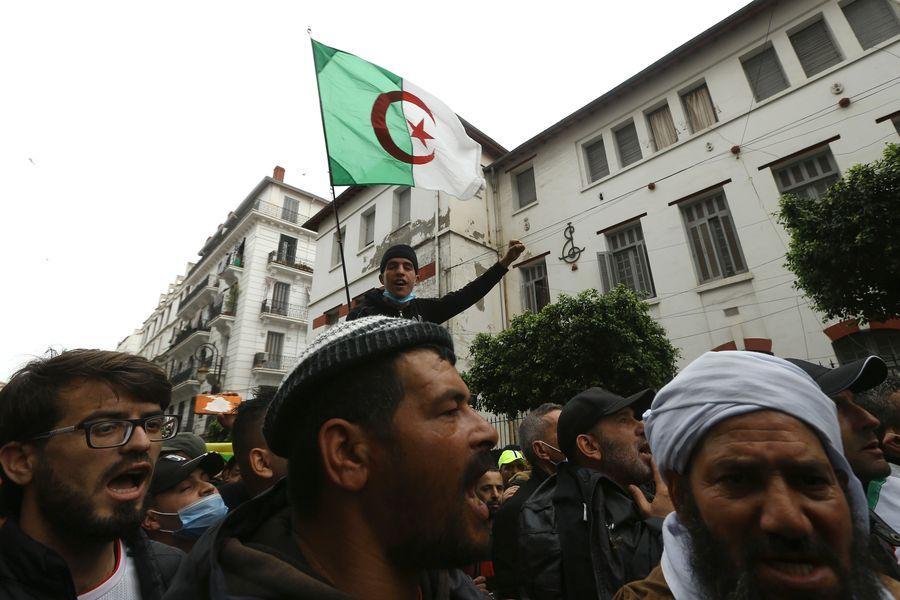
Algeria Protest
Religious Freedom Failures in Algeria Must Be Addressed
COMMENTARY
Published Sept. 10, 2023 • Read time: 5m
In 2022, after several years of Algerian authorities systematically raiding and closing Protestant churches; harassing and arresting Ahmadis, Sufis, Christians, and other religious “free thinkers”; and denying basic equality to its various religious communities; Algeria was placed on the State Department’s Special Watch List (SWL). This means that according to the analysis of the U.S. Commission on International Religious Freedom and State Department experts, between 2021 and 2022, Algeria’s government “engaged in or tolerated severe violations of religious freedom.” The designations are soon to be up for review, and regrettably, Algeria must remain on the SWL. They must remain on the list for the sake of the communities that would otherwise feel betrayed and abandoned. They must remain on the list to avoid extending to Algerian authorities a sense of impunity despite their persistent offenses. They must remain on the list in order to maintain the credibility of U.S. diplomacy.
No improvements have been made to the religious freedom landscape since the SWL designation was published, so there should be no change to the State Department’s posture. In 2023, police conducted a raid and confiscated Bibles and other materials of Christian devotion. Also this year, authorities ordered and pressured three additional churches to close. In one province, no churches remain open. In January 2023 alone, Algerian authorities interrogated, summoned, and charged at least 10 Christians. In one interrogation, police disclosed that the authorities plan to close all Protestant churches in the country. Many countries around the world already think that human rights are just a tool by which the West imposes its dominion. When the United States deprioritizes human rights at will, it only serves to reinforce that dangerous impression.
An Easter Lesson in Judging Not
Is ISIS Faithful to Islam?
Press Club Welcomes Rezaian Back Home
Hostility to Tradition
Algeria’s violations are not particularly dramatic or violent, which is why Algeria is on the SWL rather than being classified as a Country of Particular Concern. The approach taken by the Algerian authorities, in common with other rights-violating nations in North Africa, is to engage in repressive activities so mundane that they avoid provoking excitement and outrage. The Religious Freedom Institute is one of the organizations that has been monitoring and reporting on Algeria’s violations. Algeria’s government refuses to grant the status of a religious association to minority religious communities. They withhold required permits to places of worship. They block the importation of Bibles and other Christian materials. Police harass their citizens and subject them to lengthy interrogations. They pursue prosecutions based on repressive legislation such as the 06-03 Ordinance Governing Non-Muslim Worship. These violations are not sensational. Nevertheless, the repression is egregious and the impact is effective. Death by a thousand cuts. Forty-three out of the 47 Protestant churches have been shuttered during Algeria’s patient, insidious campaign of repression, waged since 2006 but intensified towards the end of 2017. Perhaps they’ll leave just one open to avoid the staggering headlines should they succeed in their complete destruction of the Christian Church within their borders.
Diplomacy is a tricky task. It is not easy to balance securing strategic wins on matters of trade or security while simultaneously doling out criticism about the host government’s assaults on democracy and human rights. However, religious freedom should be a foreign policy priority for both pragmatic and humanitarian reasons. Religious freedom addresses a vital concern regarding a human being’s most essential rights to equality before the law, to peace and dignity, and to freedom from persecution on account of one’s religious identity or convictions. It is also an important feature of secure and stable nations, reducing the likelihood that they will be exporters of terrorism or drivers of mass migration. It is a feature of countries with higher levels of economic and societal stability. Religious freedom is also a strong indicator of whether a nation will prove to be a reliable partner in bilateral and multilateral relationships.
It would have cost Algeria little or nothing politically, financially, or socially to make improvements. To their credit, U.S. and British representatives of the International Religious Freedom and Belief Alliance visited Algiers last year to raise their concerns, and the respective embassies have made efforts to encourage improvements. The Algerian Government only has to gain by getting the international community off their case. It is likely that Algeria could have avoided redesignation on the SWL simply by granting the association status to the Protestant Church of Algeria and the Ahmadiyya community. Given the diplomatic inclination to celebrate any kind of positive movement, Algeria almost certainly could have dodged the West’s rebuke if it showed it was on a path to a minimum civilized standard. In spite of the likely low bar, Algeria’s government has not budged an inch, remaining entrenched and impervious to the encouragements of international bodies, envoys, and ambassadors.
Failure to find the right balance in diplomatic engagement is challenging. However, if there’s any move to reward Algeria’s persistent abuses by upgrading their status, U.S. diplomats will be jeopardizing the safety of Algeria’s religious communities, leaving vulnerable groups feeling betrayed and exposed. Unjustified improvements to Algeria’s status would also undermine the integrity of U.S. diplomacy and render America’s own religious freedom designations utterly redundant.

Newsom Defies Voters, Juries and Lawmakers To Spare Murderers While Defending Abortion
Curtis Hill • RealClearPolitics
The Algorithmic Tilt
Frank Filingeri • RealClearPolitics
A RealClear Thanksgiving: Investing in a Better Future
David DesRosiers • RealClearPolitics
Trump’s Newsom Problem: Antagonist-in-Chief
Carolina Lumetta • RealClearPolitics
America’s Free Spirit
John Maxwell Hamilton • RealClearPolitics
The GOP Majority Should Go Out in Glory
Daniel McCarthy • RealClearPolitics
RCP Today
Top stories on RealClearPolitics
The Takeaway
Polling intelligence and analysis delivered to your inbox
World News
Featuring the latest world news
Policy
Featuring the latest policy news
Support Our Mission
As part of RealClearPolitics, authors aim to provide balanced, non-partisan analysis by presenting top reporting and commentary from all sides of the political spectrum.
Trusted by policymakers and citizens alike since 2000