
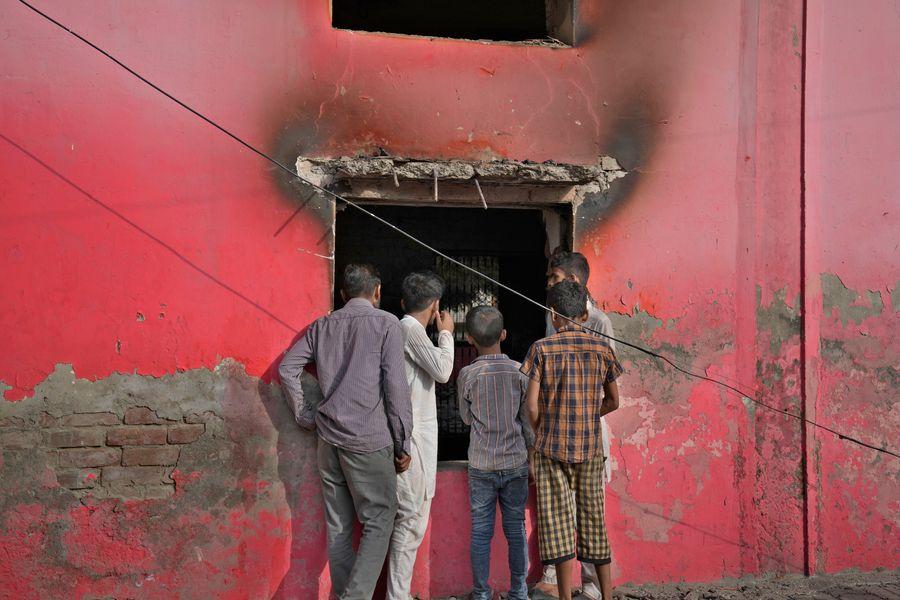
Pakistan Churches Attacked
Pakistan's Supreme Court Chief Justice Addresses Religious Persecution
COMMENTARY
Published Oct. 21, 2023 • Read time: 13m
“It was unbelievably hot. The smell of burnt debris was terrible. It was a traumatic and emotional experience. It really affects one. I still have the smell of burning in my head,” recounted Qazi Faez Isa, the newly appointed Chief Justice of the Supreme Court of Pakistan. On the morning of Aug. 16, 2023, a violent mob ransacked and set ablaze the homes and churches in the Christian neighborhood of Jaranwala, a provincial city about 70 miles from the provincial capital, Lahore. The allegation, as has become painfully predictable in Pakistan, was that two men had desecrated the Qur’an, and therefore it was open season upon the Christian community in the city. Some 89 homes and 22 churches were gutted by the mob. I was in conversation with Chief Justice Isa right after the attack, and I had the opportunity to listen to his initial reactions and to follow his journey as a thoughtful and faithful Muslim to travel to the site and to express care and concern for the victims, and to decry these heinous attacks. My hope is that presenting his reflections and the heart of our conversation will offer some insight into the complexities surrounding religious violence in Pakistan and the seeming intractability of the country’s infamous blasphemy laws.
To place this in context, it is important to recall that Pakistan inherited the “blasphemy laws” from the British. As I explored in greater detail in Review of Faith & International Affairs, the law was first added to the penal code in 1860 and was later expanded in 1927 as Section 295, the Hate Speech Law, which stands today. This was instituted following the highly publicized murder of a Hindu named Mahashe Rajpal due to his writings, which were deemed offensive to the Muslim community in the Punjab. The law made it a criminal offense to volitionally and maliciously insult the founders or leaders of any religious community. It was put in place to protect communal harmony and to temper public discourse on sensitive subjects of religion. Over time, two additional clauses have been added. The first (section b) in 1982 specified the defilement of the Qur’an as punishable by life imprisonment. The second (section c), added in 1986, specified that any derogatory remark pertaining to Muhammad or any of the prophets was punishable by death. The penal code also added Section 298, which forbade the identification of the Ahmadi sect with the religion of Islam and forbade their use of Islamic terms and the propagation of their belief. Though this offense carries a penalty of three years imprisonment, it has also provoked extra-judicial killings of some 75 people.
An Easter Lesson in Judging Not
Is ISIS Faithful to Islam?
Press Club Welcomes Rezaian Back Home
Hostility to Tradition
Within this highly contentious sphere, one important note of progress was seen in the 2017 amendment to the Criminal Law Act, which enhanced the punishments for false accusations from one to seven years to deter the law’s abuse. So, if someone makes false accusations, there are repercussions. This was a positive step, but alas, the political wheels are now turning in the wrong direction. In January 2023, the National Assembly passed a controversial bill that increased the punishment from three years of imprisonment to life imprisonment, or not fewer than 10 years (under section 298-A), for insults to the companions and family of the Prophet of Islam and the first four Caliphs. The amendment clearly targets Shia Muslims. It was passed in the Senate in August 2023 and now awaits the president’s signature.
The blasphemy laws were designed to protect communal harmony and undergird the vision for a pluralistic society where persons of any faith could freely practice their religion without fear, but over time, these have become weaponized as a cudgel to silence dissent and to intimidate minority communities. Between 1987 and 2017, for example, some 1,500 people were charged with blasphemy. Many of those accused, including their lawyers and any persons speaking against the laws or case proceedings, have become victims of lynching and street vigilantism.
According to the U.S. Commission on International Religious Freedom, around 80 people are known to be incarcerated in Pakistan on blasphemy charges. Half of these face either life in prison or the death penalty. It is also vital to note that Sunni Muslims constitute by far the largest group of those accused. It is often the case that these laws have been exploited as a means to intimidate or settle personal rivalries. The issue has become so contentious, as will be further discussed below, that even an attempt to recalibrate the laws is itself regarded as an act of blasphemy. This colonial “inheritance” has not prospered in Pakistan, and as financial pressures and political turmoil continue to mount, it is likely that atrocities such as those committed in Jaranwala will continue.
In the evening prior to his visit to the battered Christian neighborhood of Jaranwala on Saturday, Aug. 19, 2023, Chief Justice Isa recalled a strange silence in the media. “I skipped through the channels to see what was being discussed and to get some background information. There are scores of national news outlets now in Pakistan, but nothing was there. It was on the news right when it happened, but then it disappeared. And when we met the Christian families I asked them if anyone had come to see them and to help. They said no one from the government, apart from some local police on duty had come at all.”
When I asked the reason for this, the Chief Justice said, “Fear. They were afraid of accusations and repercussions.” There is a broadly held perception today that the attacks were purposefully instigated, and that to become entangled therein was dangerous. Chief Minister Mohsin Naqvi, head of the provincial government, similarly viewed the attack as a “planned conspiracy” to “light fire in the country and sabotage its peace.” Naqvi was referring to the involvement of TLP (Tehreek-e-Labbaik Pakistan) in coordinating the Jaranwala arson, as they have done before, to increase their standing in the upcoming elections. The TLP platform is to defend the honor of the Prophet at any cost, and the party has held multiple rallies since the attack and made speeches exonerating the mob as “overwhelmed by their sentiments,” and placing the blame upon international culprits, particularly countries like Denmark and France where legal structures have allowed the desecration of the Qur’an. Groups like the TLP feed upon the sense of injustice against Muslims in the West and also in India and China. TLP numbers continue to swell in Punjab, and many interpret the attack on Christians in Jaranwala as a show of force in preparation for elections in the coming year.
The rise of the TLP did not occur in a vacuum. Rather, it became the focal point for the Honor of the Prophet Movement (Namus-e risalat) that galvanized the masses following the execution of Mumtaz Qadri in 2016. Qadri was the security officer who assassinated the governor of Punjab, Salman Taseer, for his support of Asia Bibi and his call for changes in the blasphemy laws. Conspiracy theories abound surrounding Taseer’s murder, but the popular movement that arose in Qadri’s support is undeniable. The outcry is interpreted in many quarters as a harbinger of political change. It is a warning to the ruling parties who have not delivered on the basics of food, housing, and employment. In a country founded upon Islam and intended as a homeland for Muslims, an appeal to the Prophet is enough to bring together large constituencies that might disagree on countless other issues, such as religious freedom and the rights of minorities. The attack in Jaranwala, in this context, is but another opportunity to mobilize the base and stir their anger at the deplorable circumstances in which they live.
Amidst the turmoil in the government, which has dominated headlines in the past year, and the lawlessness of this particular act of mob violence, leaders were afraid to do anything that would signal opposition to those demanding forceful reprisals upon any who dare to disparage the honor of the Prophet, which is expressed most egregiously in the desecration of the holy book. This was the danger, as Chief Justice Isa recalled, that gave pause to many who would otherwise have expressed concern and solidarity for an entire community in Jaranwala that was punished for the alleged misdeeds of two of its members.
“I didn’t know that by going there in person it would open the way for many others,” Isa recalled. “But because I went on the 19th, every channel in Pakistan had it on. At least we got back the narrative.” Other than the local bureaucrats, no other senior government official had visited the site, though it was only an hour away from Lahore or Faisalabad. No one wanted to take the first step. It was a dangerous pause, the moment for counting the cost and bearing the reprisals that can come from speaking out against those who take the law into their own hands. “As soon as I read about the attack, I knew we had to do what any good neighbor would do and go pay our respects and enquire about their condition,” said Isa, “and this is a sentiment that is natural to any Pakistani.”
The presence of Chief Justice Isa opened the way for others to speak out. This provided the reassurance that one could speak out and engage in the robust sort of public discourse that will be required in the government and society at large to wade through the difficult electoral season ahead. Once the Justice came, a steady flow proceeded in his wake, including leadership from the mainstream parties but also the religious political parties such as Jamaat Islami and Jamiat Ulema-e Islam. Journalists like Saleem Safi brought the story back online, and senior religious figures like Tahir Ashrafi forcefully condemned the violence as unacceptable and contrary to the faith and practice of Islam. The silence was broken, and the public reckoning began.
Isa’s visit to Jaranwala – as he has reiterated – was personal, and this is precisely why it was so powerful. In a highly contested political realm known for soundbites and insincerities, again we see that actions speak louder than words. It is unusual that an incoming Chief Justice would make such a public display of concern, but this again underscores the severity of these issues. What is at stake here is the very notion of the rule of law. Can laws continue to be broken with impunity? Are honor killings or other forms of vigilante violence acceptable in the name of religion? For once, there seems to be an unequivocal “no” rippling through the airways and alleyways. Whether this will last remains to be seen. Yet it is in those brief moments of hesitation that a nation can find its moral compass, and listen to the inner voice of reason, and find again the heart of courage to speak up and step out as Chief Justice Isa so humbly and faithfully modeled.
There are legal issues to be addressed by the Supreme Court, but at the heart of these matters is the question of national solidarity. Religiously sanctioned violence has become all too common. These are politically motivated attacks against minority communities such as the Ahmadiyya, Hindus, and Christians in Pakistan, ones who cannot retaliate. But what will happen if such attacks are perpetrated against larger groupings such as the Shia, as has been the case, or against a competing sect among the Sunni? The proposed amendment to the Criminal Act brings the historic divisions between the two largest Muslim communities in the land, the Sunni and the Shia, into the realm of litigation. Some of the most heated intra-Muslim exchanges pertain precisely to“insulting the Prophet Mohammed’s companions, wives, and family members,” as brought forward in the amendment. Rather than strengthening communal harmony, again we see poorly conceived legislation that is liable to be weaponized by opponents, that will be injurious to families and neighborhoods, and that will place undue burdens upon the police and judicial systems. The instrumentalization of these laws and the persistence of such an abuse of power threatens the rule of law and undermines the nation’s moral core.
The U.S. State Department has designated Pakistan as a “country of particular concern” and has called for a binding agreement, as authorized under the International Religious Freedom Act, with the Pakistani government to improve religious freedom conditions in the country. Now is the time for Pakistani leadership to take action on these issues and to chart a pathway forward. It is of national interest to make a careful and focused review of the pertinent laws. In the meantime, there should be a clear mandate to train national and regional officials, including the police and judiciary, on ways to assure the safety and health of those awaiting resolution of allegations, to clarify norms for a fair and timely trial for the accused, and to provide stiff punishment for those who misuse the law and falsely defame and injure others.
In policy studies, religious violence in Pakistan qualifies as a “wicked problem” in that the circumstances are complex and resolution is inextricably related to social, historical, political, and economic factors that government policy alone cannot remedy. The problem is tied to the manifold pressures of poverty, disease, and political uncertainty. This is not to excuse in any way the actions of those who fomented the violence, but rather to say that such incidents do not provide a composite picture of the people and society of Pakistan.
On the day of his visit to Jaranwala, Chief Justice Isa issued a formal statement that simply quoted and restated the clear and specific guidance from the Qur’an and Hadith, and from Islamic tradition, on the care and attitudes required of Muslims toward those of other religions living in their vicinity. In it he stated, “Those attacking churches violate the clear directions of the Holy Qur’an, disobey the instructions of Prophet Muhammad (peace and blessings be upon him) and disobey the enlightened examples of the rightly-guided caliphs. Such grave violations of the Islamic way (shariah) can also not be justified on account of revenge or retribution for any alleged offense.” In Pakistan, there is a law against such behavior, and the perpetrators now must be brought to justice, reparations made, and assurances provided to the community that such behavior will not be tolerated. As Chief Justice Isa concluded, the directive is undeniable and actionable: “It is the religious duty of every Muslim to safeguard their inalienable right to worship, their moveable and immoveable properties, and the places of worship of non-Muslims, and if they come under attack to come forward to protect them.”
Attacks like that in Jaranwala have become all too common, and one fears that there are more to come. In the meantime, every effort must be made to strengthen the rule of law in Pakistan and to support those who work for good.

The GOP Majority Should Go Out in Glory
Daniel McCarthy • RealClearPolitics
Republican Majorities Could Return Sooner Than Expected
J.T. Young • RealClearPolitics
The Danger Before the Attack
Leslie J. Sullivan • RealClearPolitics
Jon Finer’s Old and Dangerous ‘New Approach’ to Israel
Peter Berkowitz • RealClearPolitics
The President Deserves Better
John Ullyot • RealClearPolitics
Congress Doesn’t Need Another Blame Game. It Needs To Find What’s Broken
Jarrod Bernstein • RealClearPolitics
RCP Today
Top stories on RealClearPolitics
The Takeaway
Polling intelligence and analysis delivered to your inbox
World News
Featuring the latest world news
Policy
Featuring the latest policy news
Support Our Mission
As part of RealClearPolitics, authors aim to provide balanced, non-partisan analysis by presenting top reporting and commentary from all sides of the political spectrum.
Trusted by policymakers and citizens alike since 2000