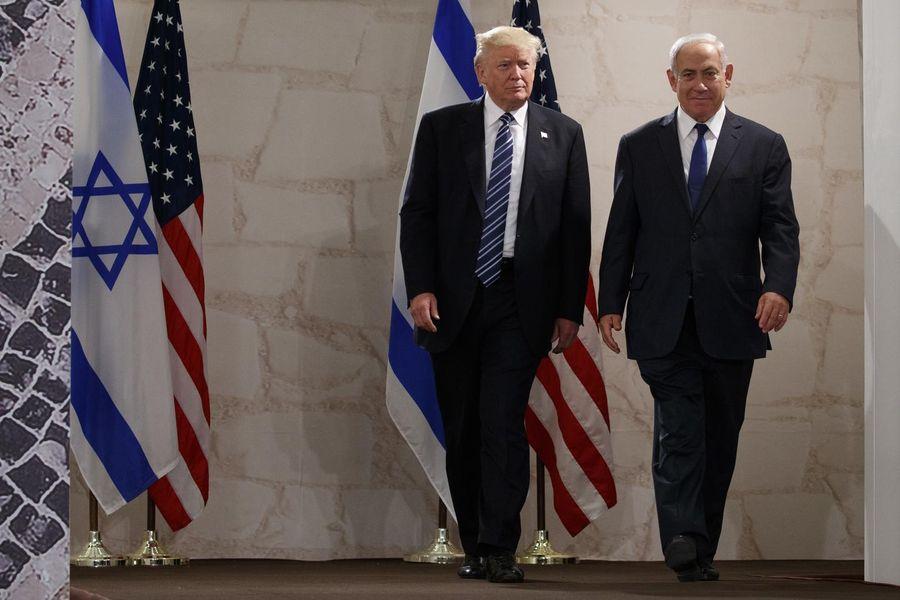
Israeli Prime Minister Benjamin Netanyahu and President Donald Trump arrive for a speech at the Israel Museum, Tuesday, May 23, 2017, in Jerusalem. (AP Photo/Evan Vucci)
Why Mideast Peace Ambitions Must Be Dialed Back
Commentary
Published June 17, 2017 • Read time: 6m
Join the Conversation
0TEL AVIV—President Trump’s administration is reportedly drafting a document outlining principles to guide negotiations between Israelis and Palestinians. The laudable aim is to bring their protracted conflict to an end.
Trump has called this the “ultimate deal.” Having promised to be a disruptive president who would cast aside Washington’s worn-out approaches and failed policies, he appears to have set his sights on the great white whale of the American foreign policy establishment—and of the international community.
Instead, Trump ought to truly break with his predecessors by abandoning the ambition to achieve a final and comprehensive peace. But he should not abandon the Israelis and the Palestinians. If—in contrast to Presidents Bill Clinton, George W. Bush, and Barack Obama—he were to pursue a partial and incomplete deal, he would considerably increase the prospects of advancing the interests of both Israelis and Palestinians while restoring American prestige and influence in the region.
In recalibrating its ambitions, the Trump team would benefit, as have Israelis across the political spectrum, from a new book by Micah Goodman. By listening thoughtfully to both sides, he provides an astonishingly succinct and trenchant guide to the complexities of the internal Israeli debate. And in the process of refining the terms in which his fellow citizens understand the Israeli-Palestinian conflict, Goodman—director of the Academy at Ein Prat and a research fellow at the Shalom Hartman Institute in Jerusalem—exposes the debilitating grip of absolute ideologies on the parties and the moral and political superiority of a pragmatic approach to the conflict.
Is Trump Right About NATO?
Over Here: Competence Amid Repulsive Politics
We're Not a Poor Country, Donald
U.S. Officials Say 2 Americans Died in Brussels Attack
Published in Hebrew last month, “Catch 67: The Ideas Behind the Controversy That Is Tearing Israel Apart” shot to the top of the nonfiction bestseller list here. It received enthusiastic endorsements from former Israel Defense Forces Chief of Staff (and retired Lt. Gen.) Gabi Ashkenazi and Rut Gavison, a distinguished professor of law, both associated with the center-left, as well as from retired Gen. Yaakov Amidror, who served as national security adviser to Prime Minister Benjamin Netanyahu and is associated with the center-right. Former Prime Minister Ehud Barak honored the book with a lengthy critique, to which Goodman effectively replied. Let’s hope “Catch 67” is quickly translated into English.
Goodman explores Israel’s searing public debate—which rarely strays far from urgent questions concerning the state’s survival and the principles to which it is dedicated—about the West Bank territories the country captured in defending itself from Jordan’s attack 50 years ago this month in the Six Day War.
The debate, Goodman contends, is marked by a set of paradoxes similar to the one at the heart of the legendary novel “Catch-22.” Joseph Heller’s masterpiece recounts the travails of a World War II U.S. Air Force bombardier who wants to be removed from flying duties because he is insane. The authorities, however, reject his requests on the grounds that avoiding combat missions is rational and hence evidence of sanity.
Israel’s Catch 67, according to Goodman, flows from the disconcerting realization that Israel has good reasons for retaining the West Bank and good reasons for withdrawing. “It has become clear,” Goodman writes, “that the right is correct, but it has also become clear that the left is correct.”
The left argues that Israel cannot remain a Jewish and democratic state while ruling over the West Bank’s approximately 2.5 million Palestinians. Unless it withdraws, Israel will destroy its democratic character by denying them citizenship or, by granting them citizenship it will subvert its Jewish character. The right replies that withdrawal from the West Bank would leave Israel with indefensible borders. Both left and right are persuasive, concludes Goodman: “The withdrawal that saves Israel from one existential threat produces another existential threat.”
The left claims that conquest of the West Bank corrupted and continues to corrupt Israeli morals. The right replies that the territories are not conquered but rather are disputed: Palestinians never had a state; Jordan conquered the territory unlawfully in 1948-1949 during Israel’s War of Independence; and, when Israel tried to return the territories in the immediate aftermath of the Six Day War, Jordan joined other leading Arab states in issuing at Khartoum the famous “Three Nos”—no peace, no recognition, no negotiations. Goodman distills the important truth in each view: The Palestinian people living under Israeli rule are conquered but the land on which they live is not.
Jewish identity also argues powerfully for and against withdrawal from the territories. On one hand, the Biblical prophets demand one law for all and equal justice for minorities and strangers. On the other hand, withdrawal from the territories—traditionally known as Judea and Samaria and embracing the core of biblical Israel—sacrifices a key part of Jewish identity.
Finally, Zionism gives rise to clashing claims, both of which are compelling. The Zionist movement drew inspiration from the universal principle that every people is entitled to a homeland, which for Jews means the land of Israel and in particular Judea and Samaria. Yet how then can the Jewish national liberation movement, grounded as it is in the universal principle of national self-determination, justify the subjugation of millions of West Bank Palestinians? Israel’s presence in the territories, Goodman maintains, both realizes and contradicts the Zionist vision. So does withdrawing from them.
The paradoxes and snares do not end there. The Palestinians, Goodman observes, are caught in the grips of a Catch 67 of their own. Israeli agreement to the establishment of a Palestinian state rests on West Bank Palestinians dropping the claim that some 5 million of their brethren around the world have the right to return to Israel, and on recognizing Israel as the nation state of the Jewish people.
But both concessions would violate defining Palestinian commitments. Palestinian national aspirations are bound up not only with ruling themselves in the territory Israel captured from Jordan in 1967 but in acquiring control over all of Israel. Muslim religious law, moreover, forbids the rule of non-Muslims in land, such as all of pre-1967 Israel, that Muslims once ruled. “A Palestinian declaration of the end of the conflict and a cessation of demands, therefore, is a betrayal of the refugees and violation of Islamic religious law,” Goodman writes. “In order to make peace, the Palestinians would have to commit a religious sin and sin against their national aspirations.”
Because of the multiple and maddening Catch 67s in which Israelis and Palestinians are enmeshed, Goodman concludes that the conflict between them cannot be solved, at least for now. But it can be transformed from a “fatal problem to a chronic problem.”
Goodman sketches two pragmatic options. Both stem from the recognition that no formula currently exists for fully and finally reconciling both sides’ fundamental moral, political, and security claims and therefore measures must be fashioned that reduce tensions without denying either side’s deepest commitments. His core idea is that Israel should take calibrated steps to reduce its control over Palestinian population centers in the West Bank while for defense purposes maintaining control over the Jordan River Valley as well as major Israeli settlement blocs.
Another name for the ambition to solve the unsolvable is messianism. Easing the conflict between Israel and the Palestinians depends on Israelis on the left and right overcoming their messianic inclinations. It also requires Palestinians to overcome theirs. And American presidents to overcome theirs.

Newsom Defies Voters, Juries and Lawmakers To Spare Murderers While Defending Abortion
Curtis Hill • RealClearPolitics
The Algorithmic Tilt
Frank Filingeri • RealClearPolitics
A RealClear Thanksgiving: Investing in a Better Future
David DesRosiers • RealClearPolitics
Trump’s Newsom Problem: Antagonist-in-Chief
Carolina Lumetta • RealClearPolitics
America’s Free Spirit
John Maxwell Hamilton • RealClearPolitics
The GOP Majority Should Go Out in Glory
Daniel McCarthy • RealClearPolitics
RCP Today
Top stories on RealClearPolitics
The Takeaway
Polling intelligence and analysis delivered to your inbox
World News
Featuring the latest world news
Policy
Featuring the latest policy news
Support Our Mission
As part of RealClearPolitics, authors aim to provide balanced, non-partisan analysis by presenting top reporting and commentary from all sides of the political spectrum.
Trusted by policymakers and citizens alike since 2000