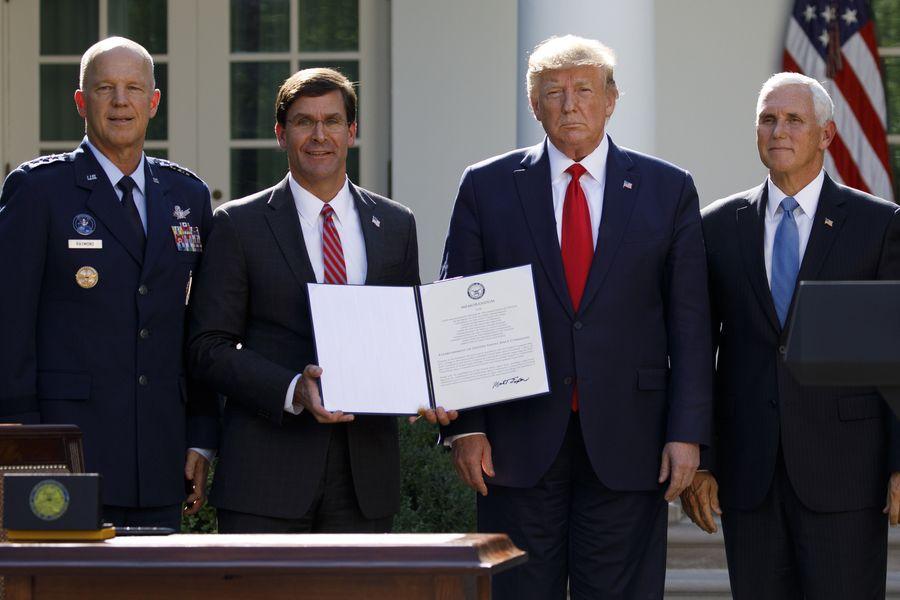
Defense Mark Esper holds a document he sign to establish the U.S. Space Command with Gen. John
Trump Declares New Space Command Key to American Defense
Published Aug. 30, 2019 • Read time: 4m
WASHINGTON (AP) — Declaring space crucial to the nation’s defense, President Donald Trump said Thursday the Pentagon has established U.S. Space Command to preserve American dominance on “the ultimate high ground.”
“This is a landmark day,” Trump said in a Rose Garden ceremony, “one that recognizes the centrality of space to America’s national security and defense.”
He said Space Command, headed by a four-star Air Force general, will “ensure that America’s superiority in space is never questioned and never threatened.”
But there’s still no Space Force.
Space Force, which has become a reliable applause line for Trump at his campaign rallies, has yet to win final approval by Congress.
The renewed focus on space as a military domain reflects concern about the vulnerability of U.S. satellites, both military and commercial, that are critical to U.S. interests and are potentially susceptible to disruption by Chinese and Russian anti-satellite weapons.
The role of the new Space Command is to conduct operations such as enabling satellite-based navigation and communications for troops and commanders in the field and providing warning of missile launches abroad. That is different from a Space Force, which would be a distinct military service like the Army, Navy, Air Force, Marine Corps and Coast Guard.
Congress has inched toward approving the creation of a Space Force despite skepticism from some lawmakers of both parties. The House and Senate bills differ on some points, and an effort to reconcile the two will begin after Congress returns from its August recess.
Is Trump Right About NATO?
Over Here: Competence Amid Repulsive Politics
We're Not a Poor Country, Donald
U.S. Officials Say 2 Americans Died in Brussels Attack
When Jim Mattis was defense secretary, the Pentagon was hesitant to embrace the idea of a Space Force. Trump’s first Pentagon chief initially saw it as potentially redundant and not the best use of defense dollars. His successor, Mark Esper, has cast himself as a strong supporter of creating both a Space Force and a command dedicated to space.
“To ensure the protection of America’s interests in space, we must apply the necessary focus, energy and resources to the task, and that is exactly what Space Command will do,” Esper said Wednesday.
“As a unified combatant command, the United States Space Command is the next crucial step toward the creation of an independent Space Force as an additional armed service,” he added.
Kaitlyn Johnson, a defense space expert at the Center for Strategic and International Studies, said she considers it likely, but not certain, that Congress will approve a Space Force in the 2020 defense bill.
The people in Space Force would be assigned to missions directed by Space Command, just as members of the Army and other services are assigned to an organization like U.S. Strategic Command.
Like other branches of the military, Space Force would be headed by a four-star general who would have a seat at the table with the other Joint Chiefs of Staff. Trump wanted Space Force to be “separate but equal” to the other services, but instead it is expected to be made part of the Air Force, similar to how the Marine Corps is part of the Navy.
Reestablishing Space Command has been a less politically contentious matter. There is a consensus that it is the most straightforward step among those proposed to shore up space defenses.
“This step puts us on a path to maintain a competitive advantage,” Gen. Joseph Dunford, chairman of the Joint Chiefs of Staff, said at a National Space Council meeting last week. He also endorsed creating Space Force, saying it would make a “profound difference.”
Initially, the opening of Space Command will have little practical effect on how the military handles its space responsibilities. Air Force Space Command currently deals with more than three-quarters of the military space mission, and it is expected to only gradually hand off those duties to the new command.
Johnson, the CSIS expert, said the attention to space during the Trump administration has led some to exaggerate the scope of change reflected in the moves to create Space Command and Space Force.
These moves, she said, “seem very flashy and fun” but are not.
“It’s really just a reorganization of functions that are already happening within the military,” she said.
Air Force Gen. John “Jay” Raymond will serve as the first commander of U.S. Space Command. He currently heads Air Force Space Command.
At his Senate confirmation hearing June 4, Raymond made the case for changing the way the military approaches its space mission.
“Unfortunately, our adversaries have had a front row seat into our many successes and have seen the advantages that they provide us,” he said. “And to be honest, they don’t like what they see. And they’re rapidly developing capabilities to negate our use of space and to negate the advantage that space provides.”

Newsom Defies Voters, Juries and Lawmakers To Spare Murderers While Defending Abortion
Curtis Hill • RealClearPolitics
The Algorithmic Tilt
Frank Filingeri • RealClearPolitics
A RealClear Thanksgiving: Investing in a Better Future
David DesRosiers • RealClearPolitics
Trump’s Newsom Problem: Antagonist-in-Chief
Carolina Lumetta • RealClearPolitics
America’s Free Spirit
John Maxwell Hamilton • RealClearPolitics
The GOP Majority Should Go Out in Glory
Daniel McCarthy • RealClearPolitics
RCP Today
Top stories on RealClearPolitics
The Takeaway
Polling intelligence and analysis delivered to your inbox
World News
Featuring the latest world news
Policy
Featuring the latest policy news
Support Our Mission
As part of RealClearPolitics, authors aim to provide balanced, non-partisan analysis by presenting top reporting and commentary from all sides of the political spectrum.
Trusted by policymakers and citizens alike since 2000