
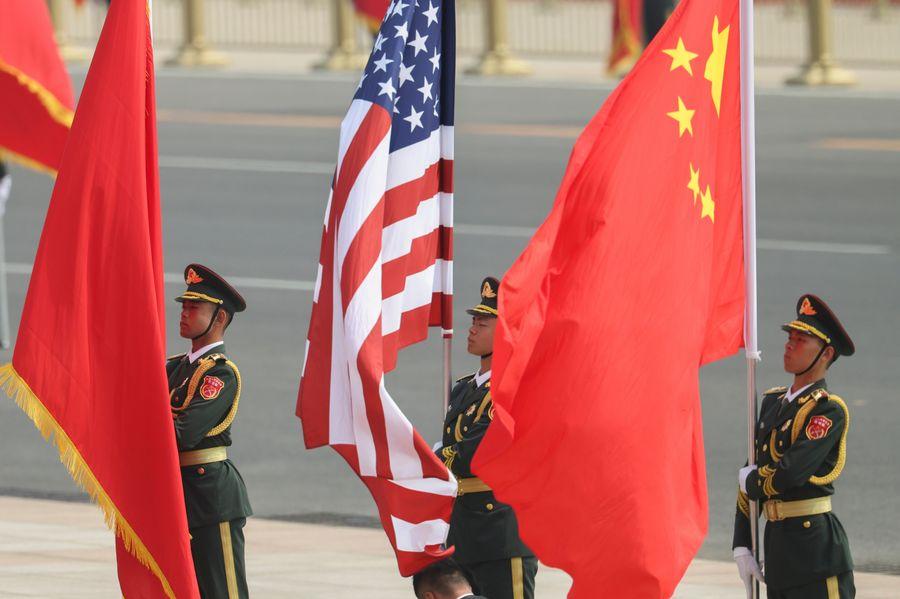
China Trump
China: Our Enemy, Not Our Rival
COMMENTARY
Published May 14, 2026 • Read time: 4m
China is not merely America's geopolitical opponent. It is America's geopolitical enemy -- and has been since the establishment of the Chinese communist regime in 1949.
For decades, American leaders and elites indulged the fantasy that this reality could be softened or reversed. Richard Nixon opened relations with China in part to split Beijing from the Soviet Union. Later, economic globalists insisted that bringing China into global markets would moderate its politics. The theory was that free trade would lead to freer people.
It didn't.
China never stopped being what it has always been: a communist surveillance state with an appetite for repression at home and influence abroad. It is a historically mass-murdering regime and a government whose ambition is nothing less than the destruction of America's global dominance.
And China plays the long game.
Unlike democratic nations that operate on election cycles, the Chinese Communist Party operates on decades. It can wait. It can plan. It can exploit. It has taken advantage of America's openness -- our markets, our universities, even our political institutions -- to undermine us from within.
Whether it's the theft of tens of billions of dollars in intellectual property, the infiltration of American universities, or influence campaigns aimed at shaping public discourse, China has treated the United States like an enemy -- because it is.
That reality became impossible to ignore in 2020. China unleashed the Wuhan virus on the world while lying about the outbreak and downplaying evidence of human-to-human transmission. It misled the World Health Organization, which by that point had become so deferential to Beijing that it functioned more like a diplomatic arm of Chinese interests than an independent watchdog.
The pandemic was a wakeup call, but it should not have been the first. For years, Americans have warned that the United States built supply chains through hostile territory. We outsourced manufacturing, pharmaceuticals and strategic industries to a nation openly committed to replacing us.
Now the question is unavoidable: What should we do?
First, America must use its economic leverage to isolate China. That means cutting strong trade deals with reliable allies and strategic partners -- Canada, Mexico, Europe and developing countries that may be tempted to drift into China's orbit.
The goal should be simple: Force nations to choose. Countries should understand they can either have access to American markets and investment, or dependence on Chinese manufacturing and influence. They should not be allowed to have both.
Second, America must cut off China's sources of revenue and influence. Much of President Donald Trump's foreign policy has been aimed at this. Pressure against Nicolas Maduro in Venezuela was about oil revenue that strengthens China. The same is true with Iran, a major supplier of oil to Beijing. Even the war in Ukraine has implications, as Russia increasingly functions as a resource pipeline for China.
Third, America must strengthen itself. One of the most dangerous vulnerabilities we face is financial dependency. China owns trillions of dollars in American debt. The implicit threat is always present: Beijing could dump U.S. bonds onto the market to destabilize our economy.
China could absorb the pain. It does not fear public backlash the way democratic governments do.
This is what happens when a nation becomes bloated, complacent and addicted to spending. If the United States wishes to remain a world power, it cannot behave like a decadent welfare state. Debt is not just an economic problem -- it is a national security threat.
Finally, America must close the doors China uses to steal, spy and infiltrate. One obvious step is also the most controversial: no more Chinese foreign exchange students. Zero.
Our universities have strong financial incentives to bring them in, but national security cannot be treated like a revenue stream. We should not be importing students from hostile regimes to access American research and institutions, only for them to return home and strengthen systems that seek our destruction.
Pretending geopolitical enemies will not exploit American openness is naive. They already have.
The United States is still the most powerful country on Earth, but power is not permanent. It must be defended and strategically deployed. China is not a competitor playing by the rules of commerce and diplomacy. It is an adversary playing for dominance.
The steps needed to confront that reality are available -- and necessary.
COPYRIGHT 2026 CREATORS.COM
Support Our Mission
The Internet provides an endless stream of content. Not all of it is worth your time. That's why, every day, RealClearPolitics curates the most essential news and information—from all sides and across mediums. The links, videos, and podcasts curated here are the product of human judgment, not algorithms or AI. Please help power our mission of presenting a thoughtful, balanced public discourse through a tax-deductible donation.
Would you consider supporting us today?
Contributing to RealClear Politics through the RealClear Media Foundation supports essential initiatives that drive meaningful change.


RCP Today
Top stories on RealClearPolitics
The Takeaway
Polling intelligence and analysis delivered to your inbox
World News
Featuring the latest world news
Policy
Featuring the latest policy news
Support Our Mission
As part of RealClearPolitics, authors aim to provide balanced, non-partisan analysis by presenting top reporting and commentary from all sides of the political spectrum.
Trusted by policymakers and citizens alike since 2000