
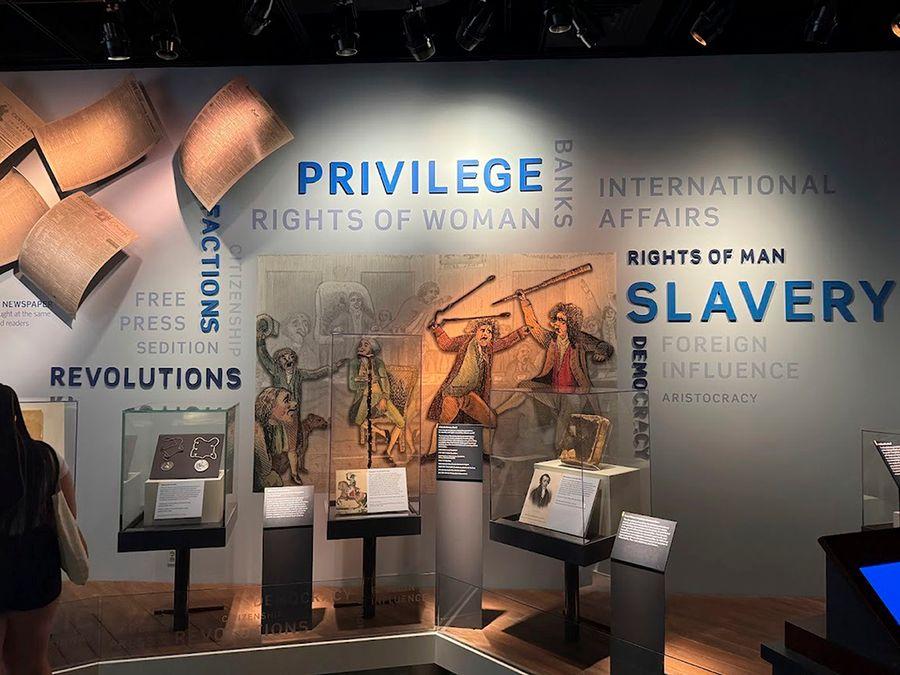
Trump Touring the Smithsonian
Smithsonian Institution Failing To Tell Truth About Christianity
COMMENTARY
Published Oct. 28, 2026 • Read time: 4m
The Smithsonian Institution’s National Museum of American History frames Christianity as a force for conquest and oppression – not freedom, according to an alarming report released by the White House Domestic Policy Council following a review ordered by President Trump.
The Museum’s “Many Voices, One Nation” exhibit opens with a panel titled “Unsettling the Continent, 1492–1776,” which asserts that the European settlement of the New World was a “profound unsettling” and that “Service to those monarchs, Christian religious fervor, and the quest for personal wealth lay behind early European efforts at conquest in the Americas.”
Its “Upending 1620” exhibition similarly recasts the Pilgrims as oppressors, Thanksgiving as a “National Day of Mourning,” and points to a Mayflower passenger’s family chest to emphasize that “not every passenger aboard the Mayflower was fleeing religious persecution.”
Then there is the “Religion in America” webpage, which states, “The root of the word religion means ‘to bind’ and binding is not always positive. Religion has also kept people in bondage. It has created boundaries. It has led to violence.” The page also features a book compiled by Thomas Jefferson with a label about how Jefferson “thought he could distinguish between Jesus’ true message and the apostles’ later additions or misunderstandings by using reason as a guide.” Yet it says nothing about Christianity’s immeasurable, positive influence on American history.
That omission speaks volumes.
Where is the faith that inspired the American Revolution and helped shape the founding principle that “all men are created equal” and are endowed by their Creator with “certain unalienable Rights”?
Where is the faith that helped shape the American founding and led Benjamin Rush, a signer of the Declaration of Independence, to declare that “the religion I mean to recommend in this place, is that of the New Testament,” grounding his vision of American liberty and human equality in the teachings of Christ?
Where is the faith that sustained Harriet Tubman, whom the enslaved called “Moses,” as she led them to freedom? Where is the faith that drove emancipation and inspired Frederick Douglass to invoke “the constitution and the Bible” to condemn slavery?
It’s an objective fact that the defining chapters in America’s struggle for freedom – from the American Revolution to abolitionism to the civil rights movement – were profoundly Christian chapters.
It was Christians, Christian churches, and Christian institutions that built the nation’s first colleges and universities, inspired the Bill of Rights, underpinned the American ideal of individual equality under the law, and established much of America’s civic, scientific, and charitable life.
Unfortunately, Smithsonian leadership appears more focused on radical ideology than historical truth. Museum Director Anthea Hartig has described history as a “prime tool of social justice,” stating that the Museum should “reframe the traditional, celebratory narrative of U.S. history for visitors.”
A national history museum that highlights Christianity when discussing oppression and conquest but fails to mention how Christianity inspired America’s greatest movements for freedom and built most of America’s most treasured institutions – is not a museum at all. It is a Trojan Horse of ideological advocacy masquerading as a museum of neutral history.
The only thing at the Smithsonian that needs reframing is Anthea Hartig’s employment status. If the institution is serious about restoring public trust, it should start by finding a new director.
Under the right leadership, the Smithsonian could tell the truth about our country, our heroes, and Christianity’s vital role in America’s founding and flourishing, but at present, it is a shell of what it could be.
President Trump is right to make restoring the Smithsonian Institution a priority. But this is about more than politics or preserving our national heritage. It is about whether we have the courage to tell the truth about the country we have inherited and the Christian faith that helped shape it.
Christianity gave our founding its moral vocabulary, fueled the abolitionist movement, inspired generations of civil rights leaders, and built institutions that have served our nation for centuries – a legacy to be honored, not apologized for.
America’s children deserve to know their history, from the sacrifices of those who came before them, to the biblical convictions that helped make liberty possible.
History does not protect itself. Someone will tell the story, and if Christians refuse to speak up, others will tell it for us – often at the expense of the truth. A nation that forgets who it is will struggle to defend what it stands for. We have a responsibility to pass our inheritance on intact, not hollowed out by those who would erase the faith that helped shape it. When our grandchildren ask where we stood while that inheritance was being erased, I refuse to say, “We saw it coming and said nothing.”
Support Our Mission
The Internet provides an endless stream of content. Not all of it is worth your time. That's why, every day, RealClearPolitics curates the most essential news and information—from all sides and across mediums. The links, videos, and podcasts curated here are the product of human judgment, not algorithms or AI. Please help power our mission of presenting a thoughtful, balanced public discourse through a tax-deductible donation.
Would you consider supporting us today?
Contributing to RealClear Politics through the RealClear Media Foundation supports essential initiatives that drive meaningful change.




RCP Today
Top stories on RealClearPolitics
The Takeaway
Polling intelligence and analysis delivered to your inbox
World News
Featuring the latest world news
Policy
Featuring the latest policy news
Support Our Mission
As part of RealClearPolitics, authors aim to provide balanced, non-partisan analysis by presenting top reporting and commentary from all sides of the political spectrum.
Trusted by policymakers and citizens alike since 2000