
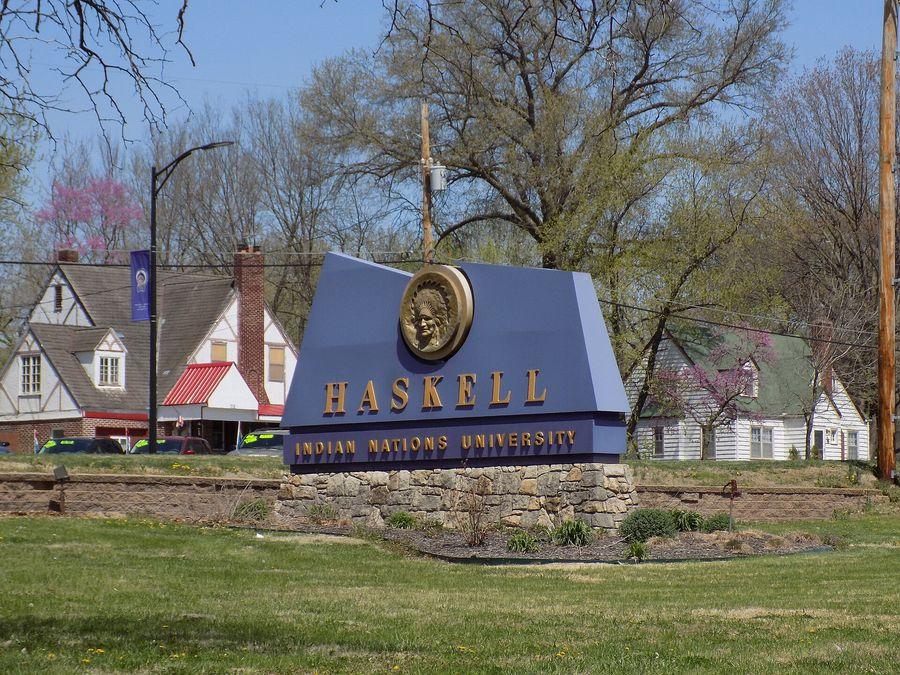
Real 'Heritage Americans' at Haskell Indian Nations University Deserve Better
COMMENTARY
Published Sept. 24, 2026 • Read time: 6m
Donald Trump wants to give the real “heritage Americans” a 90% budget cut next year.
Of course, the president’s budget is only a wish list. But that this is what he wishes for the Native students at already sanctioned and chronically underfunded Haskell Indian Nations University in Lawrence, Kansas, a federally funded university, which every student attends on a full scholarship – is not only shameful but a violation of our government’s treaty obligations. Not that those mean a lot to our chief executive, even when they are agreements he himself has negotiated and signed.
“Those treaties our ancestors made with the United States are still binding – forever,” said Steve Cadue, who grew up on the Kickapoo reservation in Brown County, Kansas, and lives near Haskell, where his wife and children went to college. Those treaties should be binding forever, but really are not; though the U.S. Constitution plainly states that treaties with Native American tribes are the “supreme law of the land,” the Supreme Court back in 1903 ruled that Congress can break or change these at any time.
Cadue gave me a tour of the Bureau of Indian Education-operated Haskell last week. He sees its closure as imminent, because the many serious problems detailed in a Higher Learning Commission (HLC) report last year still have not been addressed, and where exactly is the money to do that?
Steve Cadue lives near the school where his wife and children went to college.
M. Henneberger
Unless the administration “reverses his budget decision, this is going to close,” he said, looking out over the campus, where a small grounds crew was getting ready for the weekend’s Centennial Powwow and traditional dance competition. “All of this is going to close.”
Republican Kansas Sen. Jerry Moran, who serves on the Senate Committee on Indian Affairs, has been a fierce ally for the school since his first year in office. A Moran aide told me he’ll continue to do everything in his power to “ensure Haskell retains robust funding.”
No doubt he really will do that. But at this point, it would need a big boost to overcome problems that have long gone unaddressed.
As for the prospect of losing accreditation, Moran’s aide said the senator and his team have had extensive conversations with BIE and the Bureau of Indian Affairs, including a recent meeting with the Secretary of the Interior, and “have been encouraged by the fact that there’s a plan to make continued improvements to the campus and install a permanent president. However, they retain the belief that the current system Haskell operates under is not viable for the long term.”
A year ago, Moran co-sponsored a Haskell reform bill with Republican Kansas Rep. Tracey Mann that would remove the struggling school from Bureau of Indian Education (BIE) control – retaining federal funding but putting governance in Native hands. This legislation was supposed to address chronic federal mismanagement.
But that bill has been in limbo ever since. And even when Congress gets back to work, I’m not confident this will be at the top, middle, or anywhere at all on the do-list, though we are talking here about people we have wronged throughout our history. If the U.S. government were a person, that somebody could at a minimum be charged with abuse and neglect. And none of the problems at Haskell are new.
A 2023 BIE investigation found the school had ignored sexual assault reports, fired a whistleblower, and pressured students to sign promises not to tell anyone, their parents included, about bullying. The findings were so negative that the BIE refused to release the report for more than a year. The BIE initially responded to a Freedom of Information Act request and a lawsuit by the Public Employees for Environmental Responsibility with a different, completely unrelated report.
A 2024 report from the Office of the Inspector General, “Indian Affairs Is Unable to Effectively Manage Deferred Maintenance of School Facilities” across its entire system, found work orders approved 22 years earlier that still had not been funded.
The issues outlined in last year’s HLC report for accreditation included unsafe environmental conditions – asbestos, buildings condemned or otherwise in late-stage disrepair from long-deferred maintenance, both heating and cooling issues, and at times, no hot water.
The school, which has had nine presidents in as many years, is now operating under sanction, and the HLC will decide in December whether or not to pull the school’s accreditation, an action that would end federal financial aid and bring down the whole institution.
A sign outside one campus building encourages students to make their ancestors proud.
M. Henneberger
The history of Haskell, which opened as an Indian boarding school in 1884, is certainly a painful one; it began, as all such schools did, by – let’s just say it – kidnapping children as young as three from their families and sending them far from home to not so gently be made white.
The philosophy of Richard Henry Pratt, the Army captain who ran the country’s first Indian boarding school in Carlisle, Pennsylvania, after which all other such schools were modeled, was this: “Kill the Indian in him and save the man.” All were not saved, and Haskell was known for its harsh discipline. Cadue’s 10-year-old relative, Sophie Cadue, is among the 103 children buried in the locked and gated graveyard behind the school.
These days, though, despite its crumbling infrastructure and terrible oversight, Haskell is still a life-changing place in a positive way, giving almost 1,000 young Native Americans from all over the country a free education and a place to be together, which is no small thing.
A lot of its students are coming out of great poverty, and I think of Haskell as a place that does for Native kids what the fantastic tuition-free Berea College, which one of my Kentucky uncles attended, does in Appalachia. With full funding, Haskell could be and could do so much more.
“This should be the Howard of the Indian world,” Cadue said. It isn’t, but especially with a committed advocate like Moran on its side, there’s no reason it can’t be.
While we’re deporting non-native Americans to places they’ve never been – to be hooded and beaten in Central Africa, as The New York Times reported on Sunday – is it too much to ask that we, who were once the interlopers, at least honor our legal obligation to those from whom we’ve already taken so much?
Support Our Mission
The Internet provides an endless stream of content. Not all of it is worth your time. That's why, every day, RealClearPolitics curates the most essential news and information—from all sides and across mediums. The links, videos, and podcasts curated here are the product of human judgment, not algorithms or AI. Please help power our mission of presenting a thoughtful, balanced public discourse through a tax-deductible donation.
Would you consider supporting us today?
Contributing to RealClear Politics through the RealClear Media Foundation supports essential initiatives that drive meaningful change.




RCP Today
Top stories on RealClearPolitics
The Takeaway
Polling intelligence and analysis delivered to your inbox
World News
Featuring the latest world news
Policy
Featuring the latest policy news
Support Our Mission
As part of RealClearPolitics, authors aim to provide balanced, non-partisan analysis by presenting top reporting and commentary from all sides of the political spectrum.
Trusted by policymakers and citizens alike since 2000