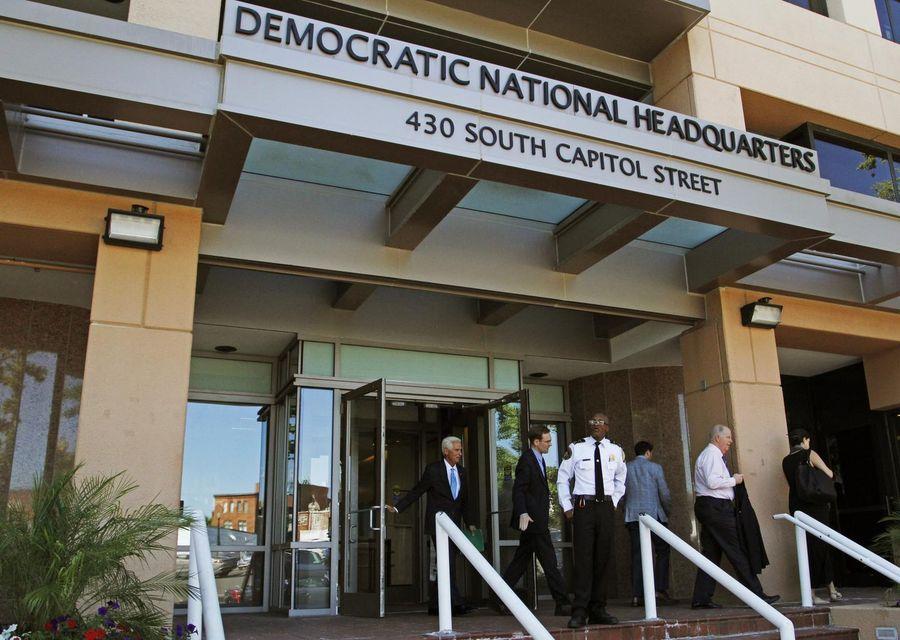
FILE - In this June 14, 2016 file photo, people stand outside the Democratic National Committee (DNC) headquarters in Washington. The computers of the House Democratic campaign committee have been hacked, an intrusion that investigators say resembles the recent cyber breach of the Democratic National Committee for which the Russian government is the leading suspect. (AP Photo/Paul Holston, File)
The Takeaway: Democrats' Favorability Falls
Published March 9, 2018 • Read time: 4m
Join the Conversation
0Intriguing tidbits from the week in election surveys and public opinion polls:
The Lesser of Two Evils: There is good news and bad news for Democrats in the newest Quinnipiac University survey. The bad: The favorable rating of the Democratic Party has hit an all-time low. Just 31 percent of Americans say they view the party favorably, while 52 percent view it unfavorably. That’s a far cry from the 55 percent favorable rating the party enjoyed when Barack Obama took office in 2009. The good? Despite the drop in favorability, Democrats still enjoy a healthy advantage over Republicans on the generic ballot question. When asked which party they’d like to see win control of the House, 48 percent said the Democrats, 38 percent said the GOP, and 15 percent were undecided. Overall, Democrats lead the 2018 Generic Ballot by 8.9 percentage points in the RCP Average.
Afraid or Not of the NRA? The same Quinnipiac poll showed that 60 percent of Americans believe the NRA has “too much influence over politicians.” A follow-up question probed whether the public thought both parties and the president were “afraid of the NRA or not.” Forty-nine percent said Democrats were afraid of the NRA, while 54 percent said Republicans were. But for President Trump, only 31 percent said he was afraid of the powerful organization while 65 percent said he was not – including 92 percent of Republicans, 66 percent of Independents, and 39 percent of Democrats.
Asia Up, Russia Down: According to a recent Gallup survey, Americans’ views of China and Japan have climbed to new heights this year. A record 87 percent of Americans now view Japan favorably, a rating so high only Australia, Great Britain and Canada have scored higher in the survey’s 40-year history. China also reached a new high with 53 percent, making it the first time in nearly 30 years a majority of the American public has viewed that country favorably.
Sanders Seeks Caucus Trifecta Win to Close Delegate Gap
Sanders Fighting Perception He Can't Overcome Clinton Edge
Clinton Targets Trump as Sanders Circles
Sanders, Clinton Differ Sharply at Flint Debate
Meanwhile, Americans’ views of Russia have reached new lows. According to Gallup, just 25 percent view the country favorably while a record 72 percent view it unfavorably.
On a related note, a new Monmouth University poll corroborates the public’s negative attitudes toward Russia. Seventy-three percent say Russia “definitely” or “probably” tried to interfere in the 2016 election, with 44 percent saying Russian meddling caused “a lot” of damage to America’s democracy. Sixty-four percent think Russia will be at it again in 2018, and majorities of the public don’t think the U.S. government or the president is taking the issue seriously enough.
Papal Popularity: As the fifth anniversary of his papacy nears, a new poll from St. Leo University shows Pope Francis enjoying a 65.6 percent approval rating among U.S. adults. This represents almost a three-point improvement since last November. Among U.S. Catholics, the pope’s job approval rating is 85.9 percent. As with everything else these days, views of the pontiff differ by party: Democrats give Francis the highest approval rating, 76.3 percent, while 63 percent of Republicans and 62.5 percent of Independents approve of the job he is doing.
The pope receives his highest marks for “advancing the cause of the poor” (66.9 percent approval), and his lowest marks for “handling cases of sexual abuse involving Catholic clergy” (59.8 percent approval).
March Losing Its Madness: With Selection Sunday this weekend, a new Morning Consult poll shows that fewer people plan on tuning into the NCAA Men’s Basketball Tournament this year. Thirty-six percent of the 2,201 adults surveyed said they intend to watch the tourney this year, down from 43 percent last year. Fifty percent do not intend to partake of March Madness, with 15 percent undecided.
There was also a slight drop in the number of people who intend to fill out brackets this year – just 18 percent versus 20 percent last year.
Of course, filling out tournament brackets is a must-do if you work for Berkshire Hathaway, the massive conglomerate owned by Warren Buffett, also a noted basketball fan. In the past Buffet had offered $1 billion to anyone who completed a perfect bracket. (At odds of 1 in 9.2 quintillion, it was a pretty safe bet no one would win – and no one did.) This year, Buffet has offered a better bet to his employees: He will award $100,000 to the employee who makes it the furthest in the tournament. Anyone who completes a perfect bracket through the Sweet 16 will get $1 million a year for life. And there’s a final kicker: If Creighton or Nebraska wins, Buffet will up the prize to $2 million a year for life.
Newsom Defies Voters, Juries and Lawmakers To Spare Murderers While Defending Abortion
Curtis Hill • RealClearPolitics
The Algorithmic Tilt
Frank Filingeri • RealClearPolitics
A RealClear Thanksgiving: Investing in a Better Future
David DesRosiers • RealClearPolitics
Trump’s Newsom Problem: Antagonist-in-Chief
Carolina Lumetta • RealClearPolitics
America’s Free Spirit
John Maxwell Hamilton • RealClearPolitics
The GOP Majority Should Go Out in Glory
Daniel McCarthy • RealClearPolitics
RCP Today
Top stories on RealClearPolitics
The Takeaway
Polling intelligence and analysis delivered to your inbox
World News
Featuring the latest world news
Policy
Featuring the latest policy news
Support Our Mission
As part of RealClearPolitics, authors aim to provide balanced, non-partisan analysis by presenting top reporting and commentary from all sides of the political spectrum.
Trusted by policymakers and citizens alike since 2000