
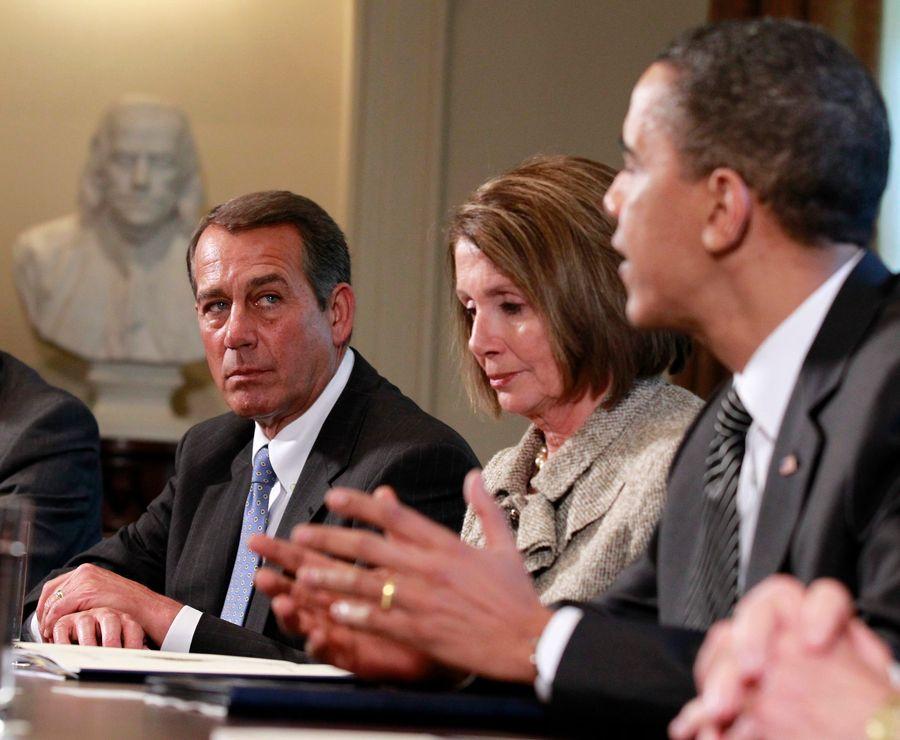
Barack Obama, Nancy Pelosi, John Boehner
Dems Say Not Leaning Left Will Hurt in '22. Data Say Otherwise.
Published March 3, 2021 • Read time: 5m
President Biden faces pressure from the progressive wing of his party on issues ranging from the $15 minimum wage to the $1.9 trillion COVID relief bill to climate change legislation. Rep. Alexandria Ocasio-Cortez told the Washington Post in mid-January that Biden’s stimulus proposal doesn’t go far enough and some have claimed that not moving further left will have dire electoral ramifications. Bernie Sanders recently echoed AOC’s concerns, tweeting “In 1994, Democrats in power lost big because they were not bold. In 2010, it happened again. If we do not take aggressive action NOW to protect working families, it will happen in 2022.”
Sanders’ tweet and subsequent comments engage in obvious revisionist history. In both the Clinton and Obamas administrations, midterm congressional losses came not from being too conservative but from moving too far left on a variety issues, especially health care. The price was paid by Democratic members of Congress from moderate to conservative districts in 1994 and 2010, particularly the ones who voted for those progressive policies.
Take, for example, Bill Clinton’s 1992 victory over George H.W. Bush. Clinton’s victory led to liberal policies ranging from gun control to jobs legislation containing a provision for voter registration at welfare and unemployment offices. Most memorably, it included health care reform packaged by a task force headed by first lady Hillary Clinton (which the president promised to veto if the bill brought to him did not include 100% coverage). The jobs legislation failed, as did voter registration at welfare and unemployment sites. However, Democratic lawmakers from marginal districts were forced to take tough votes on various aspects of Clinton’s agenda, leading to the 1994 election that cost House Democrats more than 50 seats. For the first time in four decades, Republicans took control of both chambers of Congress.
Sanders Seeks Caucus Trifecta Win to Close Delegate Gap
Sanders Fighting Perception He Can't Overcome Clinton Edge
Clinton Targets Trump as Sanders Circles
Sanders, Clinton Differ Sharply at Flint Debate
The results are clear. In districts where Clinton got less than 40% of the actual vote in 1992 (which we dub "conservative" districts), more progressive voting records led to greater chances of defeat. In the most marginally Democratic districts, no incumbents with a low progressive vote score were defeated, but a full 63% of those who had been highly supportive of the Clinton program lost. In districts where Clinton got 40%-50% of the 1992 vote (“moderate” districts), the percentage of incumbents losing was lower than in the conservative districts; but, again, the more pro-progressive the voting record, the higher the probability of the incumbent losing. Where Clinton did well in 1992 -- winning a clear majority of the vote in the three-way 1992 race -- the only Democrat who was defeated had been indicted on corruption charges.
The next Democratic president, Barack Obama, suffered a similar defeat in the 2010 midterms (though unlike Clinton, he got his health care policy enacted into law). After Obama won the presidency in 2008, he pushed through a large stimulus bill and the Affordable Care Act; he also tried to pass a landmark cap-and-trade bill. Again, Democrats from competitive districts were punished by their constituents for these policies. In the 2010 elections, Democrats lost control of the House and over 60 seats to the Republicans in what Obama later termed a “shellacking.” Table 2 shows how various Democratic members who voted for the ACA fared in 2010, based on Obama’s 2008 share of the vote in that district.
The more liberal the district, the higher the chance a Democrat had of voting yes on the ACA and retaining the seat. Ninety-five percent of Democratic representatives from districts where Obama received 45% of the vote or less lost after voting “yes” on the ACA. In districts where Obama split about evenly with John McCain, 73% who voted “yes” lost. In the more liberal districts, where Obama won 55% and 60% percent of the vote, 66% and 92%, respectively, of those who voted for the ACA won. In short, putting forward policies that are perceived as too liberal costs members of Congress from competitive districts.
The 1.9 trillion COVID relief package is Biden’s first test on the issue of pushing policies that could be perceived as overly liberal. The progressives in his party are already signaling to him that he should keep the bill at $1.9 trillion or higher (AOC has said that the $1,400 payments should be $2,000, while the Republicans that the president met with are proposing a $618 billion relief package).
As the bill moves through the Congress, those with the most at stake are the 30 or so House members who come from districts where Biden won between 45% and 50% of the vote (and whose own margin of victory was less than five percentage points). Republicans have already targeted these incumbents, along with another 17, in the 2022 midterms. The relief bill is probably not the equivalent to the health care bills of Clinton and Obama -- a recent poll showed over two-thirds of Americans want the legislation, with majorities of Republicans favoring aspects of the bill -- but it is nevertheless the first test in which Biden has to choose between the progressive wing of his party and his goal of unifying the country.
Moreover, this first test will be minor compared to coming legislation on climate control and other policies favored by progressives. Time will tell what reaction to these policy moves will be; for the moment, watch how moderate Democrats such as Abigail Spanberger of Virginia react to the progressive Democrats’ proposals to push policy to the left. Given the Democrats’ thin majority in the House (222-212), they need to balance the conflicting goals of protecting members like Spanberger from tough votes and enacting the laws they want.

The GOP Majority Should Go Out in Glory
Daniel McCarthy • RealClearPolitics
Republican Majorities Could Return Sooner Than Expected
J.T. Young • RealClearPolitics
The Danger Before the Attack
Leslie J. Sullivan • RealClearPolitics
Jon Finer’s Old and Dangerous ‘New Approach’ to Israel
Peter Berkowitz • RealClearPolitics
The President Deserves Better
John Ullyot • RealClearPolitics
Congress Doesn’t Need Another Blame Game. It Needs To Find What’s Broken
Jarrod Bernstein • RealClearPolitics
RCP Today
Top stories on RealClearPolitics
The Takeaway
Polling intelligence and analysis delivered to your inbox
World News
Featuring the latest world news
Policy
Featuring the latest policy news
Support Our Mission
As part of RealClearPolitics, authors aim to provide balanced, non-partisan analysis by presenting top reporting and commentary from all sides of the political spectrum.
Trusted by policymakers and citizens alike since 2000