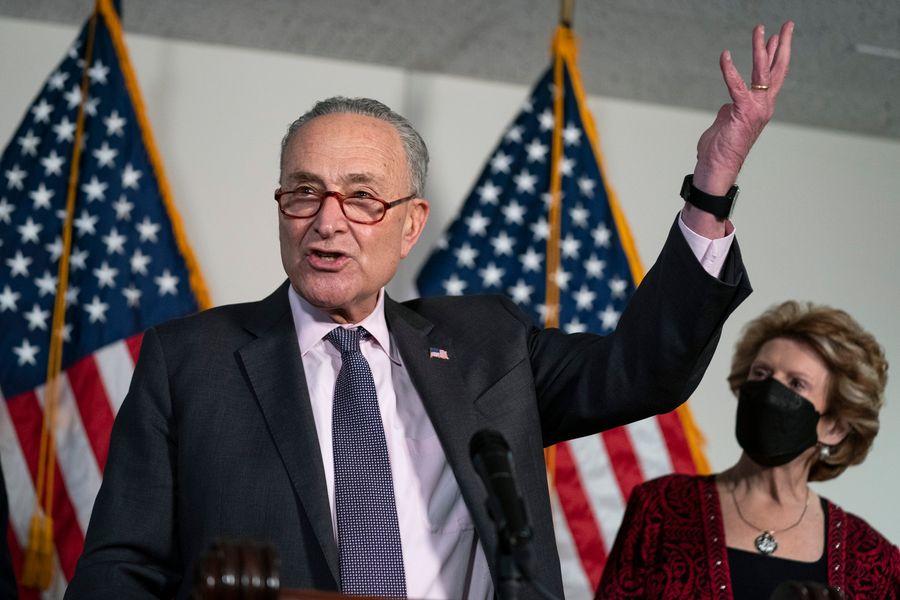
Senate Democrats
Democrats Are Tanking. How Has Chuck Schumer Escaped Blame?
ANALYSIS
Published Feb. 3, 2022 • Read time: 6m
As the Democrats’ political fortunes worsen, recriminations abound. White House Chief of Staff Ron Klain seems to be the latest target, while centrist Sens. Joe Manchin and Kyrsten Sinema continue to come under relentless attack. President Biden takes a daily pounding, and news that House Speaker Nancy Pelosi will run for another term has produced headlines like this one in Axios: “Pelosi is the GOP’s 2022 Bogeywoman.”
It seems strange, then, that Senate Majority Leader Chuck Schumer, whose fingers are all over the mess the party is in, isn’t taking more heat. Last week Politico Playbook reported that Schumer has created tension among his colleagues that has largely remained inside the tent and that no senator has articulated publicly.
This frustration resulted from Schumer’s decision to force a vote everyone knew would fail, and which – because they knew Manchin and Sinema would vote with Republicans – focused more attention on party divisions than GOP opposition.
Show votes are high-risk because they make lawmakers facing tough reelection campaigns walk the plank for nothing. The most vulnerable Democrat, Nevada Sen. Catherine Cortez Masto, for example, is now on the record seeking to carve out a filibuster exception for two voting rights bills that didn’t pass, so she can expect to answer for old videos of Joe Biden and Barack Obama championing the filibuster while they were in the Senate.
Meanwhile, Republicans got to tweet about Sinema and Manchin’s fealty to the upper chamber and praise them as institutionalists while avoiding the subject of the voting rights legislation they oppose altogether.
Sanders Seeks Caucus Trifecta Win to Close Delegate Gap
Sanders Fighting Perception He Can't Overcome Clinton Edge
Clinton Targets Trump as Sanders Circles
Sanders, Clinton Differ Sharply at Flint Debate
“The Republicans had a fine week last week,” one senior Democratic staffer told Playbook. “There was no contrast with Republicans. And it was a result of the fact that our party leader chose not to be the leader of the entire caucus.”
The anonymous aides to top Democrats quoted in the story described a failed strategy that had not only threatened caucus unity but had succeeded in disappointing their already demoralized voters even more. One senior House Democrat also told Playbook: “This level of malpractice is stunning. BBB is a once-in-a-10-year opportunity, and we fucked it up.”
The Build Back Better debacle lasted months, taking tortured twists and turns as party leaders, including Biden, allowed progressives to hold bipartisan infrastructure legislation, supported by 19 GOP senators, hostage to the social welfare bill that Manchin warned from the start was too expensive.
Thanks to Schumer the negotiations could never proceed in good faith because he kept critical information from both Biden and House Speaker Nancy Pelosi, mainly that Manchin had a bottom-line number he wouldn’t budge on. By not sharing this with the White House or House leaders, Schumer tied the hands of everyone negotiating with Manchin. Schumer didn’t just listen to Manchin lay out his concerns or criticisms. He didn’t just read them in a letter written by the West Virginia senator. Schumer signed that letter, and Manchin signed it with him.
In December, after months of strained discussions and Democrat-on-Democrat feuds staying front and center in the media, Manchin walked away from the negotiating table furious. He’s no flame thrower, but he purposefully chose to kill off BBB in an interview on Fox News in retaliation for mistreatment by top Biden aides. He made it clear that it was not the fault of Biden, but the White House staff, which had done “inexcusable” things. Manchin was explicit about his exasperation, saying on Fox, “I’ve tried everything humanly possible. I can’t get there.’
The president, progressives and even Schumer all piled on Manchin. Schumer sent a pointed letter reiterating that Senate Democrats would “not give up” that named Manchin and noted his “deep discontent and frustration,” and threatened again to bring the bill back up for a vote in January “so that every member of this body has the opportunity to make their position known on the Senate floor, not just on television,” adding, “we will keep voting on it until we get something done.”
Of course, that's not what happened. The new year dawned, negotiations were dead, and Schumer suddenly shelved his threatened vote on BBB in order to hold one on the Democrats’ voting rights legislation, which everyone knew would also fail.
Although both Manchin and Sinema supported the substance of the two voting rights bills, they opposed suspending the legislative filibuster to pass them on party lines with 50 votes. Schumer insisted on a vote anyway because he thought convincing 48 other senators to back a carve-out for the filibuster was an impressive accomplishment worth highlighting. He estimated, in an interview with Politico after the vote, that roughly half of his caucus had changed their minds on a filibuster carve-out between last fall and the vote in January.
And Schumer couldn’t resist taking a dig at Manchin, who had tried to persuade some Republicans to agree to the same rule change just for voting rights.
“We sent our best emissary to talk to the Republicans. That was Joe Manchin. And we gave him months,” Schumer told Politico. “The epiphany that occurred on a rules change? He didn’t even get any bites.”
Sen. Bernie Sanders is now threatening to support primary challengers against both Manchin and Sinema in 2024. Schumer has refused to criticize this gambit or pledge to support the incumbent senators, as party leaders traditionally do. When asked about this directly by CNN Wednesday, Schumer, apparently fearing a primary challenge from the left himself, said, “I’m focused on 2022.”
Schumer wasn’t alone in messaging to Americans that the initial $2 trillion COVID relief package that passed on party lines in March was inadequate. The White House and Democrats in Congress haven’t spent much time marketing the American Rescue Plan, or the bipartisan infrastructure law, which were both popular, back in their home states. Instead, they have cowered in fear of the left, continuing to talk about the revival of BBB that isn’t happening. This is a narrative that serves the GOP: Democrats haven’t done much that matters to voters since they took over and they can’t deliver anything else.
Yet it was Schumer’s deception that extended the fight over BBB, as he mired the party with his artificial deadlines and chaotic process while promising voters they would “change America in a big, bold way.”
Indulging unrealistic expectations, let alone leveling attacks on his own members, is not Schumer's job. His role as leader is not to soothe Bernie Sanders and the left, it’s to preserve as much unity as he can in a fractured caucus and, when he doesn’t have the math for “transformational” legislation, keep the focus on Republicans.
Bernie may be a behemoth, with a direct line to Biden, but it's still Schumer’s job to manage the relationship between two committee chairmen, Sanders and Manchin, at the leadership table. He has failed at both and it will cost the Democrats dearly.

Newsom Defies Voters, Juries and Lawmakers To Spare Murderers While Defending Abortion
Curtis Hill • RealClearPolitics
The Algorithmic Tilt
Frank Filingeri • RealClearPolitics
A RealClear Thanksgiving: Investing in a Better Future
David DesRosiers • RealClearPolitics
Trump’s Newsom Problem: Antagonist-in-Chief
Carolina Lumetta • RealClearPolitics
America’s Free Spirit
John Maxwell Hamilton • RealClearPolitics
The GOP Majority Should Go Out in Glory
Daniel McCarthy • RealClearPolitics
RCP Today
Top stories on RealClearPolitics
The Takeaway
Polling intelligence and analysis delivered to your inbox
World News
Featuring the latest world news
Policy
Featuring the latest policy news
Support Our Mission
As part of RealClearPolitics, authors aim to provide balanced, non-partisan analysis by presenting top reporting and commentary from all sides of the political spectrum.
Trusted by policymakers and citizens alike since 2000