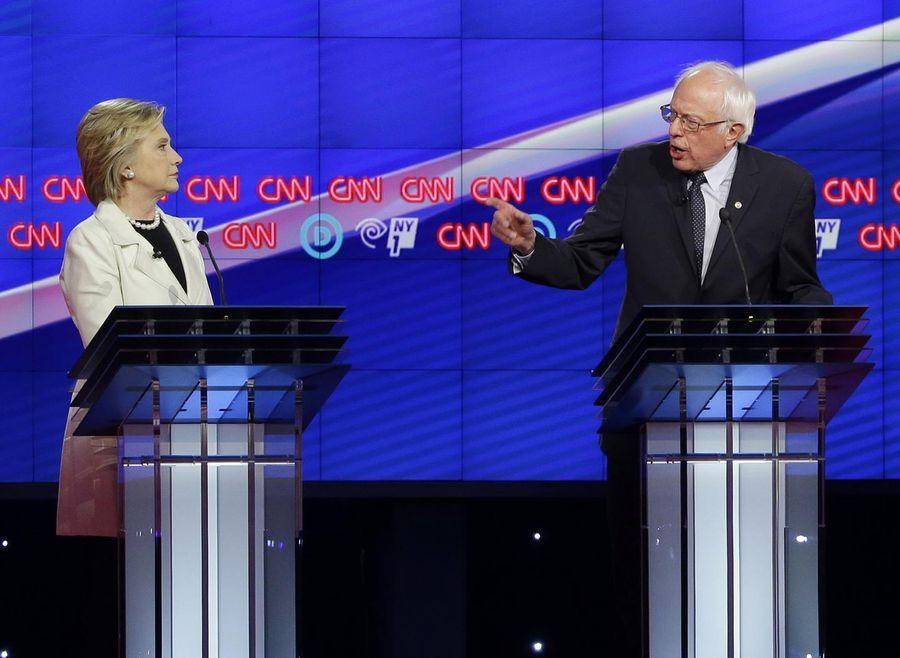
Democratic presidential candidates Sen. Bernie Sanders, I-Vt., right, and Hillary Clinton speak during the CNN Democratic Presidential Primary Debate at the Brooklyn Navy Yard on Thursday, April 14, 2016 in New York. (AP Photo/Seth Wenig)
Clinton, Sanders Let Loose in New York Debate
Published April 15, 2016 • Read time: 7m
Join the Conversation
0BROOKLYN, N.Y.—With a critical primary contest just days away, Hillary Clinton and Bernie Sanders met on a Brooklyn stage Thursday night for what could be their final debate.
And, unlike their first debate many months ago and others in between, the candidates did not pull a single punch, underscoring the high stakes for both of them: Clinton, wanting to wrap up the primary and focus her energy and resources on the general election; Sanders, hoping to prolong the race through the summer.
"If you’re both screaming at each other, the viewers won’t be able to hear either of you," CNN moderator Wolf Blitzer said at one point during the debate at the Brooklyn Navy Yard.
Given both Clinton and Sanders’ intimate familiarity with the state, each tried to hammer home policy differences through a New York lens, from issues such as Wall Street influence to gun control to foreign policy as it relates to Israel. But the arguments put forth echoed messages each has been pushing for some time, and aren’t likely to influence the outcome of Tuesday’s contest in New York.
Sanders has stepped back from questioning Clinton’s qualifications, but he did re-engage on his concerns about her judgment.
"Does Secretary Clinton have the intelligence, the experience to be president? Of course she does, but I do question her judgment,” he said. “I question a judgment which voted for the war in Iraq, the worst foreign policy blunder in the history of this country; voted for virtually every disastrous trade agreement which cost us millions of decent-paying jobs. And I question her judgment about running super PACs which are collecting tens of millions of dollars from special interests, including $15 million from Wall Street.”
Sanders Seeks Caucus Trifecta Win to Close Delegate Gap
Sanders Fighting Perception He Can't Overcome Clinton Edge
Clinton Targets Trump as Sanders Circles
Sanders, Clinton Differ Sharply at Flint Debate
For her part, Clinton questioned Sanders’ depth of knowledge, invoking a New York Daily News editorial board meeting in which the Vermont senator struggled to answer questions on breaking up big banks and on foreign policy. “I think you need to have the judgment on day one to be both president and commander-in-chief,” she said.
Clinton also reminded the audience of her connections to New York and to President Obama, whose legacy she says she would like to build upon. “The people of New York voted for me twice to be their senator,” she said. “And President Obama trusted my judgment enough to ask me to be secretary of state for the United States.”
Clinton’s embrace of Obama throughout this primary process figures to help mobilize key coalitions that propelled his presidential victories, especially in the diverse and voter-rich New York City. She has argued that she has not only more pledged delegates than Sanders, but also more votes—even more than Obama had in building his lead over her in 2008, she noted. She is also hoping to calm concerns among Democrats that a prolonged primary would hurt the party in the general election, noting that the race between herself and Obama eight years ago went on longer than this one has and the party was still able to unite and win that November.
“Where we stand today is that we are in this campaign very confident and optimistic,” she said, but “I’m not taking anything for granted, or any voter or any place.”
For his part, Sanders continued to mobilize his base in a way that underscored Clinton’s potential vulnerabilities in trying to unite the party down the road.
“Establishment politicians are never going to address the crises we face,” he said of his rival. “You can’t take money … and expect the American people to expect you’re going to stand up to these special interests.”
The race has become much more heated in recent weeks, a notable shift in a party primary that had been largely, and unconventionally, cordial, especially in contrast to the Republican contest. Sanders has escalated his attacks in an effort to keep pace, raising questions about Clinton’s judgment, harping on her vote for the Iraq War and her acceptance of large sums of money for speeches given to Goldman Sachs and Verizon, among others.
Sanders again called on Clinton to release the transcripts of her paid speeches. She deflected, even when pressed again by the moderators, by pushing Sanders to release his tax returns.
For her part, Clinton has hit Sanders on the issue of gun control, invoking the families of Sandy Hook Elementary School victims, and criticizing her opponent over legal loopholes that give immunity from lawsuits to gun manufacturers. “We hear a lot from Senator Sanders about the greed and recklessness of Wall Street,” Clinton said. “But what about the greed and recklessness of the gun lobby.”
Asked about the daughter of the Sandy Hook principal calling on Sanders to apologize for his stance on the issue, the Democratic socialist declined, but said he supported the right of the families to sue the manufacturer of the AR-15 used to kill children in the massacre. The issue of gun control figures to be a mobilizing factor among Democrats, particularly in New York, a state that both candidates claim as home turf: Clinton is a current resident who represented New York for eight years in the U.S. Senate, and Sanders was born and raised in Brooklyn.
But each see the significance of the state differently. Clinton hopes an overwhelming win here will halt Sanders’ momentum and bring the primary closer to a conclusion, allowing her to shift focus to the Republican opponents. For Sanders, who has won the past seven contests but still lags behind in the delegate count, a win would keep alive some hope of clinching the nomination and deliver a blow to the Clinton campaign’s morale.
Defeating Clinton in her adopted home state appears unlikely at this point for Sanders. The former secretary of state leads by nearly 14 points there, according to the RealClearPolitics polling average. One recent NBC/Wall Street Journal/Marist poll shows Clinton has expanded her lead over the past few days. The two candidates were tied in upstate New York, according to the poll. Sanders does best among younger voters (under age 45) and those who consider themselves very liberal.
New York’s closed primary system will also pose a challenge for Sanders, as independent voters are a key part of his base. The campaign has worked to persuade such voters to register as Democrats in order to vote for him. After having twice won New York statewide, Clinton is no stranger to campaigning in the state. She has won endorsements from unions and the New York City Mayor Bill de Blasio, who ran her Senate campaign, as well as African-American leaders. Clinton’s message of building upon the legacy of Obama figures to serve her well there.
But Sanders was able to draw 27,000 people for a rally in Greenwich Village. The image of a packed Washington Square Park, near the campus of NYU, captured the energy his campaign has generated, particularly among young people. The event also underscored a challenge Clinton could have if she becomes the nominee in galvanizing Sanders’ supporters for a victory in the general election.
While Clinton continues to pile up delegates even as Sanders wins states, given the proportional allocation involved, his continued presence and influence have prolonged the race. He has also continued to show overwhelming fundraising prowess, hauling $44 million recently, which forces Clinton to take time away from the trail to raise money.
Clinton will attend fundraisers in California over the weekend before heading back to campaign in New York City. After the debate, Sanders boarded a plane to Rome for meetings at the Vatican, and is expected to return Saturday evening.
Sanders has pledged to stay in the race through to California in June. Asked if he would take the fight all the way to the Philadelphia convention, he said: “I think we're going to win this nomination, to tell you the truth.”
The Clinton campaign, however, believes the momentum, math, and map will be in her favor next week and beyond.
“I'm going to work my heart out here in New York until the polls close on Tuesday. I'm going to work in Pennsylvania, Connecticut, Rhode Island, Delaware and Maryland, all the way through California,” she said. “And when we end up with the number of delegates we need, we will unite the party and have a unified convention.”
Alexis Simendinger contributed to this report.

Newsom Defies Voters, Juries and Lawmakers To Spare Murderers While Defending Abortion
Curtis Hill • RealClearPolitics
The Algorithmic Tilt
Frank Filingeri • RealClearPolitics
A RealClear Thanksgiving: Investing in a Better Future
David DesRosiers • RealClearPolitics
Trump’s Newsom Problem: Antagonist-in-Chief
Carolina Lumetta • RealClearPolitics
America’s Free Spirit
John Maxwell Hamilton • RealClearPolitics
The GOP Majority Should Go Out in Glory
Daniel McCarthy • RealClearPolitics
RCP Today
Top stories on RealClearPolitics
The Takeaway
Polling intelligence and analysis delivered to your inbox
World News
Featuring the latest world news
Policy
Featuring the latest policy news
Support Our Mission
As part of RealClearPolitics, authors aim to provide balanced, non-partisan analysis by presenting top reporting and commentary from all sides of the political spectrum.
Trusted by policymakers and citizens alike since 2000