
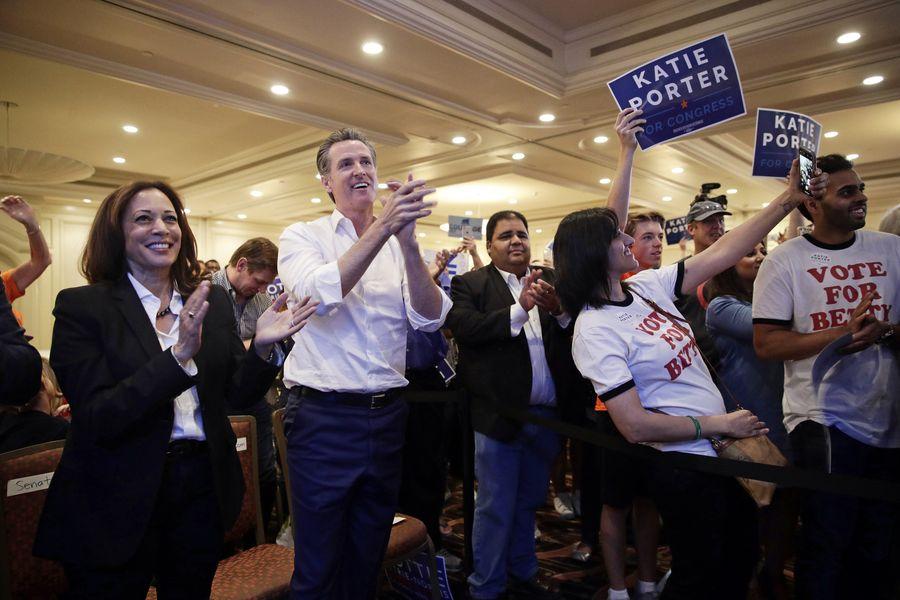
As California Goes, How Will Newsom And Harris Lean?
ANALYSIS
Published Feb. 25, 2020 • Read time: 6m
In culinary terms, February’s limited tasting menu of Democratic presidential votes – Iowa, New Hampshire, Nevada and South Carolina award 155 delegates, roughly 1/13th the 1,991 needed to secure the party’s nomination – soon becomes a March smorgasbord of main courses.
The feeding frenzy begins on the third day of the month – “Super Tuesday,” with 15 states and territories awarding 1,357 delegates. A week later, six states will award 352 delegates (crossover-voting Michigan the biggest prize). The following Tuesday, March 17, four influential states (Arizona, Florida, Illinois and Ohio) will award 577 delegates. On the final Tuesday of the month, the race shifts to Georgia and its 105 awardable delegates.
Toss in the Northern Mariana Islands’ six delegates and Puerto Rico’s 51 (the latter being the month’s last contest, on March 29), and that’s a grand sum of 2,448 delegates up for grabs in less than four weeks of voting.
You may have noticed a word missing from this rundown: California. The biggest of Democratic prizes votes on Super Tuesday, which happens to be the Golden State’s blessing – and its curse – in this year’s election.
The blessing? California’s early start means that many a Democrat has passed through the state in the past few weeks – a few even setting up shop (Bernie Sanders has 20 field offices in California). Speaking of California love, a pair of billionaires (former New York City Mayor Michael Bloomberg and activist Tom Steyer) took advantage of their personal fortunes and a field distracted by February’s schedule to spam the state’s media outlets.
The curse? With only 72 hours between South Carolina’s and Super Tuesday’s results, California won’t get the outsized role it craves – i.e., no West Coast candidates’ debate the week after South Carolina, no multiple days’ worth of hopefuls fanning across America’s nation-state.
That said, there is some California drama to play out between now and next Tuesday: whom Gov. Gavin Newsom and Sen. Kamala Harris plan to endorse. As of late January, Harris was rumored to be leaning toward former Vice President Joe Biden – an interesting twist considering that Harris, back when she was a presidential contender, laid into Biden on race and school busing, a debate stunt that briefly elevated her to the field’s top tier.
But no Harris endorsement has materialized (though she has weighed in on county attorney contests in Chicago and Los Angeles). Her hesitance? Maybe she’s waiting to see if Biden is still a viable option after Saturday’s decision in South Carolina.
Or, it could be that California’s ambitious junior senator is looking down the road – to a spot on the national ticket in 2020, or, should that ticket come up short, a second presidential run in 2024. Thus, her endorsement consideration isn’t necessarily which Democrat she likes or respects, or even thinks is electable, but which one best complements her own desire for national office.
If a Biden endorsement isn’t in the cards, Harris could turn to what’s left of the Democratic sisterhood: Massachusetts Sen. Elizabeth Warren or Minnesota Sen. Amy Klobuchar (the latter recently endorsed by The San Francisco Chronicle, which curiously chose a self-professed Midwestern centrist over the first openly gay candidate with an actual shot at the nomination).
But if either of her fellow female senators were to become the Democratic nominee, would they add Harris to what would be the first all-female ticket in presidential history?
For that same reason – gender politics – the likelihood of Harris endorsing Bloomberg would seem as likely as Harvey Weinstein gracing the cover of Cosmopolitan. Harris could turn to Pete Buttigieg, who was recently endorsed by The San Diego Union-Tribune (“Buttigieg’s election would be something to celebrate because it would smash a ceiling and inspire a range of people to be themselves, but his sexuality is irrelevant to this job, any job”). Or she could side with Sanders, the likely winner of California’s primary given his ground game and carryover from the first three 2020 primaries as well as his 2016 showing in California (Sanders finished only 7 percentage points behind Hillary Clinton).
A Buttigieg-Harris ticket could be the lightest one, in terms of political accomplishments, in modern times. And one of the many challenges confronting a Sanders-Harris ticket: squaring her health care plan with Sanders’ “Medicare-for All” scheme.
If that seems complicated, consider the choices confronting Gavin Newsom.
It begins with the presumption that California’s governor may have more to lose than any prominent Democrat should President Trump lose in November. You read the correctly – if Trump loses, so too does California’s governor.
Without a second Trump term, there no longer is a California “resistance” for Newsom to exploit as the tip of a Trump-loathing spear. With a Democrat in the White House, Newsom’s presidential ambitions likely would have wait until 2027, by which time he would be a former governor and not so youthful (he’d turn 60 that year) – not to mention in what condition recession-overdue California will find itself.
Newsom’s endorsement instincts aren’t always the best: in 2008, he preferred Hillary Clinton to Barack Obama; a year ago at this time, his choice was his fellow Californian Harris (Sen. Dianne Feinstein, the elder stateswoman of California politics, backs Biden).
In 2020, Newsom’s instinctive choice might be Buttigieg. Consider the bookend message of the California governor who, as San Francisco’s mayor, was at the forefront of the same-sex marriage debate, endorsing the gay and married former mayor — plus, if Buttigieg winds up as the nominee, Newsom traveling the country and reminding Democrats of that synergy.
But the odds of a Buttigieg-Newsom ticket? In terms of achievements and experience, this would strike many voters as upside down. A single-gender, monochromatic pairing flies in the face of the Democratic Party’s demands for a demographically diverse 2020 ticket, which also rules out Sanders choosing Newsom as a running mate.
A bold move is available to Newsom, if he’s in a gambling mood: pocket his endorsement and hold onto it until the national convention when presumably Democrats will be looking for a consensus choice — and a way out of their party’s mess — after Sanders falls short on the ballot. Without a horse in the race, Newsom could offer his services as a ticket arbiter.
Such a role doesn’t guarantee that Newsom somehow will end up as the Democratic nominee this summer, much less the second half of the national ticket. But partisan neutrality would put Newsom in good California company – last May, House Speaker Nancy Pelosi said she wouldn’t offer a primary endorsement. And it just might give California’s governor a reputation that would come in handy should there be a presidential run in his future: the man who helped to unite the party when it mattered most.
Ironically, that’s the kind of outsized, ennobling role that Golden State was hoping for when it joined the Super Tuesday lineup.



RCP Today
Top stories on RealClearPolitics
The Takeaway
Polling intelligence and analysis delivered to your inbox
World News
Featuring the latest world news
Policy
Featuring the latest policy news
Support Our Mission
As part of RealClearPolitics, authors aim to provide balanced, non-partisan analysis by presenting top reporting and commentary from all sides of the political spectrum.
Trusted by policymakers and citizens alike since 2000