
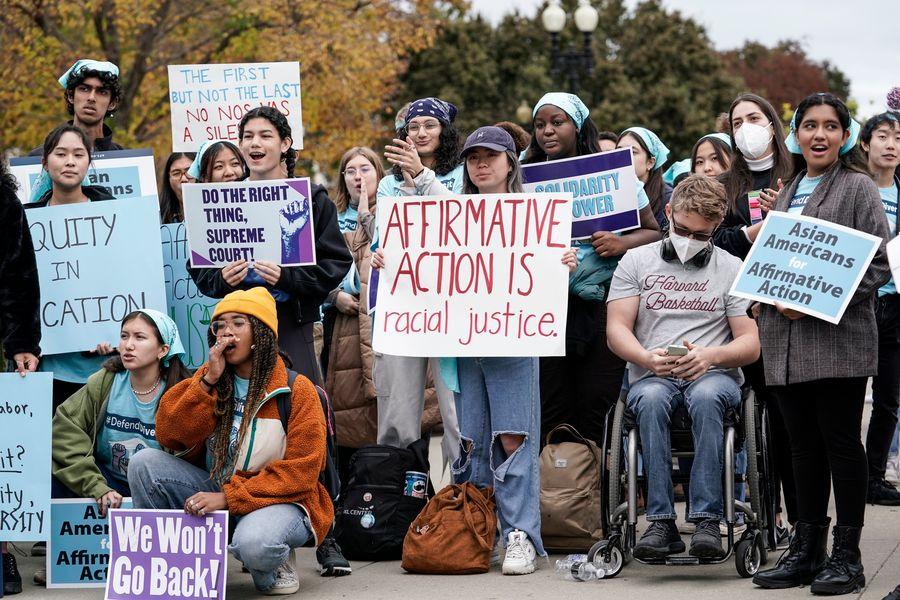
Supreme Court Affirmative Action
The Zombie Survival of Affirmative Action
COMMENTARY
Published Nov. 29, 2022 • Read time: 7m
The U.S. Supreme Court is expected to rule against affirmative action programs this term, finding they violate the Constitution because they deliberately discriminate by race. If you think that ruling will stop universities from treating racial groups differently, think again. Admissions officers are already hard at work figuring out ways to evade the forthcoming decision. They are supported by countless “diversity, equity, and inclusion” bureaucrats, nestled across campus. They are on a mission.
How will they skirt the high court’s ruling? By eliminating statistical evidence that they are actually discriminating, even as they continue to do so. They would be caught red-handed if they left data showing they admitted students from favored groups with markedly lower qualifications.
The proof lies in data from standardized tests. For undergraduates, those tests are SATs and ACTs; for law schools, LSATs; for medical schools, MCATs; and so on. Until now, they have been the accepted standard measuring scholastic aptitude and future academic performance.
Unfortunately, test scores for admitted students from different racial groups display stark differences, not the modest ones permitted by the Supreme Court several decades ago. Nor have they gradually faded away, as Justice Sandra Day O’Connor famously hoped.
The differences have remained large and persistent. How large? Economist Peter Arcidiacono gave the answer for hypothetical applicants to Harvard with good grades and high SAT scores. If that hypothetical applicant were an Asian American male, he had a 25% chance of admission. If he were white, his chances rose to 36%. If he were black, however, he was almost certain to be admitted (95%). Other studies have shown similar differences in admission rates to colleges, graduate schools, and professional programs.
Black and White, Left and Right
Liberals Exploit Race & Gender
Selma Snub vs. Eastwood Eclipse -- Who's the Victim of Discrimination?
The "NAACP Bombing" ... or The Barbershop Bang?
Differences like these are central to the cases now before the Supreme Court. They show how Harvard and the University of North Carolina regularly admit minority undergraduates with scores that would lead to rejection for most Asian Americans and whites. That’s racial discrimination, and it’s illegal, or so the court is likely to find.
If the court rules against affirmative action, universities will then face a choice. They can:
- Try to evade the court decision by dropping the tests, admitting minority students with lower qualifications than other students, and hoping no one can prove their actions are illegal; or
- Admit students without regard to race; keep the standardized tests because they are useful predictors of academic performance; and use them, along with high school grades, as primary criteria for admission.
For most schools, the choice isn’t hard. They will jettison the test requirement, unless they are stopped by their Boards of Trustees or state legislatures (in the case of public universities). This is not guesswork. Universities are already dropping the tests en masse, anticipating the court’s decision.
It is crucial to note that universities are not abandoning standardized tests because they are poor measures of future academic performance or because they are biased, racially or culturally. They were scrubbed of bias long ago and do a good job of predicting academic achievement. They are dropped solely to increase the enrollment of African Americans and, to a lesser extent, Hispanics, whose grades and test scores fall below a given university’s admission standards for other students. Although this is done ostensibly to help Latino and black students, there is some evidence that it does the opposite. Research suggests that students of any color or ethnicity tend do better academically – and graduate at much higher rates – if they attend universities that broadly match their qualifications. Students struggle if they are admitted with test scores and GPAs significantly below those of their classmates.
Standardized tests have one other advantage, irrelevant to Eastern elites but important to the rest of the country. They offer a golden opportunity for smart kids from remote locations and lesser-known schools to prove they can succeed at rigorous universities. That’s not a problem for good students at Phillips Andover Academy or Bronx Science. Admissions officers at Yale, Stanford, and Duke already know the meaning of high grades at those schools. But they don’t know anything about students – including the truly outstanding ones – from places like Dry Prong, Louisiana, or Humptulips, Washington. The best way for those students to prove they can succeed at a top-flight university is to submit top-flight SAT scores. Giving those students a shot at admission is one reason the national tests were developed.
The tests have worked as intended for a long time, opening the world of higher education for talented students across the country. A perfect score of 800 on the math test will impress Cal Tech or MIT, whether it comes from Scarsdale, New York, or Sweet Lips, Tennessee. Without the test, how would those universities know what to make of a straight-A student from rural Tennessee?
Dropping the tests poses another problem for even the most progressive universities, beyond making it harder for them to identify the best students. Test scores are used by independent rating agencies, such as U.S. News and World Report, for ranking schools. Top schools have the highest median test scores. If those schools refused to share their scores or submitted them only for a few students, they would either forfeit their top spots in the rankings, or make such ratings little more than guesswork. Since they want to drop the tests without suffering a blow to their reputations, they are developing a cunning work-around. Let’s all do it together! If all the top schools drop out together, each one would face a lower reputational cost.
That’s exactly what the nation’s leading law schools are doing right now, in anticipation of the SCOTUS decision. Almost all of them have decided, “independently” they say, to drop their LSAT test requirements for admission. The American Bar Association, never slow to signal its virtue, is encouraging them to do so. Whether these schools acted independently or coordinated illegally (in violation of anti-trust laws) is an interesting question. But you can be sure Joe Biden’s Department of Justice won’t bother looking into it. This administration wants to encourage, not impede, the society-wide push for “diversity, equity, and inclusion,” as defined by its ideological compatriots.
That’s the political vision law schools are pushing. They are dropping the test requirement to hide any statistical evidence of their systematic racial discrimination. Other professional schools and undergraduate colleges are moving down the same path for the same reason. They want to keep affirmative action alive as Zombie creatures, safe from the Supreme Court.
Expect these evasive tactics to be hotly debated after SCOTUS hands down its decision. Progressives will call them clever ways to pursue worthy goals. Conservatives will say they not only dodge the court’s ruling, they violate America’s deeply held value of equal treatment and its embodiment in our Constitution.
Nor will the attempted evasions go unchallenged. Individual students, denied admission despite strong qualifications, could still bring suit. But they will find it harder to prove their cases without evidence from standardized tests. Boards of Trustees could also mandate the tests as essential elements in admissions, as they have been for decades. So could state legislatures, which oversee public universities. States with conservative governors and legislatures could take that simple step, requiring standardized tests as part of admissions, to ensure non-discrimination or prove university bureaucrats are flouting the law.
A judicial ruling won’t end this debate. These issues are among our country’s most profound and vexing, legally and historically. Blacks were denied equal education for centuries. Slaves were prohibited from learning to read. After Emancipation, blacks were relegated to poorly funded Jim Crow schools. Their chance to truly compete for higher education didn’t begin to open up until the 1950s, and then only gradually. In 1954, the Supreme Court ruled segregated schools were illegal, but implementation took over a decade. In the mid-1960s, comprehensive Civil Rights laws prohibited all racial discrimination. More than half a century after those decisions and their broad social acceptance, the question is how to reconcile America’s ideal of equal treatment with the burdens of America’s racial history. Their uncomfortable juxtaposition – and the fierce debates about them – won’t go away just because the Supreme Court rules that college applicants must be treated equally, regardless of race, creed, or color.

The GOP Majority Should Go Out in Glory
Daniel McCarthy • RealClearPolitics
Republican Majorities Could Return Sooner Than Expected
J.T. Young • RealClearPolitics
The Danger Before the Attack
Leslie J. Sullivan • RealClearPolitics
Jon Finer’s Old and Dangerous ‘New Approach’ to Israel
Peter Berkowitz • RealClearPolitics
The President Deserves Better
John Ullyot • RealClearPolitics
Congress Doesn’t Need Another Blame Game. It Needs To Find What’s Broken
Jarrod Bernstein • RealClearPolitics
RCP Today
Top stories on RealClearPolitics
The Takeaway
Polling intelligence and analysis delivered to your inbox
World News
Featuring the latest world news
Policy
Featuring the latest policy news
Support Our Mission
As part of RealClearPolitics, authors aim to provide balanced, non-partisan analysis by presenting top reporting and commentary from all sides of the political spectrum.
Trusted by policymakers and citizens alike since 2000