Civil Rights Act 5 Things
The Disparate Impact Scam
COMMENTARY
Published Sept. 9, 2025 • Read time: 4m
Join the Conversation
0Though it received less attention than some of President Donald Trump’s other executive orders, the principles embodied in EO 14281, “Restoring Equality of Opportunity and Meritocracy,” are fundamental to American ideals.
The April 23 directive prohibits the federal government, to the “maximum extent possible,” from using disparate impact analyses to establish discrimination. It also directs the attorney general to take lawful actions to preempt inconsistent state and local laws.
Disparate impact is the precursor to the “equity” in DEI (diversity, equity and inclusion). Both require members of protected classes to receive at least the same share of opportunities as their percentages of the relevant population or applicant pool. Liability and remedies are imposed if there is a shortfall, regardless of whether that is caused by discrimination, choices made by protected individuals, or almost any other reason. Protected classes include race, sex, sexual orientation, religion, and age.
The order bluntly – and accurately – characterizes the use of disparate impact as a “pernicious movement” that threatens the foundation of the American Dream.
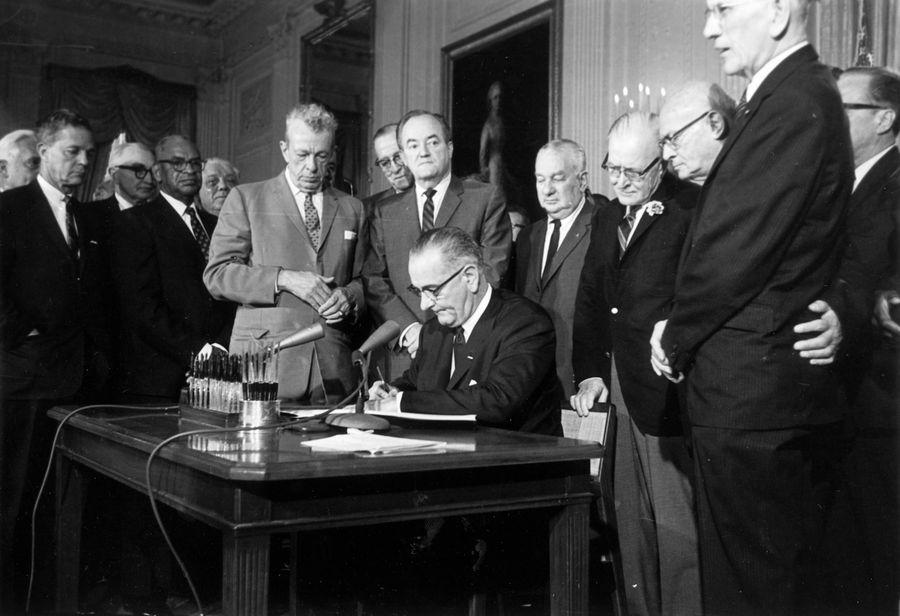
Disparate impact got its start in Griggs v. Duke Power (1971), when the Supreme Court held that Title VII of the Civil Rights Act of 1964 proscribes outcomes in which a practice or policy adversely impacts a protected class, even if that was not the intention.
There was no such requirement in Title VII, or any other civil rights act. The high court overlaid it, presumably based on its own public policy goals and out of deference to the Equal Employment Opportunity Commission. Such deference is no longer permitted, however, following the Supreme Court’s decision last year in Loper Bright v. Raimondo. The purpose of Title VII was to prevent intentional discrimination against specific individuals, not accidental or unintended imbalances among groups. Unlike the court’s dehumanizing balkanization of our society into groups based on their immutable characteristics, Congress sought to protect the innate right of every individual American to have an equal opportunity.
Black and White, Left and Right
Liberals Exploit Race & Gender
Selma Snub vs. Eastwood Eclipse -- Who's the Victim of Discrimination?
The "NAACP Bombing" ... or The Barbershop Bang?
Congress effectively codified the use of disparate impact in the Civil Rights Act of 1991. That likely was an unconstitutional violation of the Fifth and 14th Amendments then, and most certainly today, as people of all backgrounds live, work, and play together, and pursue and achieve high political office, fame, and financial success, whether in precise mathematical balance or not. When individuals are held back by improper means, they have – and should have – recourse.
Statistical imbalance may be a signal to investigate. But it should never be presumptive of discrimination. Our Constitution and, at least until 1991, our civil rights laws were not intended to advance the interests of groups. They were intended to protect individuals from improper hindrances by reason of race, ethnicity, or similar immutable characteristics.
There is no reasonable value advanced when a highly educated, wealthy, well-connected scion of a leading black family is given preference over an impoverished white child from Appalachia merely to achieve a numerical quota. It is contrary to American principles, deprives the workforce of the best qualified candidates, and disincentivizes effort.
In 2009, the Supreme Court held that employers could intentionally discriminate if the employer has a “strong basis” to believe it will be subject to disparate impact liability if it fails to do so. While a company should be permitted to avoid liability for statistical accidents, this solution doubles down on discrimination. It underscores the vicious cycle created by ignoring the court’s 2007 admonition that “[t]he way to stop discrimination on the basis of race is to stop discriminating on the basis of race.”
Recognizing this leap into the abyss, Trump’s April executive order observed that disparate impact “requires individuals and businesses to consider race and engage in racial balancing to avoid potentially crippling legal liability” and concludes that disparate impact liability is unconstitutional racial discrimination.
Equality of opportunity, not equal outcomes, is a bedrock American principle. Until the rise of disparate impact and its malign incorporation into DEI, that was America’s promise. For Americans who believe that people must be treated as individuals, not drones, that has never changed.
By contrast, disparate impact, affirmative action, and DEI are racist tools that reduce individuals to their pigmentation, genitals, and similar irrelevant characteristics.
Progressives see people through a lens of race, ethnicity, and sex. They believe opportunities and rewards should be allocated to achieve mathematical outcomes. For those who believe in equal opportunities that are awarded to individuals based on diligence, skills, intelligence, experience, and achievement, Trump’s action is welcome progress. To go the distance, however, requires an unambiguous act of Congress or a Supreme Court decision that ends the use of affirmative action, DEI, and disparate impact.

Newsom Defies Voters, Juries and Lawmakers To Spare Murderers While Defending Abortion
Curtis Hill • RealClearPolitics
The Algorithmic Tilt
Frank Filingeri • RealClearPolitics
A RealClear Thanksgiving: Investing in a Better Future
David DesRosiers • RealClearPolitics
Trump’s Newsom Problem: Antagonist-in-Chief
Carolina Lumetta • RealClearPolitics
America’s Free Spirit
John Maxwell Hamilton • RealClearPolitics
The GOP Majority Should Go Out in Glory
Daniel McCarthy • RealClearPolitics
RCP Today
Top stories on RealClearPolitics
The Takeaway
Polling intelligence and analysis delivered to your inbox
World News
Featuring the latest world news
Policy
Featuring the latest policy news
Support Our Mission
As part of RealClearPolitics, authors aim to provide balanced, non-partisan analysis by presenting top reporting and commentary from all sides of the political spectrum.
Trusted by policymakers and citizens alike since 2000