
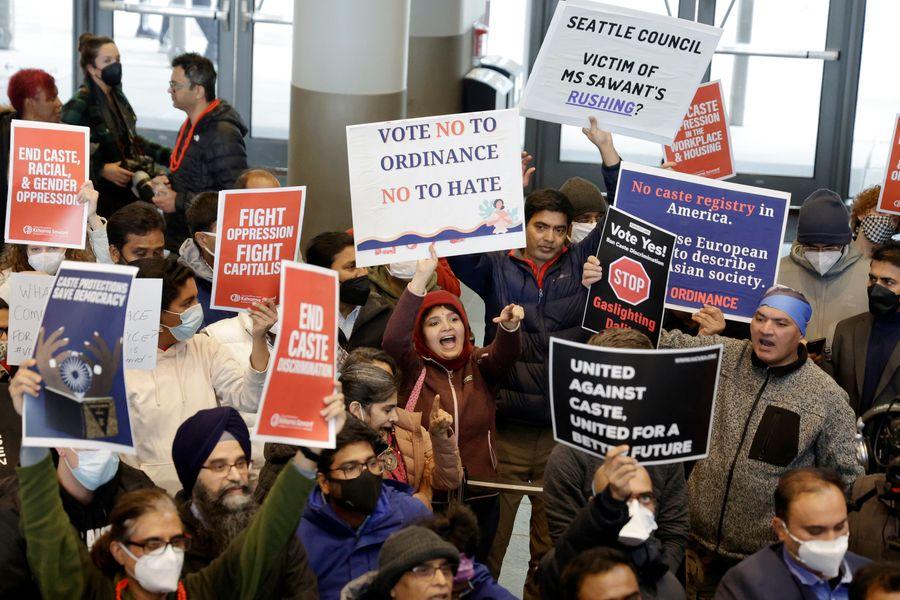
California Caste Bias Bill
Protect, Don't Persecute Indian Americans: Slander Isn't the Solution
COMMENTARY
Published Sept. 26, 2023 • Read time: 4m
Discrimination is wrong, and it’s all too real in modern America. But we cannot eradicate bigotry by racially profiling a minority community – which is exactly what California’s so-called caste anti-discrimination bill would do.
That’s why Governor Gavin Newsom should reject Senate Bill 403. It’s bad policy and a worse precedent.
The legislation aims to outlaw discrimination based on “caste,” which has become identified as an ancient Hindu social stratification system in not only the modern-day lexicon but also textbooks taught in the California public school system and its state agencies. With “caste” linked only to the customs of the Indian subcontinent, this category of discrimination, by its very nature, can only be perpetrated in practice by Indian Americans against fellow Indian Americans.
But the premise of the new “anti-caste” effort is built on anti-Indian and anti-Hindu bigotry. The implication that Americans with Hindu origins are more susceptible to “old country” biases is nothing more than a longstanding xenophobic trope that has been used against immigrants for centuries. How can German Americans engage in “caste” discrimination?
They cannot – in practice, only Indian and South Asian Americans can. And to single them out as unique purveyors of hate is a rejection of our (and their) nation’s democratic, egalitarian, and meritocratic ideals.
Profiling any American based on their origins is insulting. Worse, the underlying “proof” of such discrimination lacks any factual basis and is based on a faulty case set in Silicon Valley, where I live and work as a venture capitalist, angel investor, and philanthropist.
Black and White, Left and Right
Liberals Exploit Race & Gender
Selma Snub vs. Eastwood Eclipse -- Who's the Victim of Discrimination?
The "NAACP Bombing" ... or The Barbershop Bang?
In 2020, the California Civil Rights Department filed a complaint alleging two senior engineers at a Cisco startup discriminated against a fellow employee (“John Doe”) based on his lower caste status as the “lone Dalit” or “untouchable” on the “all-Indian” team.
A media firestorm ensued, lambasting the engineers and embracing the narrative that such hitherto unheard-of discrimination was rampant in America.
Except the whole story is not true.
The state’s anti-discrimination agency stated that the startup’s CEO and the complainant’s manager used caste or “strict Hindu social and religious hierarchy” to justify discriminating against the employee. The problem? This manager is known to be an atheist and has publicly rejected the caste system.
And the engineering team was not “all Indian,” nor was the complainant the only Dalit. The other Dalit was, in fact, named to a top leadership post before any internal complaints arose. And the victim, who claimed he was denied a raise, actually earned millions of dollars, according to court records.
The state sued the two engineers for harassing John Doe based on his caste but didn’t provide a single example from over seven years that was remotely close to harassment.
Yet, some activists and their allies at a powerful government agency are weaponizing a hoax to further their political agenda. Universities and local governments still cite the flawed Cisco case to add this “protection” to their anti-bias policies with no proven evidence of caste discrimination.
Earlier this year, after being served with a motion to sanction its lawyers, the Civil Rights Department withdrew its case against the engineers – but continued its litigation against well-resourced Cisco.
The CEO of a large tech company just sent Newsom a letter on behalf of other Fortune 500 CEOs, expressing distress with this new profiling of Indian Americans. I know of 20 startup founders and executives who have expressed serious reservations about the vagueness of “caste” in the bill.
There are already safeguards in existing statutes and case law in place as well. So why the push for a solution to a non-problem that will unconstitutionally put a target on the backs of Indian Americans? In fact, in 2018, the U.K. government completed a community consultation on caste and concluded that they should not implement anti-caste legislation because citizens would be better protected from discrimination through “the flexibility that case-law provides” judges to interpret the “complexity of caste.”
California’s law and other initiatives can (and will) be used as a sword against the rising influence and success of Indian Americans – and the Cisco case is a harbinger of things to come.
Indian Americans, like generations of immigrants, came to America to make a new life – divorced from the prejudices and privations of the past. And they have proved themselves amazingly capable and eager to overcome the myriad hardships faced by immigrants.
So, it is especially bitter that Indian Americans now face accusations of bigotry against fellow Indian Americans. Ordinary Indian Americans are collateral damage in this slander campaign. It must stop.
Governor Newsom should do the right thing and listen to his constituents – before the lie spreads.

The GOP Majority Should Go Out in Glory
Daniel McCarthy • RealClearPolitics
Republican Majorities Could Return Sooner Than Expected
J.T. Young • RealClearPolitics
The Danger Before the Attack
Leslie J. Sullivan • RealClearPolitics
Jon Finer’s Old and Dangerous ‘New Approach’ to Israel
Peter Berkowitz • RealClearPolitics
The President Deserves Better
John Ullyot • RealClearPolitics
Congress Doesn’t Need Another Blame Game. It Needs To Find What’s Broken
Jarrod Bernstein • RealClearPolitics
RCP Today
Top stories on RealClearPolitics
The Takeaway
Polling intelligence and analysis delivered to your inbox
World News
Featuring the latest world news
Policy
Featuring the latest policy news
Support Our Mission
As part of RealClearPolitics, authors aim to provide balanced, non-partisan analysis by presenting top reporting and commentary from all sides of the political spectrum.
Trusted by policymakers and citizens alike since 2000