
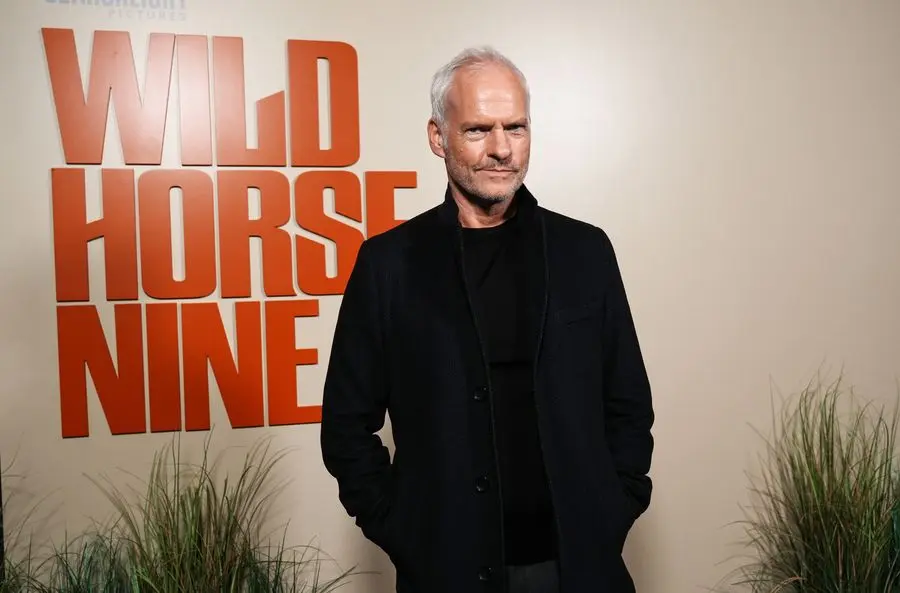
LA Premiere of "Wild Horse Nine"
Heaven on Assassin's Mind in Wildly Catholic 'Wild Horse Nine'
COMMENTARY
Published Nov. 15, 2026 • Read time: 6m
The prolific CIA assassin played by John Malkovich in Martin McDonagh’s irreverent and very Catholic new movie, “Wild Horse Nine,” would have had a much better final answer for Ross Douthat in that “60 Minutes” interview than the president did.
Donald Trump gave Douthat the answer you’d pretty much expect from him to the question of what he thinks will happen to him when he dies: Wait, he’s going to die? He doesn’t think about it, to the point that Douthat, an excellent interviewer who fact-checked Trump in real time, had to ask several times just to make himself understood.
Nothing about “Wild Horse Nine” is expected. It’s set in 1973 in Salvador Allende’s Chile, where, in the employ of the U.S. government, Malkovich’s Chris and Sam Rockwell’s Lee have just set up the coup that will soon overthrow Latin America’s first democratically elected Marxist. Now they’re going to Rapa Nui, where most of the movie takes place, to see the “big heads” and kick around the big questions.
Though Chris has not given up shooting people he thinks have it coming – “Still got it,” he congratulates himself in the film’s bloodiest scene – he also thinks constantly about mortality, and more than that, salvation.
Is he going to heaven, all things considered? Who and what else might be there? At this date – yes, it’s late, and he’s just helped plan the torture and murder of dissidents – what acts, big and small, might get him in the door?
Just in case, he’s been “escorting” the moths he finds in his room in Santiago to his window, and hates putting them out in the rain.
I’m not going to say that only Malkovich could sell an assassin trying to convince himself that moths might plead his case to St. Peter, but he does.
Aren’t we all capable of that level of self-deception? That, I think, is what McDonagh is really asking us to think about. That and whether there might be some vegetarian dinosaurs in heaven, along with the odd Nazi who wasn’t all bad.
Chris, we soon learn, has cancer, and one person he would never kill, he has told his best friend Lee, is himself, because he’s Catholic. This was a decade before the church started allowing church funerals for those who take their own lives, and 20 years before the catechism formally acknowledged “grave psychological disturbances” as a factor in salvation. Not that this has anything to do with Chris.
Because all along, his decisions have been those of a loyal CIA workhorse. On Rapa Nui, Chris finds himself calmed by one of the wild horses he wishes he had known sooner, and had been more like.
As always, Rockwell leavens almost every scene, and for all of its heavy themes, this is a funny movie, as per Chris and Lee’s discussion about how only the “gay countries” have good cheese.
In an interview with the New York Times before “Wild Horse Nine” came out, McDonagh said, “So Malkovich’s character has a little disquisition about how what he calls the ‘gay countries’ make the best cheeses. Yeah, Holland, France, the U.K. and Switzerland make great cheeses, and they are some of the ‘gay countries.’ Russia is definitely not a gay country. … And Russia doesn’t have good cheese, and there’s a connection between the two, which is then connected to democracy, and democracy leads to gay, leads to good cheeses. Something I’ve thought about often and I think is true.”
Wait, Lee asks Chris, so all Western democracies are gay? Well, we’re not, he says, thus our terrible American cheese. So does Chile have any good cheese? Oh, it was going to, Chris tells him, but we took care of that.
Meanwhile, of course, Lee has his own moral trade-offs on his mind, all about when killing is and is not “for the greater good.”
A few of those I’ve told to see this movie have said ugh, no, on political grounds – and I heard that from both directions: From the left: A comedy about one of Kissinger’s greatest war crimes, really? And from the right: Another takedown of the CIA? Can’t wait.
It’s neither of those things. These two killers are, if anything, too lovable. Yes, they have specific regrets. Take Chris’s supposed involvement in the Kennedy assassination. (Malkovich has said he puts the same faith in the Warren Commission as in Keebler elves.) This cost him his only other relationship, with his brother, played in a memorable cameo by Tom Waits.
Chris also remembers a conversation with Patrice Lumumba, the first democratically elected prime minister of Congo, before he was assassinated in 1961. “Don’t you understand?” he says Lumumba told him, “if you kill me, you’ll be killing democracy in Africa for the next fifty years?”
He remembers answering, “What do you think we’re trying to do?” Which he’s sorry about now, he says, if only because those could have been the last words Lumumba ever heard.
(President Eisenhower really did authorize a CIA hit on him, and though that never happened, the CIA did hand him over to the Congolese separatists and Belgians who killed him. I was three at the time of his execution, but I remember my parents’ pride, probably in the years that followed, when I repeated what I had heard from them, which was that Lumumba was a communist. Nice talk, kid.)
So no, this movie is not politics-free, if there even is such a thing. One scene depicts Víctor Jara, the popular Chilean folk singer who was tortured and murdered in 1973. But it’s mostly about the questions we all have to try to answer: What have we done, what are we willing to do, and what comes next?
Will Lee grant his friend’s request, when we’re told he only has hours to live, of helping him die in the way he wishes? And if he did, would that be a sin or an act of love? You don’t have to have served your country as a killer, or travel to a dazzling and remote island to be asked to make that call.
It’s still a movie, so some of the givens are questionable. As the Tom Waits character says when Chris calls him to say goodbye – paraphrasing here – you must have some great doctors to know you only have hours to live. But it’s the questions that make this visually beautiful and morally challenging movie worth seeing.
Support Our Mission
The Internet provides an endless stream of content. Not all of it is worth your time. That's why, every day, RealClearPolitics curates the most essential news and information—from all sides and across mediums. The links, videos, and podcasts curated here are the product of human judgment, not algorithms or AI. Please help power our mission of presenting a thoughtful, balanced public discourse through a tax-deductible donation.
Would you consider supporting us today?
Contributing to RealClear Politics through the RealClear Media Foundation supports essential initiatives that drive meaningful change.

RCP Today
Top stories on RealClearPolitics
The Takeaway
Polling intelligence and analysis delivered to your inbox
World News
Featuring the latest world news
Policy
Featuring the latest policy news
Support Our Mission
As part of RealClearPolitics, authors aim to provide balanced, non-partisan analysis by presenting top reporting and commentary from all sides of the political spectrum.
Trusted by policymakers and citizens alike since 2000