
Clinton's Emails: A Sampler of Notable Exchanges
Published July 1, 2015 • Read time: 5m
The State Department on Tuesday night released 3,000 pages of Hillary Clinton’s emails as part of the “rolling” disclosures ordered every 30 days by a federal judge in a Freedom of Information Act lawsuit. The correspondence, the first batch of many to come of the former secretary of state’s 55,000 pages of emails, revealed that senior Obama administration officials were aware that Clinton was using a personal email account to conduct official business during her tenure as the nation’s top diplomat.
Below is a roundup of other notable exchanges between Clinton and her close advisers.
--
At 10:35 p.m. on Oct. 8, 2009, Clinton emailed former close adviser Sidney Blumenthal, asking if he is still awake. “I will call if you are,” she wrote. The email chain did not contain a response from Blumenthal.
Blumenthal has been the subject of a congressional inquiry into his sending Clinton unverified intelligence reports about Libya during and after that country’s civil war. Clinton said the messages were “unsolicited,” but the new emails may cause some to question that claim.
--
At one point, Clinton expressed concern to senior adviser Philippe Reines about her relationship with President Obama, worrying that she did not meet with the commander-in-chief as often as Henry Kissinger and Richard Nixon saw each other.
“In thinking about the Kissinger interview, the only issue I think that might be raised is that I see POTUS at least once a week while K saw Nixon every day,” Clinton wrote to Reines. “Of course, if I were dealing w that POTUS I’d probably camp in his office to prevent him from doing something problematic. Do you see this as a problem?”
The document contained no response from Reines.
--
Clinton sent an early-morning email to aides on June 8, 2009, inquiring about a Cabinet meeting to be held at the White House later that day. But Clinton did not hear about the meeting from her advisers or even from the White House.
“I heard on the radio that there is a Cabinet mtg this am,” Clinton wrote to close aides Huma Abedin and Lona Valmoro. “Is there? Can I go? If not, who are we sending?”
Valmoro responded saying the meeting wasn’t intended to include the full Cabinet, only the heads of those departments and agencies that were affected by the stimulus money allocated in the American Recovery and Reinvestment Act, which President Obama signed in February of that year.
--
In a similar exchange, it appears there was a mix-up about a White House meeting. “I arrived for the 10:15 mtg and was told there was no mtg,” Clinton wrote. “… This is the second time this has happened. What’s up???”
--
The emails also revealed that Clinton received a phone call from Condoleezza Rice, who served as secretary of state during the George W. Bush administration, about a contentious topic involving Israel.
“Condi Rice called to tell me I was on strong ground saying what I did about there being no agreement btw the Bush Admin and Israel,” Clinton wrote to senior adviser Jake Sullivan, promising details the next day.
She was referring to an incident early in Obama’s presidency when Israeli officials blasted the administration for ignoring an unwritten accord between the Bush administration and the Israeli government regarding settlement housing in the West Bank.
--
Republicans pounced on an email conversation between Clinton loyalist and CNN political commentator Paul Begala and Capricia Marshall, the former chief of protocol, that appears to involve a fundraising idea that Begala suggested in order to help pay off Clinton’s 2008 campaign debt.
“We raised 500K from the email contest!!” an enthusiastic Marshall wrote to Begala with the subject line, “Thank you so very much!!!!”
“You all are amazing – the world adores you! You put a serious hole in hrc debt! A million thanks!” Marshall continued.
In the next email, Begala asked Marshall for a list of Clinton’s accomplishments from her first 100 days in office, ahead of a CNN special in which Begala was slated to participate.
“I gave Sec. Clinton an A+ in our dopey CNN report card last night,” Begala replied almost a week later. “So did Donna Brazile. The only two A+’s all night.”
--
In a message to Strobe Talbott, president of the Brookings Institution, Clinton thanked him for an opinion piece he co-authored in which he pushed for health care reform, knocking the “death panels” talking point used by many Republican opponents.
“I hope the absurd ‘death panels’ argument can be put to rest so people can have the peace of mind that planning provides,” Clinton replied.
--
A December 2009 email exchange with Abedin revealed a struggle Clinton had with a fax machine. She emailed back and forth with her aide, asking incredulously if the fax machine “was supposed to be off the hook to work.”
--
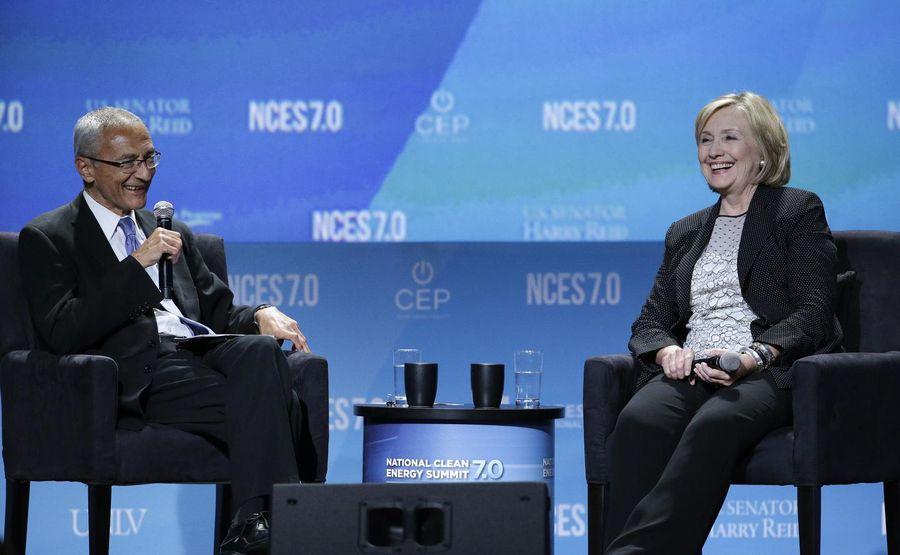
In an exchange with John Podesta (pictured), who now chairs Clinton’s presidential campaign, she told him: “Please wear socks to bed to keep your feet warm.”
The context of the remark is not clear because much of the conversation is redacted, but some have speculated that she might have been referencing someone getting “cold feet.”
--
A June 2009 email reveals that Podesta might not have had Clinton’s correct email address to begin with: “Tried you a couple days ago, but email bounced back.”
--
Heavily redacted correspondence between Clinton and Roy Spence, co-founder of advertising firm GSD&M, delves into Clinton’s political – but non-presidential – aspirations.
“u run for gov of New York and I run for gov of texas—what say you?” Spence wrote in the subject line with no text in the body of the message.
Clinton’s entire response is redacted, as well as Spence’s follow-up. She forwarded the conversation to an aide, asking for it to be printed.


RCP Today
Top stories on RealClearPolitics
The Takeaway
Polling intelligence and analysis delivered to your inbox
World News
Featuring the latest world news
Policy
Featuring the latest policy news
Support Our Mission
As part of RealClearPolitics, authors aim to provide balanced, non-partisan analysis by presenting top reporting and commentary from all sides of the political spectrum.
Trusted by policymakers and citizens alike since 2000