
Why the Senate Must Do the House's Job
Commentary
Published March 31, 2017 • Read time: 5m
An eminent legal scholar, who has studied the workings of the joint congressional committee that investigated the Iran-contra scandal, recently volunteered advice for organizing a special committee to investigate Russian interference in our election.
“First,” he cautioned, “keep the House out of it.”
Members and staff of the House of Representatives will attribute my approval of his recommendation to the endemic snobbery of the Senate, where I worked for two decades. That’s not an entirely unfair analysis of the difference in attitudes between House members and senators, though it is far from the only explanation for the disdain members of each body can hold for the other.
The rules of the House give the majority nearly total control of the place. In the Senate, rules give the minority enough power to slow, and in some matters prevent, the majority from having its way.
Senate delays in considering and making changes to legislation the House passed unilaterally, necessary to avoid obstruction by the minority, naturally frustrate the House majority.
Likewise, most House members run in safe districts and can completely ignore the local opposition’s concerns. They enjoy re-election security afforded comparatively few senators, most of whom answer to a more diverse electorate.
Senators have more practice engaging opposing points of view, and working out compromises that allow the place to function, as dawdling and unsatisfactory as their operation might appear to fellow partisans in the House. It also gives the Senate the appearance of less partisanship and greater seriousness of purpose in deliberating on weighty matters of state.
There have been pockets of resistance in the House to the intensifying tribalism ruling our politics, chiefly in committees focused on national security: the House Armed Services Committee and the House Permanent Select Committee on Intelligence. Now, the latter appears to have hurt its reputation for depoliticized oversight of the intelligence community. As happened to other things that have come in contact with Donald Trump -- the principles of the Republican Party, for example -- the panel’s integrity did not survive the encounter intact.
To be fair, it was the integrity of its chairman, Rep. Devin Nunes, that didn’t, but his disgrace has had the effect of incapacitating his committee.
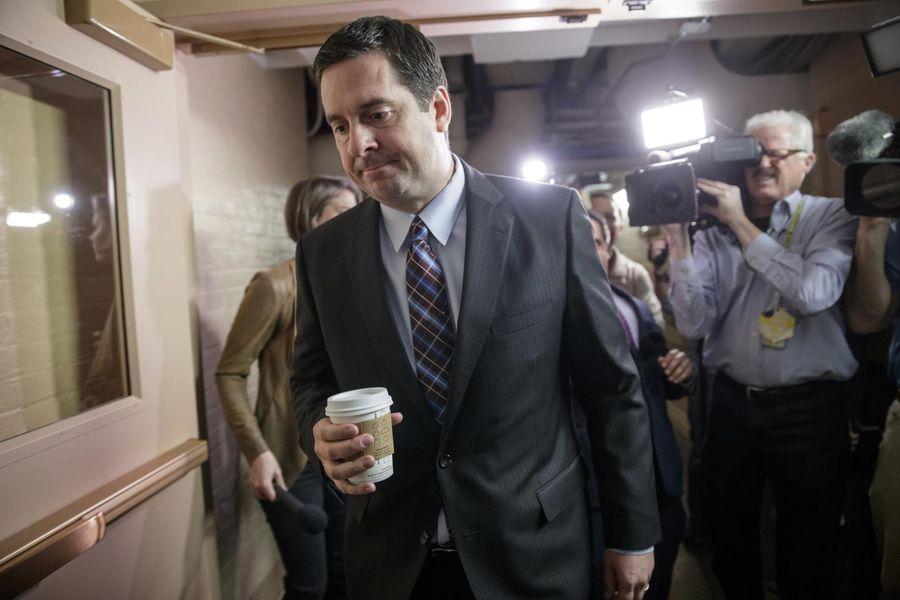
Apparently, Nunes works for Donald Trump rather than the people of California’s 22nd Congressional District. In the committee’s first public hearing, Nunes devoted his attention to excoriating unlawful leaks of classified intelligence that embarrassed the Trump administration rather than to the ostensible and extremely important subject of the hearing.
While intelligence leaks shouldn’t be taken lightly, let me offer a word of advice to Republicans in Congress concerned with their places in history. Take note that Deep Throat, the senior FBI official who leaked confidential information to Woodward and Bernstein during Watergate, isn’t remembered as the villain of the scandal.
FBI Director James Comey acknowledged during Nunes’ panel’s hearing that the FBI is investigating possible collusion between the Trump campaign and Russian operatives, a fact everyone in Washington already knew, but it was nevertheless greeted as a bombshell announcement. The chairman criticized the disclosure for placing a cloud of suspicion over the White House.
Later that week, Nunes embarked on his madcap adventure. He secretly visited the White House. Then he held a press conference to hint at information he’d been provided by someone he wouldn’t disclose but who obviously worked in the administration. Then he returned to the White House to brief the president on the information the White House had provided him. Then he held another press conference, never once pausing to brief even the Republican members of his committee on what, if anything, he had actually learned.
Nunes has had a hell of a time trying to keep his story straight. But it seems the episode was a clumsy attempt at salvaging the damaged reputation of our compulsive tweeter-in-chief by insinuating that the intelligence community’s collection and dissemination of information that might have incidentally involved some people in the Trump campaign, possibly Trump himself, was, if not illegal, then it at least supported, sort of, Trump’s complaint his wires had been “tapped” by the previous administration.
Of course, it supported nothing of the kind or, I guarantee, White House staff (who aren’t shy about leaking when it suits them) would have given the corroborating information to the media by now.
To make sure the story line wasn’t overtaken by new disclosures, Nunes cancelled the committee’s other scheduled hearings, including the one with former Acting Attorney General Sally Yates, whom, for whatever reason, the White House would prefer we not hear from. When questioned by a reporter, Nunes complained he hadn’t cancelled anything. And yet, Ms. Yates did not testify at the hearing that was not held.
Nunes squandered not only his reputation, but, at least temporarily, the public’s faith that his committee can keep the national interest above the partisan fray. Damaged, too, is the House of Representatives’ pride in its prerogatives and its constitutional responsibility to serve as a check on the power of the executive.
So, yes, if Congress is to make any serious attempt at getting to the bottom of the Kremlin’s production of “Celebrity Apprentice,” the House will have to be kept out of it.
No doubt it’s galling for honorable members of the chamber to defer to the snobs in the other body on a matter of such importance. But Mr. Nunes and his White House handlers have imposed that indignity on them. Complain to them.



RCP Today
Top stories on RealClearPolitics
The Takeaway
Polling intelligence and analysis delivered to your inbox
World News
Featuring the latest world news
Policy
Featuring the latest policy news
Support Our Mission
As part of RealClearPolitics, authors aim to provide balanced, non-partisan analysis by presenting top reporting and commentary from all sides of the political spectrum.
Trusted by policymakers and citizens alike since 2000