
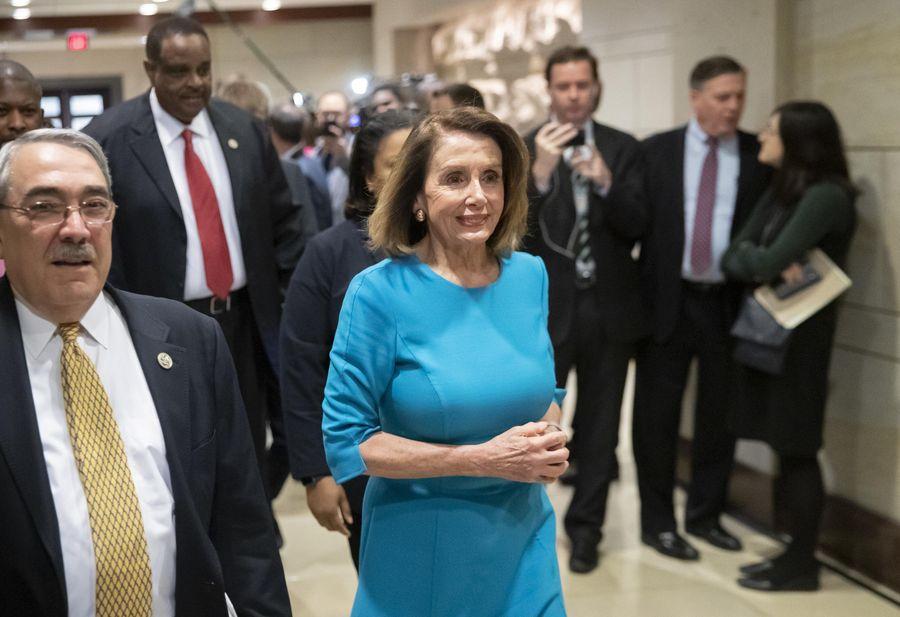
House Democratic Leader Nancy Pelosi of California, joined at left by Rep. G. K. Butterfield, D-N.C., heads into the Democratic Caucus leadership elections unopposed following an effort by a contingent working against her becoming the speaker of the House when her party takes the majority in the new Congress in January, at the Capitol in Washington, Wednesday, Nov. 28, 2018. (AP Photo/J. Scott Applewhite)
Pelosi's New Rules: A Much-Needed Step
COMMENTARY
Published Nov. 30, 2018 • Read time: 4m
Over the last few weeks, a group of congressmen worked with the likely next speaker of the House, Nancy Pelosi, to establish some new ways for Congress to conduct its business. You would have guessed, based on some of the reporting of their efforts, that this was some kind of personal attack on her or a sell-out of the Democratic agenda.
Truth is, it was about helping making Congress more responsive to the voters. Here’s what was at stake: All too often, members of Congress write legislation, recruit hundreds of co-sponsors from both sides of the aisle, and introduce the bill on the floor of the House. And then, for reasons that are not clear to the public, the bill is shelved. It never gets a vote.
This happens because the rules of the House traditionally give the speaker – whoever he or she is, no matter the party – the sole power to decide which bills are brought up for an actual floor vote. That’s right – one person, from one congressional district, decides what the rest of the people’s representatives are allowed to vote on.
The pattern has been repeated in House committees, where chairs get to decide which bills come up for discussion and debate. Again, it doesn’t matter if a bill enjoys broad support from both sides of the aisle. If the committee chair doesn’t want it to proceed, it won’t.
This kind of centralized power was antithetical to democracy. It gave outsized power to members who could somehow get the speaker and committee chairs to silently kill legislation without leaving a mark. And perhaps worse, it undermined bipartisanship, because ideological purists could stop bills they didn’t like, even if the legislation represented the will of a broad cross-section of the country.
To Pelosi’s great credit, she saw that this situation is at odds with our nation’s democratic traditions. And so she agreed to make changes.
First, if a bill has 290 co-sponsors of any party, it can’t be shelved and has an easier path to getting a full vote on the House floor. Second, if an amendment has the support of at least 20 Democrats and 20 Republicans, it gets a priority vote. And third, if you sit on a committee, you are guaranteed a vote on at least one of the bills you co-sponsored, so long as it includes a sponsor from the other party.
These rules are designed to break the gridlock that currently paralyzes Washington. Just as traffic gridlock is created when one person causes an accident or double-parks illegally, political gridlock is often caused when one powerful legislator decides to put a halt to the democratic process.
Now, thanks to Pelosi, one of the easiest ways for a single legislator to block a widely supported bill has been taken away. It means that when a great number of elected representatives of the people – especially a bipartisan chorus – wants to vote on a bill, they will have that opportunity. It means, at last, that Congress can do the people’s work.
Whether your chief concern is health care affordability, rebuilding infrastructure, sensible regulation or the environment, this is good news. For decades, good ideas on those issues were turned into legislation that had meaningful support from both Republicans and Democrats.
We saw bills die that would have addressed flaws in our immigration system – and which hundreds of members of Congress wanted to see enacted. We saw bills die that would have addressed flaws in Medicare coverage. We saw bills die that would have liberalized the Prohibition-era laws that make it hard to get a craft beer in certain stores and restaurants. We saw bills die that you would think would enjoy no opposition whatsoever – one bill that would recognize the heroism of Chinese-Americans in World War II met the fate of indifference.
That kind of senseless gridlock never made sense. Now it is less likely. And because of Pelosi’s willingness to bring much-needed change to the House rules, the next Congress will be far more productive and far more democratic than we’ve come to expect. This is a change worth celebrating, and soon, the American people will see why.





RCP Today
Top stories on RealClearPolitics
The Takeaway
Polling intelligence and analysis delivered to your inbox
World News
Featuring the latest world news
Policy
Featuring the latest policy news
Support Our Mission
As part of RealClearPolitics, authors aim to provide balanced, non-partisan analysis by presenting top reporting and commentary from all sides of the political spectrum.
Trusted by policymakers and citizens alike since 2000