
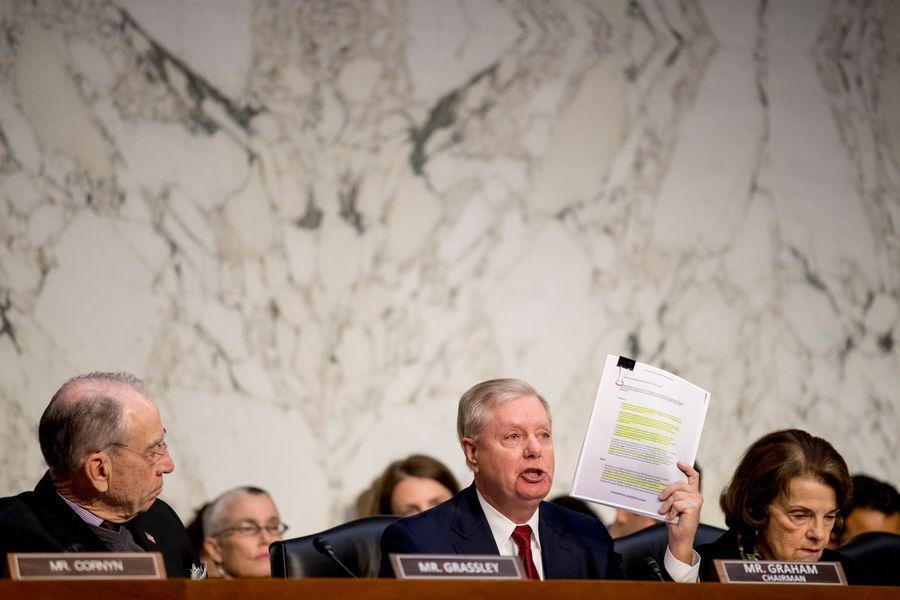
Senate FISA
Four Ways To Curb America's Emerging Surveillance State
COMMENTARY
Published Feb. 16, 2023 • Read time: 4m
Congress must decide this year whether to reauthorize Section 702, an amendment to the Foreign Intelligence Surveillance Act (FISA) that provides U.S. agencies with broad authority to collect foreign intelligence. What the FISA court itself describes as the government’s “widespread” violations of Americans’ privacy and civil liberties has, however, transformed this almost-perfunctory legislative task into a tense, down-to-the wire battle royale between civil liberties groups, the intelligence community, and their respective champions on the Hill.
Federal intelligence and law enforcement agencies have only themselves to blame for endangering what they claim is a critical tool for American national security. They have tortured the plain meaning of the law to transform an authority for catching foreign terrorists and spies into a system of mass surveillance of the American people.
The National Security Agency collects billions of text messages, emails, and internet metadata – including Americans’ communications as well as those of foreigners – “downstream” from email accounts, social media platforms, and search engines, and “upstream” from the internet backbone. Congress wrote Section 702 to specifically forbid the targeting of people inside the United States, but the FBI and NSA have fought tooth-and-nail to avoid even estimating this authority’s impact on Americans. Section 702 also holds that collection must be consistent with the Fourth Amendment of the U.S. Constitution, which requires the government to obtain a warrant before reviewing our personal effects. This has not, however, stopped U.S. intelligence and law enforcement agencies from treating Section 702 as a malleable instrument with which to spy on Americans, including millions of people who have done nothing suspicious.
The scope of FBI, CIA, and other agencies’ violations of the Fourth Amendment is mind-bending. And these are the transgressions we know about.
- The FBI uses Section 702-derived data to conduct “backdoor” searches for Americans’ communications, sidestepping the Constitution’s requirement for a warrant. An annual report from the Office of the Director of National Intelligence last April disclosed that the FBI in a recent 12-month period conducted as many as 3.4 million such warrantless searches.
- The secret Foreign Intelligence Surveillance Court (FISC) has felt compelled to go public to voice its frustration with the FBI’s disregard for lawful procedure. In 2018, Judge James E. Boasberg rebuked the FBI for improper use of 702 databases against Americans. On one day in late 2017 alone, the FBI conducted 6,800 queries of NSA databases using Americans’ Social Security numbers. It bears repeating: Congress explicitly enacted Section 702 to enable surveillance of foreigners.
- The secret court also revealed that the FBI, without a warrant, has used Section 702-derived NSA data in cases involving alleged health care fraud, bribery, and other purely domestic crimes by Americans.
- And what the government cannot obtain by spying directly on the American people, it simply buys. General counsels of federal agencies assert that if they purchase Americans’ most personal information scraped from apps and social media sites and sold by third-party data brokers, the Constitution has not been violated.
Finally, when the intelligence community is challenged on subverting the law, it points to an executive order, EO 12333, under which the government collects Americans’ communications and other personal data without any statutory authority. Surveillance law is stretched so wide and thin that 12333 now significantly overlaps with FISA surveillance, leaving Congress with no choice but to tackle it in the Section 702 debate.
Such a system is worse than broken. Whether intended or not, our government is assembling the elements of a pervasive surveillance state. Congress should subject all surveillance programs to four basic principles before reauthorization of Section 702 can be contemplated.
- First, any surveillance of Americans should be undertaken only pursuant to statute, duly enacted by the people’s representatives in Congress.
- Second, any surveillance of Americans’ communications or other Fourth Amendment-protected data should be undertaken only with a probable-cause judicial warrant.
- Third, any surveillance of Americans should be subject to adequate mechanisms – in both Congress and the judiciary – to ensure accountability for compliance with governing law.
- Fourth and finally, “surveillance” should be defined broadly, to include collection that the government describes as “incidental,” data purchases, searches of databases compiled by governments, searches of private records held by third parties, and similar ways to access our personal information without our consent.
These four principles can be embedded in the operations of intelligence and law enforcement agencies without degrading their ability to continue to track foreign terrorists and spies – what Section 702 was supposed to do in the first place.
For years, the intelligence community has misled lawmakers and the public, claiming that Section 702 is targeted only at foreigners, when agencies have been using it to access Americans’ communications. Especially given that history, these four principles must be woven into Section 702 authority, or Congress should allow that authority to lapse and start over.





RCP Today
Top stories on RealClearPolitics
The Takeaway
Polling intelligence and analysis delivered to your inbox
World News
Featuring the latest world news
Policy
Featuring the latest policy news
Support Our Mission
As part of RealClearPolitics, authors aim to provide balanced, non-partisan analysis by presenting top reporting and commentary from all sides of the political spectrum.
Trusted by policymakers and citizens alike since 2000