
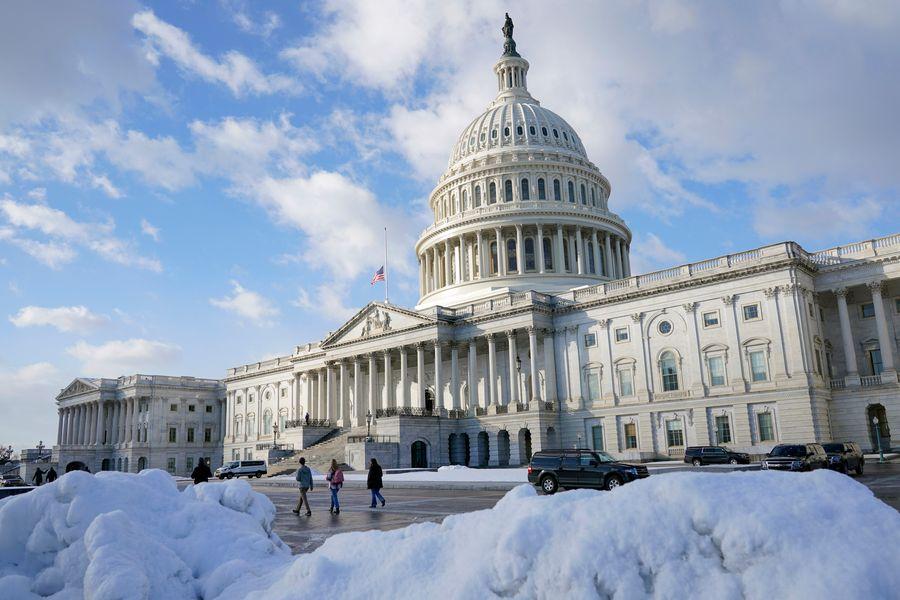
Capitol Riot Anniversary
Congress Must Address Continuity-of-Government Operations
COMMENTARY
Published Jan. 7, 2022 • Read time: 5m
This week, Congress observed the one-year anniversary of the Jan. 6, attack on the U.S. Capitol. President Biden and Vice President Kamala Harris delivered remarks at the Capitol, both chambers of Congress observed a moment of silence at noon, and several events were held within the halls that offered reflection of that infamous day.
Over 700 individuals have been arrested for crimes tied to the attack, with many investigations continuing. We wrote one year ago that Congress needed to install continuity-of-government procedures to ensure the safety of lawmakers and staff while conducting legislative business. Unfortunately, congressional operations have not changed since the events of that tragic day. While the Capitol Police has overhauled leadership and security practices, previous congressional procedures and practices remain the same.
On Jan. 6, 2021, many lawmakers, aides, and essential workers were able to escape – some with seconds to spare – before the mob stormed into the House and Senate chambers. The rioters successfully breached the Capitol, postponing the counting of Electoral College votes until early the next morning. Five people died, hundreds were injured, and millions of dollars in damage occurred. As many journalists and scholars have pointed out, this could happen again.
Other challenges – especially the ongoing COVID-19 pandemic – make addressing continuity of government even more urgent. Since the outset of the pandemic, we have made the case that Congress should adopt procedures to carry out legislative business remotely in times of emergency. We made a similar plea as the delta variant surged last summer and fall. As the calendar turned to 2022, the situation has arguably become more dire.
Rising COVID case numbers – this time from the omicron variant – have once again forced many companies, government agencies, and schools to revert to telework policies. On Jan. 3, the United States set a single-day global record of over 1 million new COVID infections in a single day and the daily average of confirmed coronavirus cases in the U.S. is almost 600,000; in all likelihood this spike will continue over the ensuing weeks.
The U.S. Capitol has also seen a massive increase in coronavirus infections, forcing the House Office of Attending Physician to encourage lawmakers to work remotely. More than 13% of those tested over a seven-day period were positive, an increase from less than 1%, according to the OAP’s Brian Monahan. Yet while many House and Senate offices are allowing staff to telework, lawmakers themselves are still required to show up in person for legislative business at a time when Washington has experienced a 17-fold increase in COVID cases over the last 30 days.
Nearly two years ago, when the nation and world began confronting the novel coronavirus, many governments adapted to maintain operations. This was the case for the House of Representatives. During the 116th Congress, the House passed H.R. 965 modifying its standing rules to incorporate proxy voting on the House floor and allow remote deliberations in committees.
Proxy voting enables any lawmaker to choose a colleague to cast a vote on their behalf if they cannot attend proceedings in person. When a proxy is utilized, a member of Congress must attest in writing to the House clerk that he or she is “unable to physically attend proceedings” for health or safety reasons related to COVID-19; enforcement is strictly by the honor system. Proxy voting is not a panacea, however, as it still requires in-person voting, creating a serious risk during an attack or an ongoing health emergency.
Unfortunately, like most everything surrounding COVID health-and-safety measures, proxy voting quickly became a partisan issue. The House Republican leadership even sued Speaker Nancy Pelosi, alleging that proxy voting was unconstitutional. Last July, the D.C. Court of Appeals unanimously rejected this lawsuit, determining that the House can establish its own rules and that proxy voting falls within the conduct of the Constitution’s “Speech or Debate” clause. Minority Leader Kevin McCarthy has appealed to the Supreme Court. Even so, many GOP lawmakers used proxy voting throughout 2021, including for non-COVID-related reasons such as attending fundraisers and political events.
The Senate is a different story. During the 116th Congress, when Mitch McConnell was majority leader, and the 117th Congress, where Chuck Schumer is majority leader, no changes have been made to legislative operations. The Senate requires committees to have a majority of senators present to report legislation. With a chamber evenly split at 50-50, any senator forced to quarantine or isolate could tip the balance of power and throw the chamber into chaos.
There have been calls from both sides of the aisle to address continuity in the Senate. S.R. 201, a bipartisan measure sponsored by Dick Durbin and Rob Portman, would amend the Senate Standing Rules to allow senators to use certified technology to cast votes outside of the chamber in circumstances when the majority and minority leaders jointly determine an “extraordinary crisis of national extent exists.” Coincidentally, Portman tested positive for COVID-19 just this week.
As it continues to spin off new variants, COVID-19 shows no signs of retreating. At the same time, the threat of another physical attack on the Capitol remains a serious concern. Both chambers of Congress need to address continuity-of-government operations. Doing so will help protect lawmakers, staff, essential workers, reporters, and others working on Capitol Hill. It will also ensure that Congress can continue to conduct its business and serve their constituents uninterrupted – even during a crisis.





RCP Today
Top stories on RealClearPolitics
The Takeaway
Polling intelligence and analysis delivered to your inbox
World News
Featuring the latest world news
Policy
Featuring the latest policy news
Support Our Mission
As part of RealClearPolitics, authors aim to provide balanced, non-partisan analysis by presenting top reporting and commentary from all sides of the political spectrum.
Trusted by policymakers and citizens alike since 2000