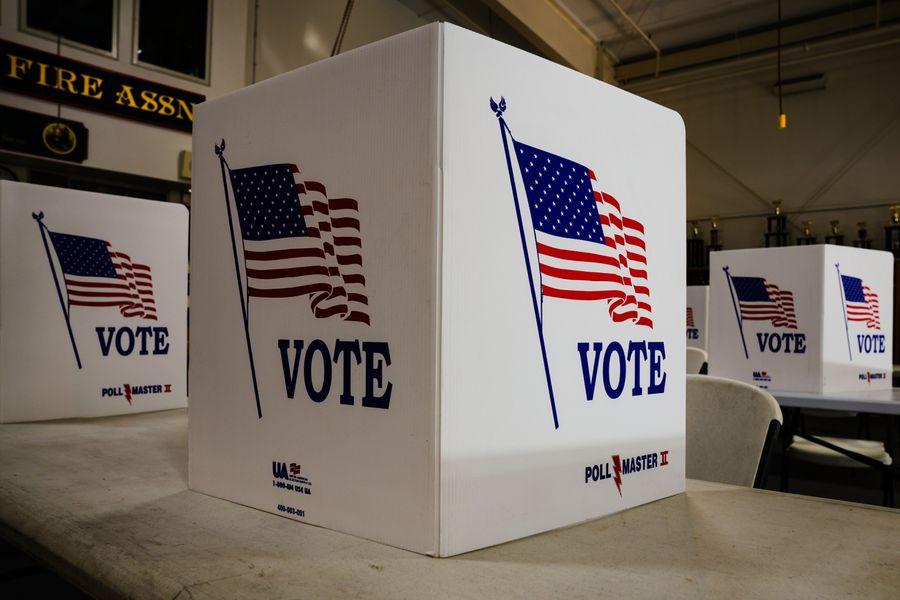
Election 2024-Pennsylvania Voting
Who Wins the Re-Redistricted House?
COMMENTARY
Published May 15, 2026 • Read time: 6m
As President Donald Trump's job approval sinks to or below 40% (depending on which poll you're looking at), betting markets and political conventional wisdom are that his Republican Party is not necessarily doomed to lose its narrow House majority, nor is it at serious risk of losing its Senate majority.
This is partly because of court decisions affecting redistricting in major states, but it also owes something to fundamentals that a few observers have noted even before. One example is Henry Olsen, writing two months ago in The Washington Post, noting that the president's job approval has been cratering more among nonvoters than among likely voters. In today's RealClearPolitics polls, the same relation is apparent: Trump's slippage is less among those more likely to vote.
Similarly, Republican pollster Patrick Ruffini in March noted that, in a 60,000-person biennial YouGov survey, the Democratic advantage in party identification has been steadily narrowed toward the vanishing point since 2006. And this year's special elections, in which the opposition party typically fares better than the president's, have been showing less anti-Republican movement than in 2025.
Nonetheless, the fact that the president's party almost always loses House seats (exceptions: 1934, 1998, 2002) plus the fact that Republicans won only 220 seats to Democrats' 215 in 2024, has made it seem close to certain that Democrats would win control.
To forestall that, Trump last summer urged Texas's Republican governor and legislature to redistrict its 38 House districts. They passed a plan portrayed as gaining five Republican seats, although it may not if the 2024 MAGA surge among Hispanics evaporates, as polls suggest. Similarly, Republicans in North Carolina (where the Democratic governor has no veto over redistricting) and Ohio passed plans advertised as gaining one and two seats, respectively.
Where "Obama Republicans" Split With Party
Curbelo Gives Spanish-Language Response to State of the Union
Rep. Bachmann Says She Won't Run For Re-Election
No, We Don't All Sin Like Mark Sanford
Democrats retaliated spectacularly last November in California, where a plan is estimated to increase Democrats' edge in the state's delegation from 44-8 to 48-4. And then incoming Gov. Abigail Spanberger (D-Va.) backed Virginia legislators' plans to temporarily have a referendum to abolish the bipartisan commission they had installed and increase the party's edge "temporarily" from 6-5 to 10-1. The state's Supreme Court declined, at Democrats' request, from ruling on the legality of the procedure until after the vote.
On April 21, Virginians who had elected Spanberger by a 15 percentage-point margin voted for the Democrats' ploy by only 3 percentage points. Unlike most special elections, turnout was higher among Republicans than Democrats. On May 8, the state Supreme Court ruled that the Democrats' procedure had violated the state constitution.
In the meantime, the U.S. Supreme Court's decision in Louisiana v. Callais ruled that the Voting Rights Act doesn't require maximizing the number of "minority-influenced" districts, which opened the way for some Republican legislators to redistrict and add a district for their party. And in Florida last week, Republican legislators quickly passed Gov. Ron DeSantis' (R-Fla.) redrawing of its 28 districts, which was predicted to add four Republican districts.
As elections analyst Nate Silver explained, the uneven distribution of the parties' voting bases tends to give Republicans an advantage in single-member, equal-population districting. Increasingly since the mid-1990s, and even more so after Trump's emergence, Democratic voters tend to be concentrated in central cities, sympathetic suburbs and university towns, while Republican voters tend to be spread more evenly around the rest of the country.
This means that Republican districting plans tend to have more compact-shaped districts, while Democrats tend to link distant nodes with tenuous corridors. Illinois Democrats' 14-3 plan, for example, consists of bacon strips leading outward from Chicago wards and heavily Democratic suburbs out across miles of treeless prairie to Democratic towns. Virginia Democrats' 10-1 plan had five districts fan out from heavily Democratic Arlington and Fairfax Counties, just across the Potomac River from Washington, D.C.
In contrast, Texas and Florida Republicans' plans would probably pass even a stringent numeric test for compactness and contiguity. Speaking of which, one Illinois Democrat called for his party to "get over the mental hurdle of contiguity" and let Chicago ward leaders pick clumps of downstate landscape hundreds of miles away for his big city neighbors to easily outvote.
The result for the moment is nearly a level playing field in the House races. The authoritative Cook Political Report rates 188 seats as solidly Republican and 184 seats as solidly Democratic. It rates 22 seats as leaning or likely Republican and 23 seats as leaning or likely Democratic. That's 210 seats at least leaning Republican, 207 as leaning or likely Democratic, leaving 18 seats, four currently held by Democrats and 14 by Republicans, as tossups.
So if Democrats win all the tossups, they would control the House 225-210, a net gain of 10 seats -- a win, but not the blue wave they've been hoping for. If Republicans win half of the tossups, they would control the House 219-216, a net loss of just one seat.
Those numbers are beginning to look familiar. The House was 222-213 Democratic in 2020, 222-213 Republican in 2022, 220-215 Republican in 2024.
But this is May, and the election is in November -- early voting starts in September. Republicans entered Trump's first term with a 241-194 majority and had better numbers at this point in the cycle than they do now, and Democrats ended up with a 235-199 majority in November.
And they didn't have the burden that year of being on the defensive on the inflation, which most voters believe has been the result of Trump pushing through two long-held priorities: erecting tariff walls around the United States and reducing the power of the terrorist regime in Iran.
Republicans, surprised and pleased that the redistricting wars have gone their way, might entertain different possibilities, such as an easing of inflation and surge of economic growth, the end of hostilities in Ukraine, and regime collapse in Iran. Disheartened Democrats would decline to turn out, while enthusiastic Republicans surge to the polls.
With all these contingencies still conceivably open five or six months before the election, there remains no reason to expect bipartisan legislative action on just about anything. It makes no sense for working politicians with some strength of conviction to compromise when the possibility of a trifecta in the White House and majorities in both the House and Senate remains a realistic possibility in the next presidential election year.
And since we have emerged into a period of parity between the parties, as a 49% nation, as I wrote in "The Almanac of American Politics" after the 2000 election, no presidential candidate has won in a landslide. Republicans have won trifectas in 2000, 2004, 2016 and 2024, and Democrats have won trifectas in 1992, 2008 and 2020.
Americans have had such periods of partisan parity, characterized by especially bitter partisanship before, in the fights between Jacksonians and Whigs between 1832 and 1852, and between the pro-Civil War Republicans and dubious Democrats between 1864 and 1894. Eventually, other issues arose, new political platforms emerged, and something like a consensus emerged.
Could that happen this year? Maybe. But it sure doesn't look like it.
COPYRIGHT 2026 CREATORS.COM
Support Our Mission
The Internet provides an endless stream of content. Not all of it is worth your time. That's why, every day, RealClearPolitics curates the most essential news and information—from all sides and across mediums. The links, videos, and podcasts curated here are the product of human judgment, not algorithms or AI. Please help power our mission of presenting a thoughtful, balanced public discourse through a tax-deductible donation.
Would you consider supporting us today?

Newsom Defies Voters, Juries and Lawmakers To Spare Murderers While Defending Abortion
Curtis Hill • RealClearPolitics
The Algorithmic Tilt
Frank Filingeri • RealClearPolitics
A RealClear Thanksgiving: Investing in a Better Future
David DesRosiers • RealClearPolitics
Trump’s Newsom Problem: Antagonist-in-Chief
Carolina Lumetta • RealClearPolitics
America’s Free Spirit
John Maxwell Hamilton • RealClearPolitics
The GOP Majority Should Go Out in Glory
Daniel McCarthy • RealClearPolitics
RCP Today
Top stories on RealClearPolitics
The Takeaway
Polling intelligence and analysis delivered to your inbox
World News
Featuring the latest world news
Policy
Featuring the latest policy news
Support Our Mission
As part of RealClearPolitics, authors aim to provide balanced, non-partisan analysis by presenting top reporting and commentary from all sides of the political spectrum.
Trusted by policymakers and citizens alike since 2000