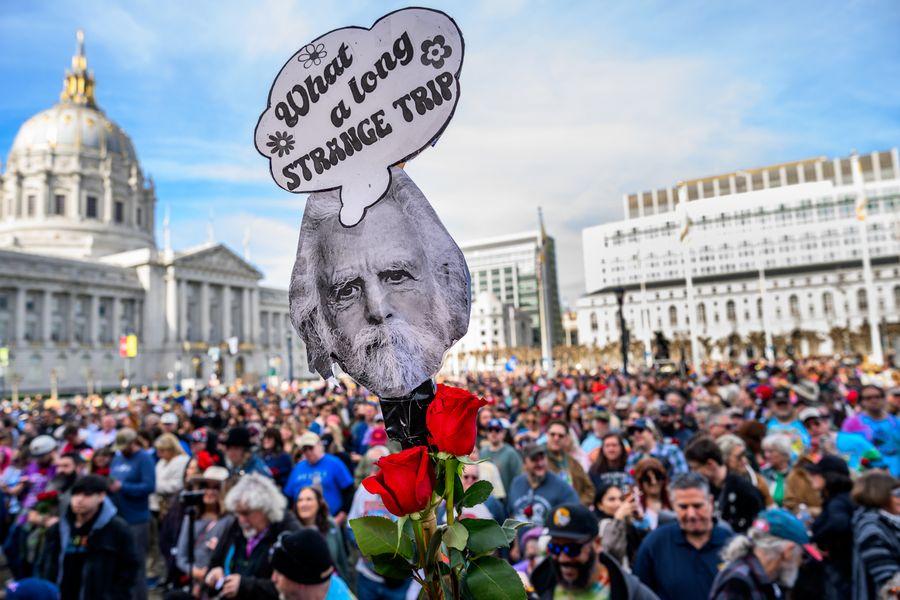
Bob Weir Remembrance
What the Grateful Dead Can Show a Fractured America
COMMENTARY
Published Jan. 23, 2026 • Read time: 7m
Join the Conversation
0After the last key member of the Grateful Dead, guitarist Bob Weir, died last week at the age of 78, the cascade of loving tributes published far and wide underscored how he and his fellow band of misfits had created a new form of music that personified America.
In our melting pot nation, the Dead uniquely wove together the many strands of music brought to and developed on our shores. You could hear English and Scottish ballads and hymns, African rhythms, classical music, the avant-garde in their songs and jams, as well as blues, gospel, country, jazz, and rock. While clearly drawing on all these sources, they produced music that was identifiably their own. They were deeply traditional and truly original.
A rare dynamic informed their distinctive sound. In many rock groups, the instruments usually back the lead guitar. In the Dead, every instrument seemed to be soloing at once, like a Dixieland band. In their commitment to improvisation, each player pushed their own vision and creative powers. Yet, those “solos” worked because they were part of a conversation as the musicians listened and responded to one another; each individual effort served the collective sound. They were alone and together at once.
A famously acquired taste – they had as many detractors as devotees – the band embodied the Latin maxim de gustibus non disputandum (in matters of taste there can be no disputes). I have spent five decades trying to convince people of their genius with spotty success (ask my wife). But the Dead were more than a band: Since their origins in the Bay Area’s Haight-Ashbury hippie scene of the 1960s, they were also a set of ideas, a way of being that captured our nation’s best traditions and rich complexity. They were both culture and counter-culture, counting rock-ribbed conservatives and wild-eyed progressives among their fans.
Rethinking the Pledge; Trump and Women; One Last Egg Roll; Eulogizing Ike
2016: A Repeat of the 1960s
An Apology, Fashioned for Nancy Reagan
Nancy Reagan, Guardian of a Legacy
As our great nation celebrates its 250th anniversary in a time of angry division, when we are wondering who we are as a people and what we stand for, the Grateful Dead’s legacy offers useful ways to think about such questions. Like the best ideas, they didn’t insist on answers but pushed us to consider possibilities. The band was quintessentially American because it gave equal play to the great forces of our society – rugged individualism and community – resolving the tension between ideas that our politics too often cast as conflicting. Or, as the group’s first-among-equals, Jerry Garcia, would have put it, every yin depends on a yang.
If the idea they embodied can be boiled down, it might be this: We are all in this together, so let’s each do our part. While the Dead exemplified this ethos in their music, their example is far more consequential in American society because of the very intentional way they shared it with their fans, the ultra-loyal “Deadheads.” The band almost never spoke from the stage or made any political or cultural statements, and yet they embodied a set of values that laid down a challenge and a marker to their audience: What are you doing? Can you do better?
Dead shows were a powerful experience for fans – including this one, who attended about 200 performances (I have the ringing in my ears to prove it) – because the music beckoned us to surrender to its waves. At the highest, albeit fleeting moments, we were no longer ourselves; we merged with the music and the crowd around us, forming a community of transcendence. We couldn’t do it alone; we fed off the band and each other. Like America itself, we were all part of creating something exceptional, together.
And yet, these moments of surrender were often matched by periods of deep personal reflection. As the band jammed, we quite pointedly asked the question often stirred by faith: What am I going to do with sublime knowledge? How am I going to be the best version of myself?
Those queries were prompted by the example of the band. Yes, they were hippies who rebelled against the straight life. As Garcia once said, they wanted to live “uncluttered” lives apart from the expectations and coercions of our larger society. They chased that most American of values: freedom.
But at the most fundamental level, the Dead acted on this freedom in the most conventional of ways, through hard work. During their 30-year run before Garcia’s death in 1995, they played thousands of concerts across the country. By all accounts, when they weren’t on stage, they had their instruments in hand, practicing and perfecting their art. The example they set was that following your bliss requires dedication; whatever you do, commit to it. Find meaning, strive to be your best. Their performances spotlighted a group of individuals who were doing just that, right in front of us, just a few feet away. Even if we weren’t geniuses like them, they challenged and inspired many of us to find and commit to our own passions.
The band members, of course, were also fallible human beings; the drug addiction and obesity that led to Garcia’s death at age 53 showed us the dangers of freedom as well. As they sang: “When life looks like easy street, there is danger at your door.” Yin and yang.
The Dead encouraged this human flourishing – and developed their own highly successful business model – through the radical embrace of free-market capitalism that hinged on freedom rather than exploitation. Violating a basic rule of the record business, they allowed their fans to tape and trade copies of their shows (many of the high-quality soundboards made by the band also trickled out). As Garcia once said, “Once we’re done with it, they can have it.” Like other bands, the group sold t-shirts and other paraphernalia, many based on their iconic dancing bears and lightning bolt skull iconography. But they also invited their fans to compete with their merchandise, enabling a sprawling underground economy of t-shirts, bumper stickers, and more, mostly sold in the parking lot outside their shows. They seemed to ask: What can you do with our ideas?
By allowing fans to express their own creativity, the band ended up reaping rich rewards as these little engines of commerce spread their fame far and wide. As Don Henley sang, “Out on the road today, I saw a Deadhead sticker on a Cadillac.”
But the Dead were not pure laissez-faire – they invested deeply in their community. In the early 1970s, they almost went broke combining some 600 speakers into a massive Wall of Sound because they wanted to deliver the best audio to their audience. As their popularity exploded in the 1980s, they set up their own ticket service, allowing hardcore fans to avoid the lines and fees of ticket brokers. The lesson: Flowers will bloom when they are nurtured.
For all our prosperity and strength, it is hard not to look at our country today without despair. But it feels like our problems are more spiritual than material – we have lost our way because we have forgotten how to be as individuals while remaining members of a community. The legacy of the Grateful Dead cannot solve this problem, but it can inspire Americans to think more deeply about how we can be better people and better citizens. The magic starts with each of us and requires all of us.
Support Our Mission
The Internet provides an endless stream of content. Not all of it is worth your time. That's why, every day, RealClearPolitics curates the most essential news and information—from all sides and across mediums. The links, videos, and podcasts curated here are the product of human judgment, not algorithms or AI. Please help power our mission of presenting a thoughtful, balanced public discourse through a tax-deductible donation.
Would you consider supporting us today?

Newsom Defies Voters, Juries and Lawmakers To Spare Murderers While Defending Abortion
Curtis Hill • RealClearPolitics
The Algorithmic Tilt
Frank Filingeri • RealClearPolitics
A RealClear Thanksgiving: Investing in a Better Future
David DesRosiers • RealClearPolitics
Trump’s Newsom Problem: Antagonist-in-Chief
Carolina Lumetta • RealClearPolitics
America’s Free Spirit
John Maxwell Hamilton • RealClearPolitics
The GOP Majority Should Go Out in Glory
Daniel McCarthy • RealClearPolitics
RCP Today
Top stories on RealClearPolitics
The Takeaway
Polling intelligence and analysis delivered to your inbox
World News
Featuring the latest world news
Policy
Featuring the latest policy news
Support Our Mission
As part of RealClearPolitics, authors aim to provide balanced, non-partisan analysis by presenting top reporting and commentary from all sides of the political spectrum.
Trusted by policymakers and citizens alike since 2000