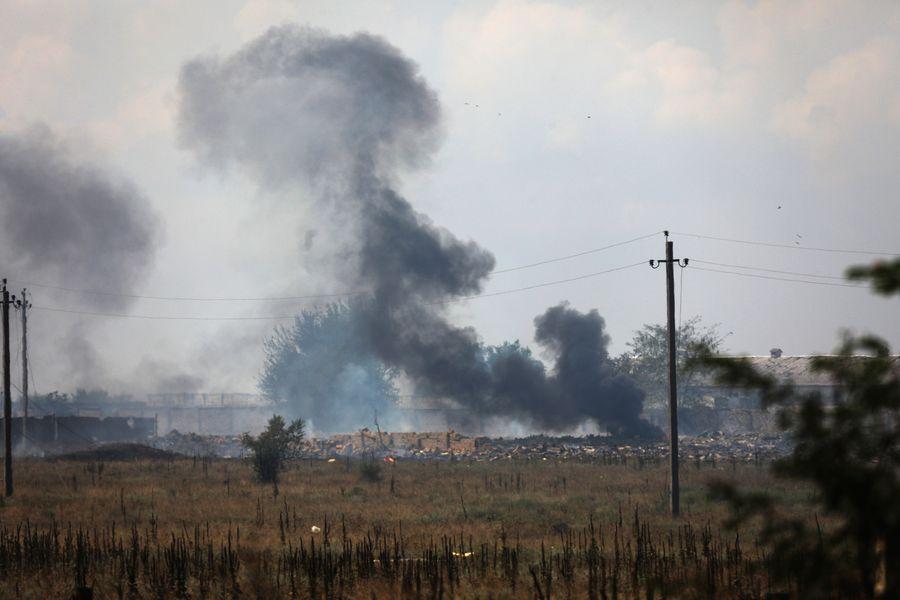
Russia Black Sea Fleet Under Attack
Ukraine's Freedom Forge
COMMENTARY
Published April 12, 2024 • Read time: 5m
As the U.S. dithers on whether it will continue to arm Ukraine’s fight for freedom, Kyiv is not waiting for Washington to do what it must and restock its arsenal for democracy. President Zelensky is transforming Ukraine’s bread basket economy into a denizen of drones and other armaments that is helping Ukrainian forces arrest Russian advances as it waits for decisive weapons from the West. Two years into the war, the message for Washington and Moscow is that Ukrainians will continue to fight and will do so with an innovative and entrepreneurial military-industrial base.
Two days on the ground in Kyiv, visiting drone companies and commercial manufacturers-turned-defense-industrialists reveal a modern-day Freedom’s Forge. The effort is led and overseen by Ukraine’s Ministry for Strategic Industry, a government entity akin to America’s War Production Board during World War II. While this military transformation will not deliver a victory in the conflict – that will only happen with U.S. and allied support – it is making a strategic impact on the ground today.
The Ukrainian war effort involves both public and private sectors. The Joint Stock Company, which oversees the privatization of Ukraine’s 114 state-owned defense enterprises, has taken on the development of sophisticated long-range drones and missiles that can target Russian forces in the Black Sea, Crimea, and over the border into Russia.
The Neptune cruise missile that destroyed the Moskva cruiser, the flagship of the Russian Black Sea Fleet, will see production increase tenfold in 2024. A Neptune strike is credited with reopening the Black Sea shipping corridor, allowing for the export of Ukrainian agriculture and restoring its economy. In the coming year, the Neptune will increase its range up to 1000 kilometers, opening the way for targets deep inside Russia.
Is Trump Right About NATO?
Over Here: Competence Amid Repulsive Politics
We're Not a Poor Country, Donald
U.S. Officials Say 2 Americans Died in Brussels Attack
Ukraine’s private sector is converting into a hub for low-cost drones. One company just outside of Kyiv transformed its civilian helicopter business into a drone factory in less than a year. The long-range Morak attack drone has a range of 800-1000 kilometers and costs $40,000. How is that possible? Other than the software used for targeting and countering Russian jamming, it relies on cheap commercial components you can buy from Amazon (which they do). The workforce is made up of engineers and designers, some of whom are former actors and footballers eager to help the war effort.
In the last few months, Ukrainian forces carried out over 200 missions with the Morak targeting Russian factories and airfields, including one such strike this week. A year ago, the Morak didn’t exist. Its owner told us it will produce hundreds a month this year.
The battlefield on the front lines in Eastern Ukraine has been dominated by tactical drones called First Person View or FPV drones. As Ukraine runs low on 20th-century howitzer guns firing 155-millimeter rounds, FPVs are filling the battle space. Russian kamikaze FPVs target Ukrainian units, armored personnel carriers, and other light infantry vehicles. Ukraine drone units are now doing the same. The Ukrainian Ministry of Defense plans to buy 1.2 million FPVs this year. It will rely entirely on scores of startups to meet the mandate.
Buying FPVs from Western Allies is not an option, given the dynamic nature of the Ukrainian battlefield. Unless you are on the ground constantly iterating, the Strategic Industries Minister told us, it is impossible to keep pace with the battlefield innovation cycle, which is so fast that software becomes out of date in a matter of months. Indeed, we’ve seen media reports of U.S. drones failing to operate successfully in Ukraine because they don’t account for battlefield realities. In other words, the laboratory for the future of warfare has advantages only for those who commit to staying in the laboratory.
One Ukrainian FPV manufacturer we visited operates out of an underground cellar in a Kyiv commercial retail district. Their prior facility was hit by a Russian missile. At $350 per copy and a range of 20 kilometers that can carry a one-to-six kilogram payload, the FPV is capable of knocking out Russian armored personnel carriers. The drones are made with a combination of 3D printed parts and commercial components, which are obtained from websites like GETFPV.com. The owner is a former cyber engineer who was a Bass fisher enthusiast before the war. He is under contract with the Ukrainian military to deliver 4000 drones this year, but he is making thousands more, given the military’s need.
Despite this significant progress, the new Ukrainian military-industrial complex faces industrial and technological challenges. It remains to be seen if Ukraine can scale its nascent defense industry. Putin is committing seemingly endless resources to the fight, and Ukraine’s tattered economy lacks sufficient capital and resilient supply chains to fuel the effort.
Perhaps the greatest technological problem is overcoming Russian electronic warfare capability. It has become a potent problem on the battlefield as it severely diminishes the success rate of hitting targets. The FPV target hit rate is often less than 50%, and the longer-range drone attrition rate is less than 20%. Ukraine’s drone war desperately needs Western software solutions to defeat Russian jamming efforts. This requires urgent attention and is a problem the U.S. can help solve without necessitating a congressional appropriation.
Ukraine knows that innovation is its lifeline in this conflict. While it is not a replacement for the sophisticated American weapons it desperately needs, like Patriot batteries, ATACMs, and HIMARs, it is now the critical capability holding back Putin’s offensive. But reports from the military front reveal it is a tenuous hold and one that Putin is determined to break through. Only the combination of the Ukrainian will to fight with the aid of U.S. military platforms will defeat Vladimir Putin.
Support Our Mission
The Internet provides an endless stream of content. Not all of it is worth your time. That's why, every day, RealClearPolitics curates the most essential news and information—from all sides and across mediums. The links, videos, and podcasts curated here are the product of human judgment, not algorithms or AI. Please help power our mission of presenting a thoughtful, balanced public discourse through a tax-deductible donation.
Would you consider supporting us today?

Newsom Defies Voters, Juries and Lawmakers To Spare Murderers While Defending Abortion
Curtis Hill • RealClearPolitics
The Algorithmic Tilt
Frank Filingeri • RealClearPolitics
A RealClear Thanksgiving: Investing in a Better Future
David DesRosiers • RealClearPolitics
Trump’s Newsom Problem: Antagonist-in-Chief
Carolina Lumetta • RealClearPolitics
America’s Free Spirit
John Maxwell Hamilton • RealClearPolitics
The GOP Majority Should Go Out in Glory
Daniel McCarthy • RealClearPolitics
RCP Today
Top stories on RealClearPolitics
The Takeaway
Polling intelligence and analysis delivered to your inbox
World News
Featuring the latest world news
Policy
Featuring the latest policy news
Support Our Mission
As part of RealClearPolitics, authors aim to provide balanced, non-partisan analysis by presenting top reporting and commentary from all sides of the political spectrum.
Trusted by policymakers and citizens alike since 2000