
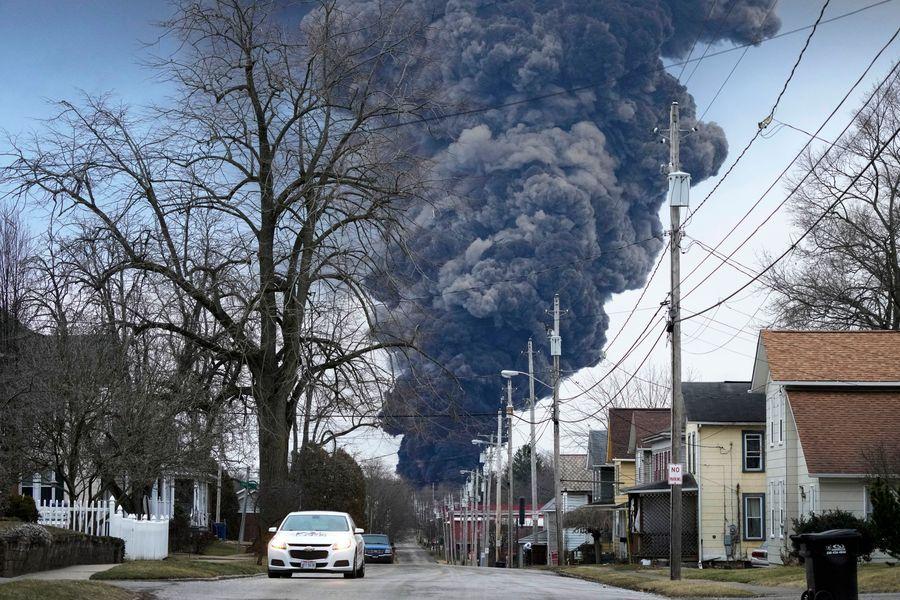
EPA Vinyl Chloride
Railroads Are Improving Safety and Policymakers Can Help
COMMENTARY
Published Feb. 5, 2024 • Read time: 4m
Feb. 3 marks the one-year anniversary of the train derailment in East Palestine, Ohio. With this date comes increased discourse about railroad safety.
This was evident in a recent House hearing in which the chair of the National Transportation Safety Board noted that “rail transportation is not only cleaner and more fuel efficient than transportation on our roadways, it is also far, far safer.”
While work remains to drive all incidents lower, rail remains by far the safest way to move freight on land. According to federal data, railroads continue to show strengths in rates pertaining to mainline accidents, hazmat accidents, and employee injuries.
Preliminary government data indicates that accidents on the mainline rail network ticked up slightly in the first 10 months of 2023. While this data is subject to change, context is essential. For instance, some like to cite a figure of 1,000 derailments per year, perhaps because it sounds alarming. But the reality is that 76% of those derailments are in rail yards or low-speed tracks – akin to fender benders – not on the main rail lines that carry freight around the country.
This is not an excuse, and no one should ever minimize the impact that any single incident, such as East Palestine, can have on a community. Railroads can and do learn from each accident as they strive for new safety records each year. Employees stand at the vanguard of this unparalleled commitment to rigorous safety protocols, and in 2023, experienced the lowest number of employee fatalities in history. Yet one fatality is too many.
BART Is Not a Homeless Shelter
Thank Gridlock for Economic Turnaround
Infrastructure Is Not the Problem
Take the Public-Private Road to Efficiency
As part of an overall safety culture, railroads invest billions each year to reduce accidents. One of the industry’s biggest areas of focus is track-caused incidents, where a large portion of annual capital spending goes to repair and upgrade infrastructure. Another key area is reducing human error – the source of nearly 50% of incidents – by constantly innovating to aid employees with new technologies. One great example of this is the industry’s $15 billion investment in Positive Train Control, which prevents accidents caused by speeding or head-to-head collisions. Another example is Automated Track Inspection, or ATI, which is being used to assess infrastructure health and provide deeper readings than possible by manual inspections alone. ATI systems increase detection by up to 90%.
Since last year, railroads have taken quick, decisive action in response to lessons learned from the derailment in Ohio. To decrease the likelihood of an overheated bearing causing a similar accident, carriers have deployed hundreds of additional hot bearing detectors and established a more stringent threshold for stopping and inspecting cars. Importantly, the vast set of detectors perform myriad types of inspection and detection, and were already on the network before 2023. They were there because railroads voluntarily developed and installed them after identifying safety-enhancing opportunities.
Recognizing that first responders must know what’s moving through their communities and how to respond, the industry to date has expanded access to critical information through a tool called AskRail to 2.3 million first responders, providing real-time details on train car contents and safety handling instructions. Additionally, railroads provided hands-on emergency response training to more than 36,000 first responders in 2023 alone.
Following a long history of collaborating with hazmat shippers on voluntary actions, railroads also issued new tank car requirements to improve performance in case of a fire.
To the extent that lawmakers or regulators seek to advance related measures – which is prudent and additive to voluntary action – data must drive the discussion. The nation’s complex freight rail system requires an evidence-based, nuanced, and surgical approach. Future rulemaking at the USDOT should be subject to standard cost-benefit analysis.
This is important as some lawmakers consider policy changes that may lead to unintended consequences, including increased risk in other parts of the supply chain. While some legislative proposals include sensible ideas, others risk needlessly hamstringing railroads and their customers without corresponding safety benefits.
Railroads are wholeheartedly dedicated to advancing safety through our own initiatives and collaborative efforts with policymakers across party lines. It is not a mutually exclusive proposition. We will continue our work to improve, identify, and implement ways to reduce risk to our employees and the communities we operate in and drive toward even higher levels of safety.

The GOP Majority Should Go Out in Glory
Daniel McCarthy • RealClearPolitics
Republican Majorities Could Return Sooner Than Expected
J.T. Young • RealClearPolitics
The Danger Before the Attack
Leslie J. Sullivan • RealClearPolitics
Jon Finer’s Old and Dangerous ‘New Approach’ to Israel
Peter Berkowitz • RealClearPolitics
The President Deserves Better
John Ullyot • RealClearPolitics
Congress Doesn’t Need Another Blame Game. It Needs To Find What’s Broken
Jarrod Bernstein • RealClearPolitics
RCP Today
Top stories on RealClearPolitics
The Takeaway
Polling intelligence and analysis delivered to your inbox
World News
Featuring the latest world news
Policy
Featuring the latest policy news
Support Our Mission
As part of RealClearPolitics, authors aim to provide balanced, non-partisan analysis by presenting top reporting and commentary from all sides of the political spectrum.
Trusted by policymakers and citizens alike since 2000