
Election 2023 Ohio Abortion
Proponents of Ohio Initiative Aiming for Its Extreme Consequences
COMMENTARY
Published Nov. 4, 2023 • Read time: 6m
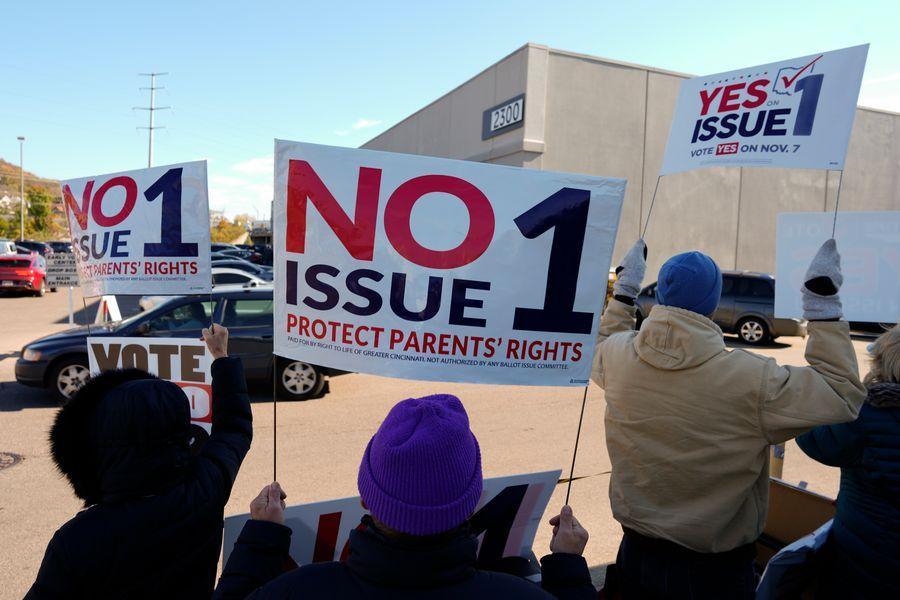
Ohio’s Issue 1 is on the ballot for Tuesday’s election, and votes are already being cast under the state’s early voting schedule. Proponents often deny the measure’s extreme consequences or try to change the subject – but anyone in doubt need only look at the track record of those at the forefront of this effort to change Ohio’s state constitution.
Take just some of the most glaring issues being debated. For starters, Issue 1 eviscerates the right of parents to be involved in the decisions of their minor children on whether to terminate prenatal life. But the measure sweeps well beyond abortion and parental rights. In addition to establishing taxpayer-funded, no-limits abortion, it also covers any procedure involving the reproductive system, including sex-change surgery and other gender transition procedures.
Tracy Thomas, who directs the University of Akron’s Center for Constitutional Law, called the notion that Issue 1 would invalidate parental involvement laws “a straw argument” and “a false argument,” noting that there are “lots of examples in the law, both state and federal, where ... children’s rights are limited.” Talk about a straw argument.
There are, of course, some contexts in which children’s constitutional rights are limited. But even a cursory familiarity with the Supreme Court’s decades of adjudicating abortion cases reflects the obvious reality that unwanted pregnancy is a phenomenon that often occurs among minors. Challenges to parental involvement laws have long been a fixture of abortion litigation.
Why a Good Person Can Vote Against Same-Sex Marriage
Prop 30 -- Delphic Oracle Pronouncement
Don't Read Too Much Into the Ohio Referenda
Ohio Voters Reject Law Limiting Public Unions
Ms. Thomas has written in detail about past Supreme Court case law that included the invalidation of parental consent provisions – along with requirements of informed consent and a 24-hour waiting period, all mild abortion regulations she treats with thinly veiled hostility.
And while such laws met different fates before the high court at different times, as we previously discussed, it is telling that they ever would have been struck down under a Constitution that contains no language comparable to Issue 1 about abortion or about reproduction more generally. The same is true at the state level: Despite a lack of any language in their state constitutions resembling Ohio’s Issue 1, at least four state supreme courts previously struck down parental involvement laws.
By contrast, Issue 1’s explicit language covers the “right to make and carry out one’s own reproductive decisions,” expressly “including but not limited to” abortion, in terms so absolute that the state could allow no condition that would “directly or indirectly, burden, penalize, prohibit, interfere with, or discriminate against” the procedures in question. The possibilities as to what “indirectly” could interfere with or burden abortion or sex-change surgery are endless. Even state and federal protections of religion and free speech do not address “indirect” phenomena that are only tenuously related to the rights at issue.
But such language provides an insurance policy for the litigation agenda of the ACLU, a prime mover behind Issue 1. In 1974, just one year after Roe v. Wade was decided, the organization set up its Reproductive Freedom Project to advance its agenda of no-limits abortion.
The ACLU website includes a broad-ranging platform against parental involvement laws and notes the organization’s success in challenging a parental consent law before the U.S. Supreme Court in Bellotti v. Baird (1979). The organization has also been behind state-level attacks on parental notification and consent laws. After narrowly failing to get the U.S. Supreme Court to strike down the Hyde Amendment’s prohibition of federal funds for most abortions in 1980, the ACLU boasts that it “pioneered the use of state constitutions to restore state Medicaid funding.”
The ACLU does not stop there. It has also sued in numerous federal district courts challenging state laws prohibiting gender transitioning or reassignment procedures for minors, often basing its arguments on the very broad language of the U.S. Constitution’s Equal Protection and/or Due Process Clauses. The ACLU has litigated other expansive interpretations of legal text, including persuading a majority of the U.S. Supreme Court in Bostock v. Clayton County (2020) that “sex” as it is stated in Title VII of the Civil Rights Act of 1964 includes sexual orientation and transgender status, a conclusion no federal appellate judge reached for over 50 years after the 1964 act was passed.
It does not require a comparable stretch of language for Issue 1 to encompass gender reassignment procedures.
Another member of the coalition pushing Issue 1 along with the ACLU, Unite for Reproductive and Gender Equity (URGE), identifies as its mission advocating for a “liberated world” and “reproductive justice.” The group unabashedly advocates “celebrating all abortions, no exceptions,” and publicly funding the procedure. It broadly opposes parental involvement laws, not only for abortion but also in the context of gender-identity and transgender treatment, which it regards as a constitutional right that extends to minors.
Planned Parenthood is another coalition member and funder of the Issue 1 campaign. It is well known for advocating for abortion without parental involvement or other limits and forcing taxpayers to cover the cost. The organization provides gender transition services that include cross-sex hormones for minors.
Kellie Copeland, the executive director of the coalition member Pro-Choice Ohio, stated this summer that “we should work on” eliminating Ohio’s parental consent law. That was a glimmer of candor from a source who previously spread misinformation conflating miscarriage treatment with abortion.
She now claims that contrary to “a false narrative about our campaign ... [o]ur reproductive freedom amendment does not impact care related to gender.” No, no, of course not. Why would anyone reach the far-fetched conclusion that Issue 1’s sweeping language regarding “reproductive decisions” includes procedures that involve the human reproductive system?
Pay no attention to her coalition partners who insist that silent federal constitutional text dictates policy regarding these procedures at the same time that they deny that Issue 1’s explicit text would have the same effect. Never mind what the ACLU has been doing for the past 50 years, with Copeland and her colleagues in full support of its judicial activist positions before playing coy once the Issue 1 debate arose this year.
Whom do they think they are kidding?
Major newspaper editorial boards are known to be overwhelmingly pro-choice, so it is telling that one of Ohio’s largest newspapers, the Toledo Blade, opined that Issue 1 “goes too far and should be defeated,” while another paper, the Cleveland Plain Dealer, declined to issue a conventional endorsement editorial.
The extreme consequences of Issue 1 are demonstrated by the longstanding track record of its principal proponents. Their objectives could not be more obvious. They are looking to adopt explicit, unbounded constitutional language to achieve in state courts what they have tried to achieve in federal courts in the absence of such language. The only question is whether they respect the people of Ohio enough to be honest with them. In any event, their actions speak louder than their words.
The proposed Ohio constitutional amendment calls to mind a saying: Act in haste, repent at leisure. If Issue 1 becomes part of the state constitution, with the state legislature unable to undo its damage, the people of Ohio will regret it for years to come. Vote no on Issue 1.

The GOP Majority Should Go Out in Glory
Daniel McCarthy • RealClearPolitics
Republican Majorities Could Return Sooner Than Expected
J.T. Young • RealClearPolitics
The Danger Before the Attack
Leslie J. Sullivan • RealClearPolitics
Jon Finer’s Old and Dangerous ‘New Approach’ to Israel
Peter Berkowitz • RealClearPolitics
The President Deserves Better
John Ullyot • RealClearPolitics
Congress Doesn’t Need Another Blame Game. It Needs To Find What’s Broken
Jarrod Bernstein • RealClearPolitics
RCP Today
Top stories on RealClearPolitics
The Takeaway
Polling intelligence and analysis delivered to your inbox
World News
Featuring the latest world news
Policy
Featuring the latest policy news
Support Our Mission
As part of RealClearPolitics, authors aim to provide balanced, non-partisan analysis by presenting top reporting and commentary from all sides of the political spectrum.
Trusted by policymakers and citizens alike since 2000