
Power Cameroon
USAID's 'Power' Play on Religious Engagement
Published Sept. 25, 2023 • Read time: 16m
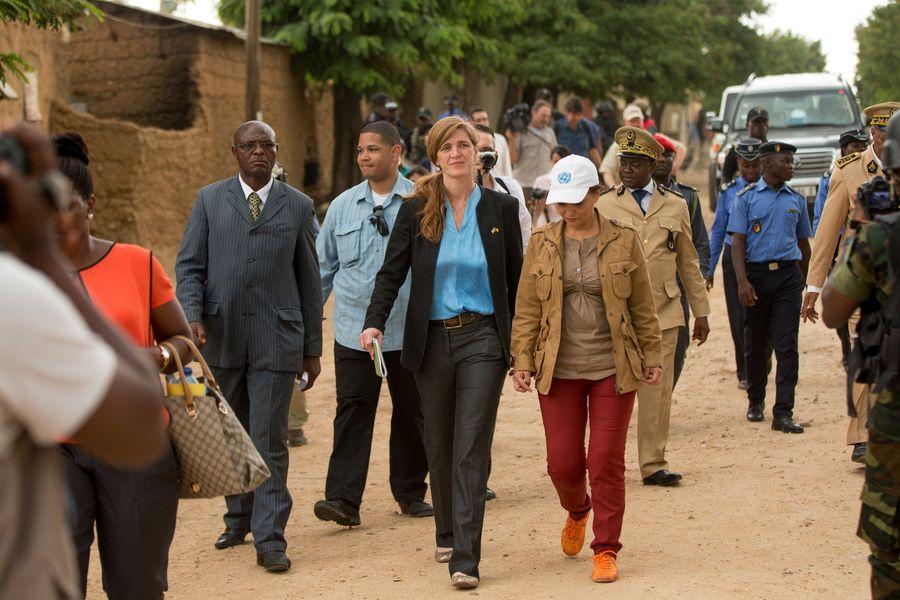
Samantha Power, a former journalist and longtime human-rights activist who heads the U.S. Agency for International Development, is keenly aware of the role religious pluralism plays in preventing wars and mass atrocities.
Power literally wrote the book on America’s failed record of fighting genocides around the world, even as the nation’s leaders have repeatedly promised “never again” after the Holocaust.
In Power’s “A Problem From Hell: America and the Age of Genocide,” she recounts her experiences reporting on the massacre of more than 7,000 Muslim men in the siege of Srebrenica during the Bosnian war. Afterward, she examined several genocides of the 20th century, including the Ottoman slaughter of Armenians, the Holocaust, Pol Pot’s reign of terror in Cambodia, Saddam Hussein’s destruction of Kurds in northern Iraq, and the Hutus’ systematic extermination of the Tutsis in Rwanda.
All had religious persecution at their core, and in every case, the United States chose to look the other way for too long and failed to prevent or stop the mass killings. The book earned Power a Pulitzer Prize in 2003 and helped launch her out of academia to eventually become President Obama’s U.S. ambassador to the United Nations.
Over the years, through her travels in various global leadership roles, Power says she also has witnessed first-hand just how critical local religious leaders can be in bringing people together to help embrace reforms and provide humanitarian relief for communities.
Now she is leaning into those partnerships by launching USAID’s first strategic religious engagement policy, an effort to overcome the reluctance of U.S. foreign aid officials to work with religious groups and leaders in recent years.
An Easter Lesson in Judging Not
Is ISIS Faithful to Islam?
Press Club Welcomes Rezaian Back Home
Hostility to Tradition
In announcing the new agency-wide initiative last week, Power recalled how former Secretary of State Madeleine Albright responded when asked why it wouldn’t be better if U.S. agencies kept religion out of foreign policy altogether.
“She answered adamantly, ‘We can’t, and we shouldn’t. Religion is a large part of what motivates people and shapes their views of justice, right behavior, it must be taken into account,’” Power recalled.
Power is now upping the ante.
“When we fail [to take religion into account], we fail to tap into one of the world’s most powerful potential forces for change,” she told a large audience gathered at the U.S. Institute of Peace to witness the launch of the new engagement policy.
Power tried to clear up misconceptions on what can and can’t be done legally when the U.S. government partners with faith-based groups and pledged to overcome negative perceptions about religious organizations’ involvement and internal agency worries about violating the separation of church and state doctrine embedded in the Constitution.
“Sometimes, instead of reckoning with this history, facing it squarely and coming up with a strategy to overcome these challenges – including some confusion about these legal constraints – we refrain from engaging with religious leaders who might be able to further our goals,” she said.
Faith-based organizations, she said, are “integral, necessary partners in development” and key to helping drive more resources to local organizations with the power to produce the most impact, a top USAID priority.
“I’ve seen how during times of crisis, which sadly there are too many of these days, [local religious leaders] are often the first to arrive and the last to leave,” Power said. “Many have committed their lives to fighting for justice and caring for those with the greatest needs. Grounded in the principles of their faith and living out their religious conviction in a way that uplifts humanity and inspires us all.”
“And when we partner with these changemakers, the results can be extraordinary,” she added.
Power pointed to an overwhelmingly positive success story from the recent past: When the State Department worked closely with faith-based leaders to fight AIDS and HIV in Africa in the early 2000s during George W. Bush’s presidency. U.S. State Department and USAID administered the President’s Emergency Plan for AIDS Relief, or PEPFAR, the largest commitment by any nation to combat a single disease.
“Religious leaders were absolutely key in disseminating essential information to communities at risk,” she said, noting that the effort is credited with saving 25 million lives in 55 countries, and faith-based organizations were on the frontlines of the effort.
Now in its 20th year, PEPFAR faces criticism from some conservatives who originally supported the program but believe it has strayed from its main purpose of fighting AIDS and malaria to become a vehicle for funding abortions overseas. But its effectiveness in fighting disease is undisputed.
Over the last week, Power’s new commitment to forging religious partnerships has won rave reviews even from those wary of the Biden administration’s approach to helping populations persecuted for their religious beliefs.
“Administrator Power deserves so much credit,” said Katrina Lantos Swett, the daughter of the late-Rep. Tom Lantos, the only Holocaust survivor elected to Congress and a longtime human-rights champion.
“She spoke with a real understanding and a sense of genuine commitment in implementing this new strategy in a meaningful way, and I found that very encouraging,” Lantos Swett, who runs the Lantos Foundation for Human Rights and Justice, told RealClearPolitics.
Lantos Swett, who co-chairs the International Religious Freedom Summit with Sam Brownback, the former ambassador for Religious Freedom in the Trump administration, highlighted Power’s participation and remarks during a break-out session at the gathering earlier this year.
“We have had a problem with not just USAID, but also to some degree the State Department because our civil policy culture is so very secular in its orientation, and there has been a difficulty in connecting those groups to local religious leaders who are often the most able to play a positive role in USAID’s efforts on the ground,” she said.
During former President Trump’s administration, an effort to direct USAID funding to assist religious minorities decimated by ISIS in Iraq faced major bureaucratic hurdles at both USAID and the State Department. Ultimately, Secretary of State Mike Pompeo, with the help of Vice President Mike Pence and other political appointees, including USAID Administrator Mark Green, waded through United Nations and internal U.S. government red tape to direct U.S. money to victims of genocide, including ISIS victims in Iraq and the Rohingya communities in Burma.
With the help of Pompeo and Sam Brownback, the administration also elevated the issue of religious freedom by hosting annual international summits highlighting the plight of persecuted religious minorities around the world. The meetings, held in 2018 and 2019, led to greater news coverage and awareness about numerous abuses worldwide.
In the early days of the Biden administration, critics also voiced concerns over a shift to a broader human rights focus and away from prioritizing religious freedom in U.S. foreign policy.
In March 2021, Secretary of State Antony Blinken formally acknowledged the change in priorities, which includes a focus on the rights of immigrants and refugees, victims of human trafficking, LGBTQ individuals, and women’s access to abortion, birth control, and other reproductive options. At the time, Blinken took a shot at the Trump administration for what he characterized as an “unbalanced” emphasis on religious persecution over other concerns.
“Human rights are also co-equal. There is no hierarchy that makes some rights more important than others,” Blinken said. “At my confirmation hearing, I promised that the Biden-Harris administration would repudiate those unbalanced views. We do so decisively today.”
Critics noted that Blinken’s comments downplaying religious freedom negated 25 years of bipartisan public policy forged since President Bill Clinton signed into law the International Religious Freedom Act of 1998, which cemented a U.S. commitment to promoting religious freedom as a foreign policy priority. That law also created the U.S. Commission on International Religious Freedom, or USCIRF, as a way to promote independent policy recommendations to the State Department.
Religious persecution around the world has worsened in recent years, even as more and more countries have recognized China’s internment and mass forced sterilization of its Uyghur populace as genocide.
Yet, in the first few months of the Biden administration, religious freedom programs approved during the Trump administration were canceled or put on hold, including a project in Nigeria to provide a detailed accounting of Christian and Muslim persecution by the jihadist terrorist group Boko Haram, militant Fulani herdsmen, and others.
Nigeria is the most dangerous place in the world to be a Christian even though Christians make up nearly half of Nigeria’s population of 200 million. According to the religious freedom watchdog Open Doors International, more than 5,000 Christians were killed in Nigeria last year alone, accounting for nearly 90% of Christian deaths worldwide.
Despite these alarming statistics, in 2021 Blinken removed Nigeria from a State Department blacklist of worst offenders when it comes to religious persecution, reversing the designation the Trump administration had made against the West African country in December 2020.
Nigeria’s removal sparked a backlash among religious freedom advocates, including a rare rebuke from USCIRF, a bipartisan body, which issued a statement saying it was “outraged” by the omission. The Biden administration attributes the slaughter of Christians in Nigeria not to religious persecution but to a conflict over resources exacerbated by climate change.
Rep. Chris Smith, a leading human rights champion in Congress, and Rabbi Abraham Cooper, who chairs USCIRF, have since called on the Biden administration to reverse course and add Nigeria, as well as India and Afghanistan to its blacklist of worst religious freedom offenders.
During a July Congressional hearing, Smith and Cooper pressed Rashad Hussain, Biden’s ambassador-at-large for International Religious Freedom for an explanation for the decision to take Nigeria off the list.
Hussain appeared to agree with Smith and Cooper, saying that he shares their concerns, adding that his office had just begun work on its annual report, which provides detailed information about every country’s religious freedom record. The office is expected to issue its findings in November.
Hussain, the first Muslim to hold the position of U.S. ambassador for religious freedom, has helped to mollify critics who question the Biden administration’s commitment to faith-based liberty. Over the last two years, he has earned high marks from leaders across the political spectrum for his engagement and hard work on behalf of victims of religious persecution around the world.
When Power announced USAID’s new engagement initiative, Hussain spoke at the event, extolling the virtues of the new policy and citing detailed examples of the important roles local religious leaders play in efforts to address the humanitarian needs of communities around the world.
“I remember efforts to address the famine in the Horn of Africa where oftentimes it was religious leaders who were the ones who could provide access to places that were difficult because of extremists and others that were controlling certain areas,” he said. “Religious actors can be such a powerful force for good, and we cannot fully meet our foreign-policy objectives without engaging them.”
Both Power’s new religious initiative and Hussain’s commitment have helped to break through some of the partisan divisions that emerged over the last several years on the religious freedom front.
Knox Thames, a former top State Department advisor on religious freedom issues during the Obama and Trump administrations, applauded Power for continuing to knock down barriers within the foreign policy world by formalizing her belief in religious engagement in an official strategy document.
“This new strategy demonstrates continuity from the Trump administration to the Biden administration,” Thames told RCP. “The baton was passed, and they were able to carry it forward and introduce this very impressive document that really could be a game-changer in how USAID approaches working with religious communities and faith-based organizations in the field.”
During his time in government, Thames, now a senior fellow at Pepperdine University and director of its Program on Global Faith and Inclusive Societies, recalled experiencing an “over-cautiousness” about engaging faith-based organizations. However, the ISIS rampage across Iraq and Syria and its genocide against Yezidi and Christian communities made it impossible to ignore the key role local religious partners could play.
“We had these horrific events in Iraq with [ISIS] terrorizing, victimizing minorities in ways that were just truly unimaginable, and there was this huge response militarily – humanitarian, economic – a full court press,” he recalled. “There was fear of doing it the wrong way and crossing some red lines. This document explains how to do it right.”
Power readily acknowledges, however, that she’s not reinventing the wheel when it comes to local religious engagement, pointing to the success of the PEPFAR program’s partnership with local religious groups in the early 2000s. The landmark assistance was implemented during Andrew Natsios’ tenure as USAID administrator.
Natsios, who held numerous important titles during his time in government, including U.S. special envoy to Sudan, said such partnerships seemed only natural to him after serving as vice president of World Vision, the largest faith-based nongovernmental organization in the world, from 1993 to 1998.
Although Natsios applauds Power’s new religious engagement push, he also maintains that many U.S. foreign aid officers who have spent most of their careers overseas don’t have the same hang-ups about religious engagement as D.C. bureaucrats.
“The career people in the field have been dealing with religious communities for decades, but they don’t tell everybody in Washington because they’re afraid to get into political trouble,” he told RCP.
During the initial days of the PEPFAR program, Natsios recalled how he convened an unprecedented meeting of different religious leaders in Uganda, bringing together the chairman of a Muslim doctors association, the head of the Pentecostal Church, and bishops from the Anglican and Catholic churches.
Natsios anticipated having to mediate sharp exchanges between the Muslim and Christian leaders, but the conflict that arose was between the Pentecostals and Anglicans because Pentecostal churches were winning over some Anglican parishioners and diminishing their numbers.
“They started fighting in the meeting, and it was the Muslim doctor who went to calm them all down and said, ‘Can we focus on the issue of HIV? That’s why we’re here,’” Natsios recalled. “The ambassador was watching, and he said, ‘They’ve never been in the same room together – all these four groups.’”
The experience helped Natsios see that these religious leaders were the only ones who could slow the AIDS epidemic because the African people don’t trust their governments, only their faith leaders. During that meeting, imams, pastors, and priests relayed a big problem that they were witnessing in their churches and mosques: In some families, both parents had already died of AIDS, and the children were being taken care of by their elderly grandparents, who were too feeble to farm and were having trouble getting enough food for their grandchildren.
“So, we created a whole program to support the families where kids had been orphaned, but the grandparents were taking care of the kids,” he said. “There were stories like this in every country, some of them very, very moving.”
In another success story during Natsios’ tenure leading USAID, he said the government in Bangladesh asked USAID to teach additional courses on development issues at a Quranic Institute, a Muslim academy primarily dedicated to Islamic theology and religious law.
Natsios said he was surprised that the agency was already operating at an Islamic institution but quickly learned they were focused on fish-farming and basic health precautions and other development-oriented material, which were the most popular courses taught at the institute. One of the USAID courses focused on efforts to curb human trafficking, a terrible problem in the area because criminals from India would come across to the village from Mumbai and kidnap girls and boys and take them away to work at brothels across the border.
At one point, one of the local mullahs feared he had lost his 13-year-old child to human traffickers during a bad rainstorm. It was a false alarm, but the experience led him and other local mullahs to call on USAID to help develop a program to protect their children. The agency worked with the local mullahs through their mosques and quickly developed a public awareness campaign and monitoring system to teach children and families how to avoid being tricked into the sex slave trade, Natsios said.
“They cleaned out the entire human-trafficking ring from the whole region using the system,” Natsios recalled. “It was a community-based enforcement system.”
The State Department and USAID have a long history of working with large religious nongovernmental organizations, such as Catholic Relief Services. But most of the barriers in working with hyper-local religious partners come from an inability to comply with the legal red tape those organizations must file to meet U.S. contracting regulations.
In order to jump through all the required hoops, outside organizations must have enough funds to hire teams of lawyers and accountants. Robert Destro, who served as assistant secretary for the State Department’s Bureau of Democracy, Human Rights and Labor during the Trump administration, said too many taxpayer dollars are going to fund the overhead costs at large NGOs rather than being channeled to more effective local assistance.
“By the time it gets to the local level, it’s like a friend from Nigeria said to me, ‘Wow, this is like the dew that never quite makes it to the grass. If we had access to a fraction of this money, we could really move mountains,’” Destro, the founding director of the Interdisciplinary Program in Law & Religion at the Catholic University’s Columbus School of Law, said in an interview.
One of the reasons U.S. government agencies prefer dealing with “these big Beltway bandits,” Destro argued, is because the State Department or USAID officers supervising the projects usually pay more attention to the top-layer spending, which is easier, and don’t scrutinize the impact at the local level where the money is supposed to be making a difference.
Samantha Power has set a goal of increasing the agency’s work with local organizations to make up 25% of all USAID assistance and noted that “faith-based organizations rooted in the communities with all that history and that local knowledge will be wonderful candidates.”
It won’t be easy, Power acknowledges, but she’s committed to helping cut through all the legal and paperwork challenges to increase these critical partnerships.
“If you have questions, don’t then say, okay, let me go run off and find another partner where it might be less complicated or where I don’t have to talk to a lawyer,” Power instructed agency officials during her announcement. “But call the [agency] general counsel, call your legal adviser at your mission about the wide array of partnerships that are possible.”
“We really want to get the word out to the faith community that USAID has always been open [to them] for business, but now we’re even more intentional in this direction,” she said.

The GOP Majority Should Go Out in Glory
Daniel McCarthy • RealClearPolitics
Republican Majorities Could Return Sooner Than Expected
J.T. Young • RealClearPolitics
The Danger Before the Attack
Leslie J. Sullivan • RealClearPolitics
Jon Finer’s Old and Dangerous ‘New Approach’ to Israel
Peter Berkowitz • RealClearPolitics
The President Deserves Better
John Ullyot • RealClearPolitics
Congress Doesn’t Need Another Blame Game. It Needs To Find What’s Broken
Jarrod Bernstein • RealClearPolitics
RCP Today
Top stories on RealClearPolitics
The Takeaway
Polling intelligence and analysis delivered to your inbox
World News
Featuring the latest world news
Policy
Featuring the latest policy news
Support Our Mission
As part of RealClearPolitics, authors aim to provide balanced, non-partisan analysis by presenting top reporting and commentary from all sides of the political spectrum.
Trusted by policymakers and citizens alike since 2000