
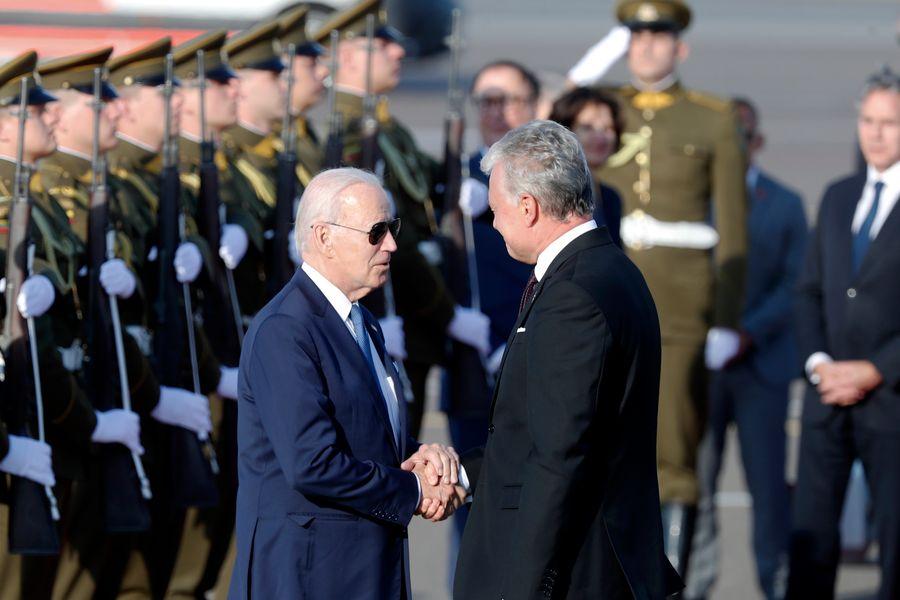
Lithuania NATO Summit
Ukraine: Questions and Answers as NATO Meets
Published July 11, 2023 • Read time: 8m
NATO members are meeting in Vilnius, Lithuania, on July 11 and 12, primarily to deal with the Russo-Ukrainian War, which has now lasted more than 500 days. What questions will President Biden and his NATO partners face?
Didn’t everyone expect Ukraine to achieve a big breakthrough by now?
Yes, many analysts expected a breakthrough in southern Ukraine, primarily in the Zaporizhzhia oblast (province). That region is crucial since it forms a land bridge between Russia and occupied areas of Zaporizhzhia, southern Kherson (south of the Dnipro River), and Crimea.
The hopes of a rapid breakthrough have been dashed. Ukraine has managed only slow, incremental progress, not the swift liberation it achieved in Kharkiv and, later, in Kherson north of the Dnipro.
Does this slow progress indicate a stalemate?
Not necessarily. Right now, Ukraine’s southern strategy has two prongs, which are progressing slowly but still moving forward. One is to probe for weak points in Russian defenses, which Ukraine could then smash through with the forces it has held in reserve. There are leaks reporting the Ukrainians have located some weak areas but outsiders simply don’t know. The second prong is to strangle Russian logistics, which supply those defensive lines with guns, tanks, ammunition, fuel, and new bodies.
Ukrainian missile attacks on fuel and ammunition depots in occupied territory have caused the massive explosions we see every night on video. This “strangulation strategy” has worked well but would be far more successful if the U.S. had supplied longer-range precision weapons to hit supplies coming through Crimea and jets to launch missiles at storage areas.
Over Here: Competence Amid Repulsive Politics
We're Not a Poor Country, Donald
What America Should Learn from the Attack in Brussels
Anti-Muslim Rhetoric Profits the Enemy
The strategy of targeting Russian logistics was the key to Ukrainian success in Kherson province, north of the Dnipro River (directly north of Crimea). The Ukrainians pounded Russian strongholds for months, cut off their supplies of weapons and fuel, and then broke through and rolled up Russian emplacements. That’s exactly what they hope to do in Zaporizhzhia, though the task there is far slower and more difficult.
Why has the Ukrainian progress been so slow in Zaporizhzhia?
Ukrainian progress has been slow because Russia fights much more effectively when it’s on static defense than when it attempts a dynamic offense. Second, the open terrain in the south is ideal territory for defense. As offensive units try to cross open fields and overrun the entrenchments on them, they are exposed and vulnerable. Third, winter weather and spring rains delayed any Ukrainian offensive and gave Russia ample time to dig in and fortify multiple lines of defense. Finally, the U.S. repeatedly delayed giving Ukraine the long-range weapons and fighter jets it needed for an effective assault on Russia’s defensive lines in Zaporizhzhia, southern Kherson, and Crimea.
The U.S. delay prevented its NATO partners from supplying those planes to Ukraine or training pilots to use them as part of a combined-arms offensive. Without F-16s for months to come, Ukraine is forced to fight without air superiority.
In any case, it is much harder to cut off Russian logistics in Zaporizhzhia than it was in northern Kherson. Russia had only a few avenues of resupply there, and those were vulnerable to Ukrainian attack with short-range missiles. In Zaporizhzhia, by contrast, Russia can resupply its emplacements from multiple avenues, including trains and trucks from Russia and ships docking in Russian-controlled ports on the Sea of Azov. Only long-range weapons can disrupt those supply routes.
The United States, wary of Russia’s response to any weapons it supplies Ukraine, denied and then slow-walked Kyiv’s requests for F-16 fighter jets, just as it has delayed supplying longer-range missiles such as ATACMs (the acronym for the Army Tactical Missile System, the MGM-140).
These American delays prevented its NATO partners from supplying Ukraine with F-16s from their ample stocks. The cost to Ukraine has been high since those jets and long-range missiles are essential for NATO-style combined arms operations, precisely the kind needed to break through Russian defenses in the south.
Why did the U.S. finally decide to supply cluster bombs?
Because they are essential to break through Russian defensive lines in Zaporizhzhia, reach the Sea of Azov, and sever the Russian land bridge to southern Ukraine. If Ukraine fails in that effort, the war will be stalemated and Western support for Ukraine’s war effort will undoubtedly decline sharply.
What will rise in its place is Western pressure for a negotiated settlement that cedes Ukrainian territory to Russia. It is unlikely any government in Kyiv could survive such major territorial concessions. Nor is it clear if Ukraine could be rebuilt with Russia still controlling a huge naval base in Crimea or potentially launching another war.
If cluster bombs are so useful to Ukraine, why was the U.S. so slow to provide them?
Partly because Biden has been very slow to approve any arms that could be seen as escalatory (include F-16s and long-range artillery), but mostly because these particular weapons are seen as cruel, immoral, and criminal by over 100 countries that have signed a treaty prohibiting their use. Although the U.S., Ukraine, and Russia did not sign, many U.S. allies did – and are still opposed to Washington supplying these weapons to Kyiv. Russia has no such qualms. It has repeatedly used these bombs and other prohibited weapons, such as phosphorus bombs, and directed them at civilians rather than military targets.
What are cluster bombs and what are the objections to using them?
Cluster bombs are large shells that release many smaller bomblets, covering a wide area, just before impact. The ethical and legal problem is not that the bomblets kill enemy soldiers but that they can kill non-combatants, either if they are used in civilian areas or if unexploded bombs remain on the ground and are touched by innocent children or farmers, plowing their fields, after the war ends.
How do the U.S. and Ukraine respond to those objections?
The U.S. and Ukraine have three responses, beyond the practical one of needing the bombs to clear enemy trenches and running short of other munitions (which Joe Biden inadvertently revealed in a public interview). The first is that American bombs actually do explode, unlike many Russian ones. The figures for unexploded Russian cluster bombs run as high as 30%. U.S. figures are said to be under 1%. Second, the U.S. is restricting both the numbers of cluster bombs it will supply and the areas where Ukraine can use them. They will be limited to Russia’s battlefield entrenchments where Ukraine is attempting a breakthrough. Third, these same areas are already covered with buried Russian roadside bombs, anti-tank mines, and other unexploded Russian shells. All of these weapons need to be cleared before civilians can safely return, and any unexploded cluster bombs can be cleared at the same time.
What about the fight in the east? Why is Ukraine trying to retake Bakhmut? Didn’t Western analysts tell us it wasn’t important strategically?
Yes, they did. The city is not important strategically, but it is important symbolically. It took Wagner mercenaries and other Russian forces over eight months to capture the city, at a huge cost in lives and materiel. Moscow trumpeted this rare victory to its people. To lose the city so quickly to Ukraine would be a psychological blow to Russia and a boost to Ukrainian morale, even if Putin keeps ordinary Russians in the dark. Their frontline soldiers will hear about the loss, and their morale will sink even further.
After Ukraine takes Bakhmut, they might try to drive further into the Donbas region of eastern Ukraine. But that is less important than the fight to cut off Russia in the south.
What will President Biden and America’s NATO partners discuss at their meeting this week in Vilnius, Lithuania?
One of the biggest issues was decided just before the meeting began. Turkey finally removed its veto over Sweden’s membership in NATO. The increase of alliance membership on Russia’s doorstep is yet more evidence of Putin’s strategic incompetence in launching this war-of-choice.
Beyond Sweden’s accession, NATO’s agenda is dominated by three immediate items and two for the future.
The immediate issues are sending more weapons to Ukraine, forecasting how long the war might last (and how long Western support will continue), and discussing whether some kind of settlement can be negotiated. Both Ukraine and Russia would have to accept the deal.
In the background will be efforts to deter any Russian attack on the Zaporizhzhia Nuclear Power Plant. China can be helpful there since any contamination would crush world food supplies, including the imports Beijing desperately needs.
Two issues dominate the longer-range future: rebuilding Ukraine and its membership in NATO. A Western rebuilding effort will succeed only if lots of partners provide lots of funding and only if the war is truly over. The country cannot be rebuilt if peace is unstable. Second, they will discuss a timetable for Ukraine joining NATO and undoubtedly postpone it.
The goal of Ukrainian membership is obvious: to deter any future Russian attacks. The danger is just as obvious: If Russia did attack its neighbor, it would activate NATO’s Article 5 and lead to a direct war between Russia and the West, not the proxy war now grinding on.
These are hard issues to resolve, life-and-death issues. But that’s what you would expect after Russia launched a massive, unprovoked war, the most devastating in Europe since the Nazis surrendered in 1945.

The GOP Majority Should Go Out in Glory
Daniel McCarthy • RealClearPolitics
Republican Majorities Could Return Sooner Than Expected
J.T. Young • RealClearPolitics
The Danger Before the Attack
Leslie J. Sullivan • RealClearPolitics
Jon Finer’s Old and Dangerous ‘New Approach’ to Israel
Peter Berkowitz • RealClearPolitics
The President Deserves Better
John Ullyot • RealClearPolitics
Congress Doesn’t Need Another Blame Game. It Needs To Find What’s Broken
Jarrod Bernstein • RealClearPolitics
RCP Today
Top stories on RealClearPolitics
The Takeaway
Polling intelligence and analysis delivered to your inbox
World News
Featuring the latest world news
Policy
Featuring the latest policy news
Support Our Mission
As part of RealClearPolitics, authors aim to provide balanced, non-partisan analysis by presenting top reporting and commentary from all sides of the political spectrum.
Trusted by policymakers and citizens alike since 2000