
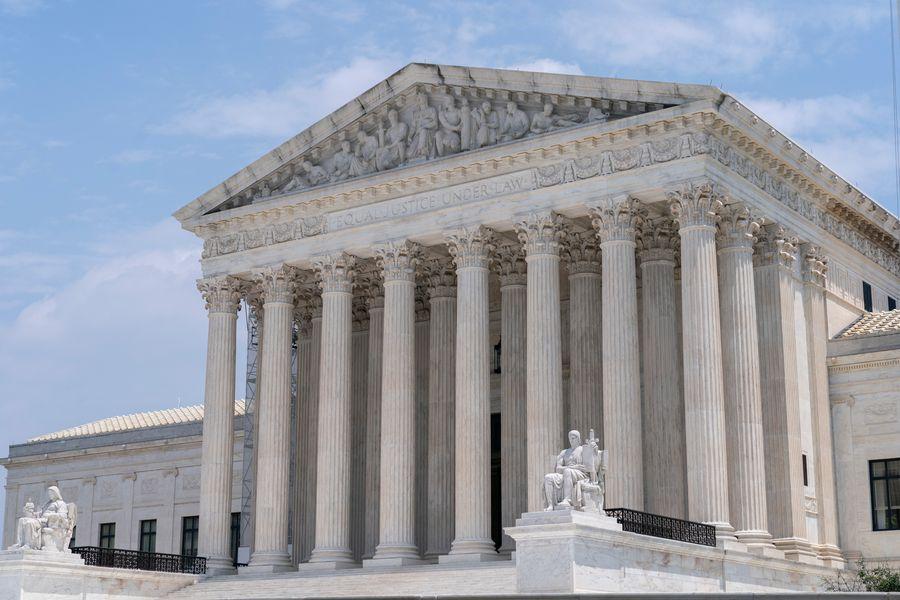
Supreme Court
The Court Upholds Washington's Promise of Religious Liberty
COMMENTARY
Published July 4, 2023 • Read time: 3m
Early in our history, President George Washington wrote to a small Jewish congregation in Rhode Island about his pride that the young nation would respect religious liberty for everyone, including religious minorities. Last week, in between hotly contested decisions about other topics, all nine justices agreed on key principles of religious liberty that are worthy of Washington’s prediction, and worthy of celebration this Fourth of July.
Washington wrote that Americans should be proud of showing the world “an enlarged and liberal policy” by protecting religious liberty. Rather than mere “toleration”—"as if it was by the indulgence of one class of people, that another enjoyed the exercise of their inherent rights”—Washington promised a government that “gives bigotry no sanction” and “persecution no assistance.” Allowing everyone to fully participate in society while living out their varied religious beliefs would help us “become a great and happy people.”
Last week, the Supreme Court helped that project twice. First, in Groff v. DeJoy, the Court issued a unanimous ruling that will protect religious workers. Federal civil rights laws are supposed to protect religious workers in much the same way they protect workers with disabilities—by requiring employers to provide reasonable accommodations. But an old Supreme Court case had gutted that law for decades, saying that employers can avoid accommodation any time they face even a slight cost.
On Thursday, a unanimous Supreme Court reinstated strong protections for religious diversity in the workplace. The Court cited a “bevy of diverse religious organizations”—representing Sikhs, Muslims, Jews, Seventh-day Adventists and more—whose members had faced difficulties under the prior rule. All nine justices agreed the prior rule was wrong, and that employers should reasonably accommodate their employees’ religious beliefs, unless doing so would impose “substantial increased costs.”
An Easter Lesson in Judging Not
Is ISIS Faithful to Islam?
Press Club Welcomes Rezaian Back Home
Hostility to Tradition
Next, in 303 Creative v. Elenis, the Court ruled in favor of Lorie Smith, a religious website designer who cannot in good conscience create websites celebrating same-sex weddings. Although Smith will hire gay employees and serve gay customers in other contexts, she resisted a Colorado law that would have forced her to make websites celebrating weddings that violate her beliefs about marriage.
Ruling for the designer, the Court explained that “the opportunity to think for ourselves and to express those thoughts freely is among our most cherished liberties and part of what keeps our Republic strong.” The Justices further explained that the First Amendment protects the right of speakers “to think and speak as they wish, not as the government demands,” and that Colorado cannot force Smith to celebrate an event against her will.
Unlike Groff, the Court was not unanimous in 303. The three Justices who wrongly supported Colorado wrongly thought creating website content counts as conduct rather than speech. But even the dissenters agreed that, when writing the content for a website, the designer has the right to decide “what messages to include or not to include.” That makes sense—no one should be forced to speak in support of ideas (or events, or political candidates) with which she disagrees.
Together, Groff and 303 show the Supreme Court’s commitment to the America Washington promised—one in which people of different beliefs can live and work in peace, and without coercion to violate their faith. As a truly free nation, we will always have neighbors with different ideas about religion, politics, and other important issues. The American approach of accommodating those neighbors, rather than coercing them, is the kind of “enlarged and liberal policy” that Washington noted was worthy of applause.
This Fourth of July, that is an achievement we should all celebrate.

The GOP Majority Should Go Out in Glory
Daniel McCarthy • RealClearPolitics
Republican Majorities Could Return Sooner Than Expected
J.T. Young • RealClearPolitics
The Danger Before the Attack
Leslie J. Sullivan • RealClearPolitics
Jon Finer’s Old and Dangerous ‘New Approach’ to Israel
Peter Berkowitz • RealClearPolitics
The President Deserves Better
John Ullyot • RealClearPolitics
Congress Doesn’t Need Another Blame Game. It Needs To Find What’s Broken
Jarrod Bernstein • RealClearPolitics
RCP Today
Top stories on RealClearPolitics
The Takeaway
Polling intelligence and analysis delivered to your inbox
World News
Featuring the latest world news
Policy
Featuring the latest policy news
Support Our Mission
As part of RealClearPolitics, authors aim to provide balanced, non-partisan analysis by presenting top reporting and commentary from all sides of the political spectrum.
Trusted by policymakers and citizens alike since 2000