
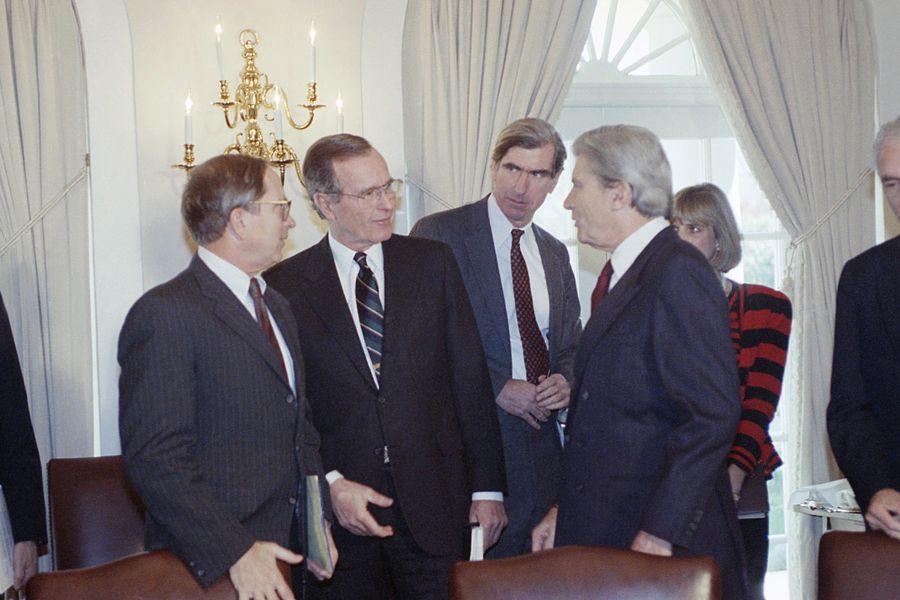
President George H. Bush and John Warner
Three Things I Learned From Boyden Gray
COMMENTARY
Published May 25, 2023 • Read time: 6m
I learned this past weekend that the man who had been my boss, mentor and friend, C. Boyden Gray, had passed away peacefully at his home in Washington, D.C., at 80 years old. I had seen him only last week, at his magnificent yellow house in Georgetown, where we sat together and talked about everything from law to politics to kids and grandkids.
After the initial shock of his loss passed, I felt two distinct emotions: Sorrow that Boyden's unmatched wisdom and wit would no longer be but a phone call away; and gratitude, for all that he taught me in the two years I worked for him, lessons that had made him — for me and for so many others — a fixed star by which to navigate the legal profession and world beyond.
Like his father, Gordon Gray, the second president of the University of North Carolina, Clayland Boyden Gray was a natural teacher. To observe him and work with him — reviewing his penciled line edits on draft briefs, submissions to federal agencies, and op-eds — was to learn from him. Among too many other lessons to recount, I learned from him a distinct approach to law, American history and statesmanship.
Law
Boyden (picture above at President Bush's left)was a lawyer’s lawyer, a counselor to presidents and world leaders. His legal advice alone seemed to check presidential or congressional power, and his strategic insight could offer the surest path for statesmen, CEOs and global institutions.
When I worked with him, his phone never stopped ringing as clients and government officials sought his insights. All those phone calls would trigger research projects that he insisted should be summarized in a single page. “If you cannot explain it in a single page, I do not believe you understand it,” he often said. Whenever I write, I still hear his admonition to “unburden the reader” with a succinct roadmap at the beginning.
The FBI Gained Access; We'd Already Lost Our Privacy
Is Trump Right About NATO?
Arizona's Voting Rights Fire Bell
U.S. Officials Say 2 Americans Died in Brussels Attack
He was willing to advocate even daring legal theories to move the law in a positive direction, but he always hewed responsibly to established text, precedent and tradition. And unlike so many in the legal profession I have met, conservative and liberal alike, Boyden remained an adamant optimist about the law and its capacity to shape events, even through a single lawsuit or piece of legal counsel.
His optimism was well earned. Whether in filing the first suit challenging the constitutionality of the Consumer Financial Protection Bureau (vindicated in part by the Supreme Court in Seila Law, with the CFPB’s many remaining constitutional issues still pending next term), or advocating for American and European energy independence to check Russian or Chinese ambition, even the first draft of history regularly proved him farsighted.
And many of his most important legal achievements endure in the text of executive orders requiring regulatory cost-benefit analysis, the Montreal Protocols that helped solve the hole in the ozone layer, the Clean Air Act Amendments of 1990 that helped save our forests from acid rain and promoted low-carbon biofuels, and the Civil Rights Act Amendments of 1991 that balanced equal treatment with free enterprise. America rightly owes these and other essential compromises in large measure to his instrumental efforts as counselor to the vice president and then White House counsel.
American History
I learned to share his optimism by seeing what he saw in human history, a story culminating in the still exceptional country he dedicated his life to serving. He often traced the U.S. Constitution’s separation of powers in part to the Republic of Venice, and other continental intellectual and mercantile hubs depicted in the priceless collection of 16th century maps hung on his law firm’s office walls. He saw the germ of America’s independent judiciary in the Scottish judiciary. He explained the origins of our free market prosperity in Scottish Enlightenment thinkers who tutored many of America’s Founders. He also took a long view of American culture, and helped me to see its texture more completely when he recommended one of his favorite books of American history (and now one of mine): David Hackett Fischer’s magisterial description of America’s essential character, “Albion’s Seed.”
And Boyden never forgot what time it was, always standing for liberty against the genuine threats to American exceptionalism and the common good: the growth of the administrative state through congressional abdication, and the private sector cartels that captured federal agencies and used them to the detriment of ordinary men and women.
He resisted these threats fiercely, shrewdly and effectively, prompting his enemies to dub him “Gray Fox.” But unlike so many others in the brass-knuckled politics on the Potomac, Boyden remained a happy warrior who scuttled bad ideas with a smile or an anecdote from his service as ambassador to the European Union or clerkship for Chief Justice Earl Warren. Boyden was a warrior-statesman, but the affable and impeccable kind who could play tennis with the Washington Post’s longtime maven Katharine Graham. And he could make even political adversaries smile with his porcine tie, a tribute to the pet pig he famously used to take on walks through his beloved Georgetown neighborhood.
Statesmanship
I am grateful to have caught a glimpse of the life Boyden led, the ever rarer gentleman’s life dedicated to excellence, friendship and generosity. Like his characteristic dark-rimmed glasses and gray pinstripe suits that somehow made him, at 6-foot-6, look even taller, he seamlessly integrated his work with his intellectual and social life. A trip to Maine for relaxation would result in new intelligence on a developing case. A dinner at his home could produce an action plan to serve people in developing nations (and the funding to do it), or an email with a plan to protect the paychecks of working Americans during a pandemic.
His law practice, public commentary and philanthropic engagement were almost as natural as his ever-present cup of coffee, deep Winston-Salem voice and daily games of bridge. And when he would saunter into my office in the morning to hand me a folded print copy of the paper with an article touching on our work, I could see the familiar glint in his eyes that said the unsaid words, “We’re making a difference.”
I will always see Boyden as one of the last true giants of Washington, a deserving heir to a family that embodied the founding vision of a government accountable to the people and led by statesmen drawn from among their best. From his daily trips to the gym to his constant ability to plow through what seemed like endlessly dense pages of legal briefs, newspapers and emails (which he somehow replied to quickly, signed CBG), Boyden was an alert and active soul. He never stopped striving to embody the brightest of what his own late mentor and friend, President George H.W. Bush, called a thousand points of light.
Last week, after we had talked for an hour, he checked his watch and suggested he needed to be mindful of the time. I stood and thanked him for spending some of his afternoon with me. When I shook his hand for the last time, he said, “Please come visit me anytime, whenever you’re in D.C. next.” I deeply wish that I could. But I will often revisit these many things I learned from him.

The GOP Majority Should Go Out in Glory
Daniel McCarthy • RealClearPolitics
Republican Majorities Could Return Sooner Than Expected
J.T. Young • RealClearPolitics
The Danger Before the Attack
Leslie J. Sullivan • RealClearPolitics
Jon Finer’s Old and Dangerous ‘New Approach’ to Israel
Peter Berkowitz • RealClearPolitics
The President Deserves Better
John Ullyot • RealClearPolitics
Congress Doesn’t Need Another Blame Game. It Needs To Find What’s Broken
Jarrod Bernstein • RealClearPolitics
RCP Today
Top stories on RealClearPolitics
The Takeaway
Polling intelligence and analysis delivered to your inbox
World News
Featuring the latest world news
Policy
Featuring the latest policy news
Support Our Mission
As part of RealClearPolitics, authors aim to provide balanced, non-partisan analysis by presenting top reporting and commentary from all sides of the political spectrum.
Trusted by policymakers and citizens alike since 2000