
American Holidays
The Gentle Art of Disagreeing
COMMENTARY
Published April 26, 2023 • Read time: 4m
My friend Stephen died last month, and we remembered him this weekend. He was a brilliant, creative, hard-charging man, with a kind heart and the wrong politics. Of course, he thought the same about mine. We enjoyed each other. I admired him for so many reasons, and we knew how to disagree with each other about beliefs that were deeply important to each of us.
A Jew from Jacksonville who went to Ivy League schools before landing in New York to practice labor law and then private equity, he wanted a bigger, more active government to fight for those he saw as oppressed.
A Christian from New York who also went to other fancy schools before landing in Chicago to practice corporate law, I want a smaller government that won't oppress people and squelch opportunity.
He would buy companies that were struggling, often unionized. He sought out investments that others would avoid because he knew how to get workers to help turn things around. And I would help him, allocating risks, clearing the way for him to achieve what he set out to do, wondering why this great capitalist didn't love capitalism, at least not as unabashedly as I do.
We shared a deep love of our country and each person's right to pursue opportunity. In that spirit, he would say, "Give me smart young people, and I am serious about promoting diversity." He had high standards and an open heart. Together, we mentored the first black corporate partner at my firm, launching him on a stellar career cut short by cancer.
Stephen was a member of the Democratic National Committee. I am a member of the Republican National Committee. We shared a passion, but with often opposing perspectives. Still, we would always discuss events of the day. We did so with courtesy, knowing where the other was likely to be.
Culture Wars, Old and New
The Better Option
Trust -- Society Depends On It
Family Fragmentation: Can Anything Be Done?
I never gave up on trying to convince him. I would choose my words carefully, trying to frame arguments taking into account his perspective. I sought to reach him where he was. And I think he did the same with me. We didn't joust with anger, and we certainly didn't bully or mock.
We debated, with a smile and with respect. We agreed to disagree.
I embraced my admiration of him, instead of dwelling on our differences. We treated each other as we would each wish to be treated ourselves. We treated each other with the same brotherly love upon which the nation we love was founded.
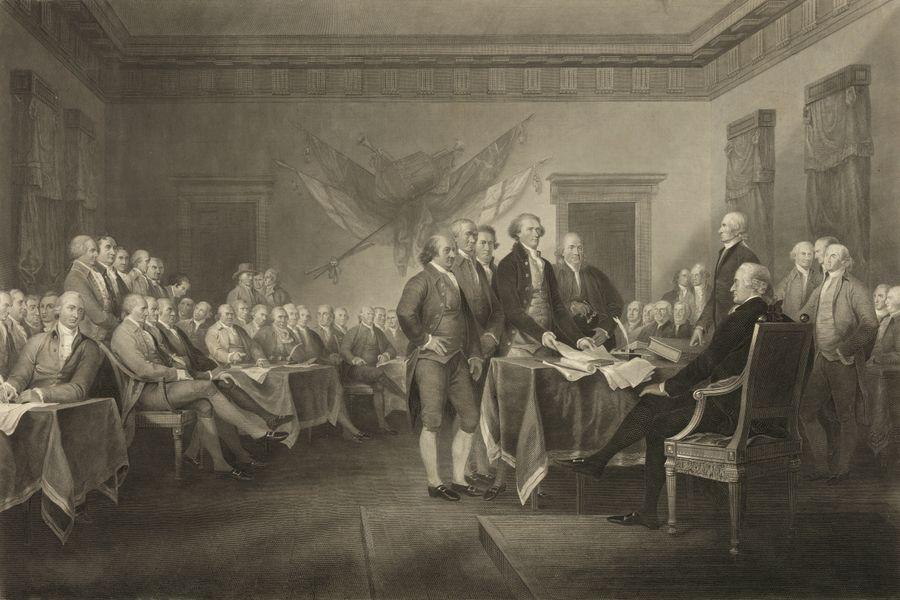
Jefferson wrote the Declaration of Independence in the city of brotherly love: Philadelphia. Philos, the root of Philadelphia, is one of several Greek words for love. And Jefferson slyly built love into the Declaration.
"We hold these truths to be self-evident, that all men are created equal, that they are endowed by their Creator with certain unalienable Rights, that among these are Life, Liberty and the pursuit of Happiness."
Being “created equal” does not mean that we are the same or that our abilities are equivalent. Instead, we are equal as humans in terms of our relationship to our Creator and how He commands that we relate to each other. Jefferson's words are a manifestation and a reminder that we are commanded to love God and our neighbors. This commandment is in the Old Testament (Deuteronomy, Leviticus), the New Testament (Matthew), and in other great world religions.
Love equalizes. Treating one another as we would wish to be treated ourselves puts us each on the same level. No one is entitled to more or less respect than we would expect to receive ourselves.
And loving our neighbor is the premise upon which our Creator endowed us with unalienable rights, including liberty – because loving others as ourselves governs and empowers the exercise of liberty.
Our nation was the first and is still the only nation founded on the premise of the equalizing power of brotherly love. Brotherly love informs the structure of our Republic and is amplified in the Bill of Rights – such as the First Amendment rights to free speech and religion.
Stephen and I governed ourselves and our speech with love for the other. We expressed our passions and agreed to disagree, respectfully. Neither of us sought to silence the other, and we each tried to manage the anger we may have felt about ideas or positions we may have found noxious.
He was a great man and a great American and I will miss him. Friendships like ours reflect what's exceptional about our nation.
Treating others as Stephen and I treated each other is how we can make America great again.

The GOP Majority Should Go Out in Glory
Daniel McCarthy • RealClearPolitics
Republican Majorities Could Return Sooner Than Expected
J.T. Young • RealClearPolitics
The Danger Before the Attack
Leslie J. Sullivan • RealClearPolitics
Jon Finer’s Old and Dangerous ‘New Approach’ to Israel
Peter Berkowitz • RealClearPolitics
The President Deserves Better
John Ullyot • RealClearPolitics
Congress Doesn’t Need Another Blame Game. It Needs To Find What’s Broken
Jarrod Bernstein • RealClearPolitics
RCP Today
Top stories on RealClearPolitics
The Takeaway
Polling intelligence and analysis delivered to your inbox
World News
Featuring the latest world news
Policy
Featuring the latest policy news
Support Our Mission
As part of RealClearPolitics, authors aim to provide balanced, non-partisan analysis by presenting top reporting and commentary from all sides of the political spectrum.
Trusted by policymakers and citizens alike since 2000