
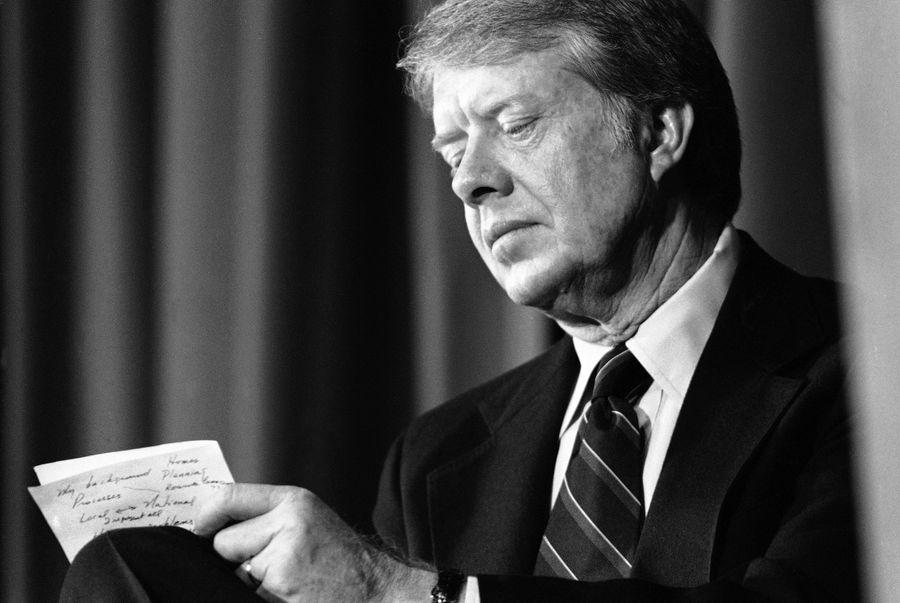
President Jimmy Carter Reading Notes
Jimmy Carter and the Pursuit of Happiness
Published March 7, 2023 • Read time: 15m
Join the Conversation
0One spring day 22 years ago, a friend called from California with an intriguing freelance idea. Patrick Dillon, editor of a Forbes magazine offshoot in Silicon Valley, had a straightforward, if ambitious, assignment: Ask the living U.S. ex-presidents to write an essay or grant an interview on what “the pursuit of happiness” means to them.
George W. Bush was newly ensconced in the White House, my beat at the time. Although I’d heard Bush’s father – as well as Gerald Ford, Jimmy Carter, Ronald Reagan, and Bill Clinton – employ the evocative phrasing in the Declaration of Independence, I’d never given much thought to what Thomas Jefferson and his collaborators (John Adams, Benjamin Franklin, Roger Sherman, and Robert Livingston) expected Americans to do with those words. Or what modern U.S. presidents thought when they invoked the revolutionary concept that all human beings are created equal and endowed at birth “with certain unalienable rights” including “life, liberty, and the pursuit of happiness.”
The quest was an adventure, which I turned into my first book. More immediately, it would generate written essays from Bush 41 and Bill Clinton, and personal interviews with Jerry Ford and Jimmy Carter. (The incumbent president passed along his thoughts through the White House press secretary Ari Fleischer. Ronald Reagan, unfortunately, was by that time lost to the mists of Alzheimer’s.) True to form, Carter was difficult to deal with; or rather, his staff at the Carter Center in Atlanta proved impenetrable. But ultimately my experience with him was the most rewarding.
Rethinking the Pledge; Trump and Women; One Last Egg Roll; Eulogizing Ike
2016: A Repeat of the 1960s
An Apology, Fashioned for Nancy Reagan
Nancy Reagan, Guardian of a Legacy
James Earl Carter Jr. is now 98 years old. Eschewing further hospital treatments, he’s at home in hospice care. As a faithful adherent of the old-time religion, Carter does not fear what lies ahead. He’s said so publicly. And as an American who served his country, and the citizens of the world, for eight decades, Carter is receiving the respectful media coverage deserving of someone who occupied the public sphere for that long without a hint of scandal.
He has long been a rarity in modern American politics. Even when he occupied the White House, Carter was a throwback: an evangelical Christian who is conservative theologically, but progressive politically. He took flak for it – from the left and the right.
In 1976, the year Carter won the presidency, an African American activist from a nearby town drew attention to the fact that Plains Baptist Church, which Carter attended since he was baptized there as boy, was segregated. This was not happenstance. By an overwhelming margin, (with Carter and his family in the minority) the congregation voted in 1965 to bar blacks and “civil rights agitators” from worshiping there.
Maranatha Baptist Church, where former President Jimmy Carter taught Sunday school for years, sits among pecan trees in Plains, Ga. (AP Photo/Steve Helber)
And so, on Election Day in America’s bicentennial year, a man who was both black and an agitator arrived at Plains Baptist Church. Carter’s own pastor, the Rev. Bruce Edwards, wanted to allow him in, but the congregation’s deacons overruled him. Edwards was soon forced to resign. Among its 10 churches, Plains already had a black Baptist church, as well as an African Methodist Episcopal church, so it wasn’t a question of anyone lacking a place to worship. It was a matter of confronting Georgia’s racist past. Thus, even before he took the oath of office, President-elect Jimmy Carter had a problem. He solved it by siding with a group of dissidents who formed a third Baptist church (in a town of fewer than 700 souls). Carter is still a leading member of this congregation, Maranatha Baptist Church. And that was where I went in the summer of 2001 to ask him about the pursuit of happiness.
Blessed Are the Peacemakers
In the late 1970s, Jimmy Carter and the Democratic Party faced a far more significant cultural challenge than aged, segregation-minded churchgoers in small Southern towns like Plains, Georgia. In 1973, while Carter served his lone term as governor in Atlanta, the U.S. Supreme Court handed down its Roe v. Wade decision. Until then, abortion had not been a strictly partisan issue. In California, for instance, second-term governor Ronald Reagan signed a bill liberalizing abortion that had been opposed by many Catholic Democrats in the legislature and favored by libertarian-minded Republicans.
As the full implications of Roe v. Wade became clear, however, the political battle lines hardened. Millions of Carter’s fellow evangelical Protestants who had previously voted Democratic (and many devout Roman Catholics) came to view Carter and other party leaders as apostates over abortion and other hot-button social issues. They defected en masse to the Republican Party. At the same time, Carter’s overt piety – and, let’s be honest, his Southern-ness – made him suspect to Democratic Party elites. It was these liberal activists who rallied to Ted Kennedy’s 1980 primary season challenge against Carter.
Carter was always convinced that Ted Kennedy’s 1980 presidential candidacy, which he took all the way to the Democratic National Convention in New York, made it easier for Reagan to defeat Carter in November. This view elevates Kennedy’s role, while underestimating Reagan’s talents, but Carter’s resentment is understandable.
One-term presidents are not generally adjudged by historians or political professionals to have had successful tenures in office (George H.W. Bush may be an exception), but after returning to Georgia in 1981, Carter began building the résumé that would lead many observers to describe him as a “great ex-president.” This wasn’t a universal consensus. His successors in the Oval Office tended to view Carter’s unilateral forays into foreign policy as irksome; some White House officials groused privately that Carter was on an unseemly quest to win a Nobel Peace Prize.
Egyptian President Anwar Sadat, left, U.S. President Jimmy Carter, center, and Israeli Prime Minister Menachem Begin clasp hands at the White House after signing the peace treaty between Egypt and Israel. (AP Photo/ Bob Daugherty)
But the Norwegian Nobel Committee should have given the peace prize to Carter when he was president. It was awarded to Menachem Begin and Anwar Sadat after the Camp David Accords that were shepherded by Carter. The committee finally awarded a peace prize to Carter in 2002, citing the Camp David Accords among his achievements. They didn’t do themselves or Carter any favors, however, by conceding publicly that they intended to send a message – “a kick in the leg,” one Nobel official said – to anyone siding with George W. Bush’s impending invasion of Iraq.
So Carter got his Nobel Peace Prize. And like Herbert Hoover before him, he learned to be content with earning back the respect of his countrymen and being lauded as a worldwide humanitarian. (Hoover, literally dubbed the “Great Humanitarian,” was nominated four or five times for a Nobel, and never won.) Hoover had to settle for knowing he helped save millions of lives in post-war Europe in the 1940s, just as he had done in World War I.
Jimmy Carter’s extensive good works range from his long partnership with Habitat for Humanity and monitoring elections in emerging democracies to nearly eradicating Guinea-worm disease in Africa – saving millions of lives in the process. The snarky comments of the Nobel committee notwithstanding, Carter was a voice for peace after 9/11, which put him on the same side as his old nemesis Ted Kennedy. Both advised caution and diplomacy instead of a massive U.S. military invasion of Iraq.
A Deeper Kind of Happiness
My “pursuit of happiness” project for Forbes FYI was begun prior to 9/11 and completed afterwards, which required me to make sure that what Jerry Ford and George H.W. Bush told me before the attacks was still operative afterward. This was not a problem when it came to Carter, whom I didn’t talk to until three weeks after the attacks. Not that it would have mattered. His observations were not time sensitive. They were eternal. The 39th U.S. president essentially gave me what evangelical Christians call their “testimony.”
I hadn’t known what to expect when I flew from Washington to Atlanta and then drove to Plains. I wasn’t sure Carter would even be there, or if so, whether I’d get the chance to talk to him. I was making a cold call – to a former president. I did know that the church deacons at Maranatha expected him that Sunday. He had been giving regular talks in the sanctuary during the hour preceding the worship service, where he would discuss his latest travels around the world, linking them with a relevant biblical passage. Usually, the room was full. The day I was there, about half the audience were locals; the other half came on tour buses to hear the man talk about good works and the Gospel.
In preparing to ask the former presidents to write an essay or grant an interview, I researched what they had previously said or written about the Declaration of Independence. Carter’s earlier observations had been particularly expansive. A few days before leaving the Oval Office, he articulated a poignant definition of what life, liberty, and the pursuit of happiness mean to peace-loving 20th-century progressive-minded Americans.
“America did not invent human rights,” Carter said. “In a very real sense, it’s the other way around. Human rights invented America.” He continued:
Ours was the first nation in the history of the world to be founded explicitly on such an idea … Our American values are not luxuries, but necessities. Not the salt in the bread, but the bread itself. Our common vision of a free and just society is our greatest source of cohesion at home and strength abroad – greater even than the bounty of our material blessings.
Remember these words: “We hold these truths to be self-evident, that all men are created equal; that they are endowed by their Creator with certain inalienable rights; that among these are life, liberty, and the pursuit of happiness.”
This vision still grips the imagination of the world. But we know that democracy is always an unfinished creation. Each generation must renew its foundations. Each generation must rediscover the meaning of this hallowed vision in the light of its own modern challenges. For this generation – ours – “life” is nuclear survival; “liberty” is human rights; “the pursuit of happiness” is a planet whose resources are devoted to the physical and spiritual nourishment of its inhabitants.
Former President Jimmy Carter and Democratic candidate for the presidential nomination Walter Mondale wave to supporters during a BBQ in Mondale's honor. (AP Photo/Ric Feld)
Three and a half years later, while speaking at the Democratic National Convention in San Francisco while Walter Mondale, Carter’s former vice president, was receiving the party’s nomination as its 1984 standard-bearer, Carter modified this vision slightly while trying to make Jefferson’s prose relevant to a modern world. From the dais inside the Moscone Center, he described “the pursuit of happiness” as “equal opportunity to enjoy the fruits of a productive society.”
I was on the convention floor that night and recall being surprised by Carter’s understated eloquence. Still, I didn’t know what to expect when I spoke with him in Plains, a town I had not visited since he ran for the presidency in 1976 when I was a reporter in Columbus, a city on the Georgia-Alabama border about 45 miles away. The date was Sept. 30, 2001.
The week before, Carter had told the Sunday school group that a planned trip to Bangladesh had been canceled because of 9/11, but he used the occasion to tell the congregants what he knew about Islamic rage in the Arab world. He read aloud portions of Osama bin Laden’s two previous fatwas against Americans. Yet, as President Bush was doing at the time, Carter defended most Muslims, saying that al-Qaeda was no more reflective of mainstream Islam than the Ku Klux Klan was representative of Christianity. Carter did assert, however, that it’s no accident that such hatreds emanate from a part of the world that excoriates people based on their religious faith – and grants few rights to women. He noted that the New Testament book of Luke points to “that facet of Jesus’ ministry – the exaltation of women, the equality with which Jesus treated women.”
When I was there, which was the day before his 77th birthday, Carter lectured again. The Bible lesson, from the book of John, was about raising Lazarus from the dead. Carter prefaced his talk with a travelogue about a recent five-day trip to Alaska’s Kodiak Island where he fly-fished and went whale-watching. Afterward, Carter lingered on the lawn outside the church, where he patiently shook hands with everyone who came that day, or had his picture taken with them, when I approached.
“Mr. President, I am a reporter from Washington who covers the White House. I’d like to ask you about an essay we are doing on the pursuit of happiness …”
“I don’t do that at church,” Carter snapped, cutting me off.
The south tower begins to collapse as smoke billows from both towers of the World Trade Center, in New York, Sept. 11, 2001. (AP Photo/Jim Collins)
I told him that I hadn’t had any luck going through proper channels, and in any event, I had come a long way to ask him a single question about a topic he’d discussed before. “It was quite eloquent,” I said, “but in light of the September 11 attacks on this country, I’d like to know if you believe this definition is still current.”
As his wife looked on, Carter softened and asked me to wait under a shade tree until the worshipers and guests had gone. Then, when it was just Carter and the church pastor and his wife and a couple of Secret Service agents, he agreed to discuss the Preamble. I read a passage from his previous thoughts about the pursuit of happiness and asked him, “Do you still believe this is true?”
“What I wrote, that’s still true, yes,” he answered. He paused, before adding softly, “But there’s always a new threat, isn’t there?”
We talked briefly about Mother Teresa, who had won a Nobel Peace Prize while he was president. I told him that she had said something to the effect that the first obligation of a Christian is to be happy, to show the world that belief in Jesus makes a person more content.
“She did?” he said. “Well, it depends on where you find your happiness. As I tried to say in today’s lesson, the truth preserved in the teachings of Christ – what the Bible says – is that your happiness is not based on worldly successes and failures.”
“You think you have a successful and happy life, but if you lead a Christian life, it surpasses all understanding,” he said. “I found that out in my own life: that apparent failures can actually lead to true happiness, a different kind of happiness.”
A Just God
Two decades before Thomas Jefferson became president, the Sage of Monticello authored a book, “Notes on the State of Virginia.” It contains several searing passages in which Jefferson is remarkably candid about the evils of slavery. It’s painful to read even now. Although Jefferson’s own words – in the Declaration of Independence – would provide the intellectual underpinnings that helped bring slavery to an end, Jefferson freed only a small fraction of Monticello’s slaves, even upon his death. Emancipation came later, and only after the deaths of so many Civil War soldiers, not to mention the cruel lives and deaths of generations of enslaved people.
“[C]an the liberties of a nation be thought secure when we have removed their only firm basis, a conviction in the minds of the people that these liberties are the gift of God?” Jefferson wrote. “That they are not to be violated but with his wrath? Indeed I tremble for my country when I reflect that God is just: that his justice cannot sleep forever.”
In an odd coincidence, Jimmy Carter, now 98 years old and in failing physical health, was born 98 years after Jefferson’s death. It is a reminder of how young this country is, and also of Southern author William Faulkner’s famous admonition about the past not ever really being behind us. Although he slightly garbled Faulkner, Barack Obama invoked this line in his best-remembered 2008 campaign speech, “A More Perfect Union.”
The officially segregated society of Jimmy Carter’s youth no longer exists, in part because Southerners like him finally decided to adhere to the spirit of the Declaration of Independence’s promises of equality. And also because they finally began to truly practice the tenets of a faith that instructs its followers to “love your neighbor as yourself.”
“Gone with the Wind,” Margaret Mitchell’s nostalgic ode to Southern white supremacy, was published the same year 11-year-old Jimmy Carter accepted Christ into his life in a baptismal ceremony in an all-white church. As he grew to adulthood, Carter embraced the core of his faith, while rejecting its apartheid trappings.
Former President Jimmy Carter and his wife, Rosalynn, walk back to a Habitat for Humanity building site. (AP Photo/Mark Humphrey)
It’s a faith that also teaches there is life after death, a belief in which Carter says he is “absolutely confident.” He expressed that view after a previous health scare in a 2019 sermon at Maranatha Baptist Church. “I, obviously, prayed about it,” he said then. “I didn’t ask God to let me live, but I just asked God to give me a proper attitude toward death. And I found that I was absolutely and completely at ease with death.”
Jimmy Carter isn’t trembling for his country, or for his own soul. Rest in peace, Mr. President. You’ve earned it.

The GOP Majority Should Go Out in Glory
Daniel McCarthy • RealClearPolitics
Republican Majorities Could Return Sooner Than Expected
J.T. Young • RealClearPolitics
The Danger Before the Attack
Leslie J. Sullivan • RealClearPolitics
Jon Finer’s Old and Dangerous ‘New Approach’ to Israel
Peter Berkowitz • RealClearPolitics
The President Deserves Better
John Ullyot • RealClearPolitics
Congress Doesn’t Need Another Blame Game. It Needs To Find What’s Broken
Jarrod Bernstein • RealClearPolitics
RCP Today
Top stories on RealClearPolitics
The Takeaway
Polling intelligence and analysis delivered to your inbox
World News
Featuring the latest world news
Policy
Featuring the latest policy news
Support Our Mission
As part of RealClearPolitics, authors aim to provide balanced, non-partisan analysis by presenting top reporting and commentary from all sides of the political spectrum.
Trusted by policymakers and citizens alike since 2000