Poland Russia Ukraine War
One Week Later, Biden's "Gaffe" Doesn't Look So Bad
COMMENTARY
Published April 4, 2022 • Read time: 5m
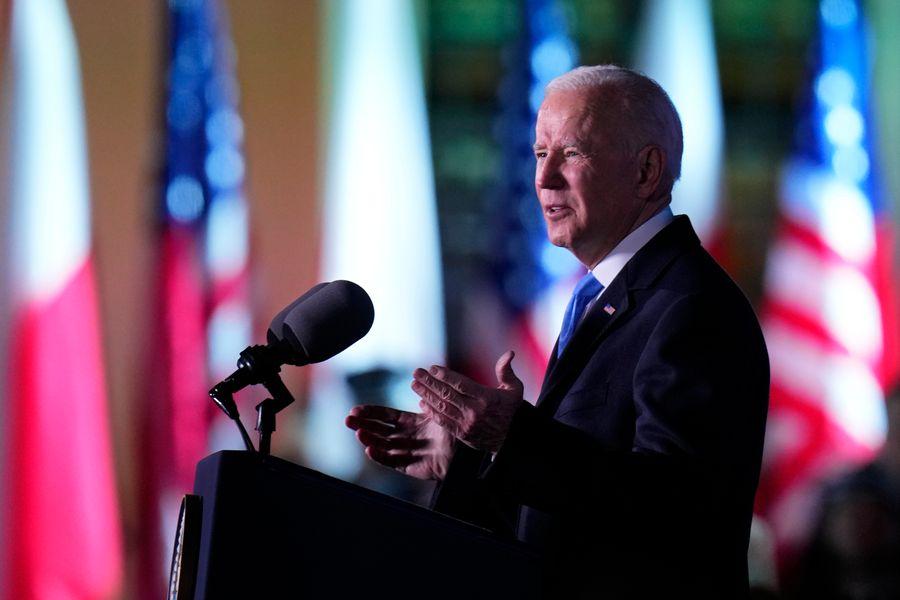
When President Joe Biden said during his speech in Warsaw about Russian President Vladimir Putin, “For God’s sake, this man cannot remain in power,” he was scolded by just about everybody for suggesting the United States is pursuing a strategy of regime change, needlessly provoking a nuclear power and risking an escalation of the war in Ukraine.
Yet over the course of the past week, the war did not escalate. Instead, Russian forces largely retreated from the Ukrainian capital of Kyiv.
Of course the words of a president matter and they should be uttered with care. But the events of the past week remind us that a president’s unscripted words don’t necessarily matter more than all the other factors that shape international political dynamics. For example, Biden’s loose talk can’t make the Russians fight better or the Ukrainians fight worse.
Moreover, Biden's suggestion of regime change doesn’t appear to have altered Putin’s strategic thinking, perhaps because he's long believed the United States wants regime change. In his speech justifying the Ukrainian invasion, he accused the “United States and other Western partners” of trying “to put the final squeeze on us, finish us off, and utterly destroy us.”
For Republicans to get the vapors over Biden’s bluntness is a bit of a role reversal. Typically, Democrats are the ones who complain about Republican presidents speaking intemperately on the world stage and risking deadly conflict, from Ronald Reagan’s dubbing of the Soviet Union as an “evil empire,” to George W. Bush’s description of Iraq, Iran, and North Korea as an “Axis of Evil,” to a whole host of rhetorical provocations from Donald Trump. Republicans in the past were more likely to defend their presidents’ plain-spoken charm.
Is Trump Right About NATO?
Over Here: Competence Amid Repulsive Politics
We're Not a Poor Country, Donald
U.S. Officials Say 2 Americans Died in Brussels Attack
The example from the past that I find has the most relevance to today is from the summer of 1984, when during a sound check before his weekly radio address, Reagan said, “I’m pleased to tell you today that I’ve signed legislation that will outlaw Russia forever. We begin bombing in five minutes.” Yes, Reagan was joking and Biden was not, but Russia may well have taken Reagan’s comment more seriously than Biden’s. Soon after the crack, a coded message was sent from a Soviet military base to naval ships in the Pacific which read, “We now embark on military action against the U.S. forces,” though it was canceled before any hostilities took place. (A reporter from NBC News said one U.S. official “did speculate that the Russian” who sent the alert “might have been drunk.”)
The common thread connecting the Reagan joke and the Biden gaffe was that while they both suggested deep disinterest with rapprochement with the Kremlin leadership at that time, they also could not be taken seriously as a policy shift toward direct war. Reagan’s unpresidential humor didn’t fundamentally alter the course of White House-Kremlin relations; in fact, one year later Reagan held the first of his four summit meetings with Mikhail Gorbachev, which culminated in both an arms control treaty and a friendship. Biden and Putin won’t be following in their footsteps and walking in the woods anytime soon, but that’s because of Putin’s actions, not Biden’s words.
If Biden’s unfiltered inner monologue has done damage, it’s not to the Ukrainian resistance, but to Biden’s image. Former Bush political adviser Karl Rove argued in his Wall Street Journal column that “Mr. Biden’s gaffes appear to have hurt his image as a strong leader,” noting polls that show the public is far less likely today than 18 months ago to see Biden as a “strong leader.”
I would argue that attributing the decline strictly to “gaffes” discounts the important role played by the protracted pandemic and inflation. But a crisis offers an opportunity to show leadership. Biden has been leading. He has unified Democrats and Republicans at home, as well as the members of the NATO alliance abroad, in support of a strategy providing critical military aid to Ukraine – allowing the besieged nation to thwart Putin’s long-held imperialist ambitions without entangling America or NATO in direct military conflict with Russia.
Yet the American public isn’t crediting Biden with leadership when it comes to Ukraine. Before his Warsaw speech, Biden delivered a State of the Union address that began with a stirring defense of Ukraine and democracy welcomed by both parties, but ended with the usual laundry list of policy wishes that made it easy for Republicans to lob partisan attacks. Similarly, Biden’s speech in Poland was another powerful call to protect democracy and “the rule-based international order established since the end of World War Two.” But with the final ad-lib, Republicans no longer had any political obligation to salute a Democratic president. Twice, a chance to use presidential rhetoric to unify Americans was squandered.
But again, that is a problem for Biden’s domestic political standing, not for Biden’s foreign policy strategy. That strategy could still succeed with a withdrawal of Russian forces and a Ukraine still intact, maybe even followed by the end of Putin’s dictatorial reign. In the aftermath of such an event, as with Reagan, perhaps Biden’s unvarnished rhetoric will be remembered more fondly.

Newsom Defies Voters, Juries and Lawmakers To Spare Murderers While Defending Abortion
Curtis Hill • RealClearPolitics
The Algorithmic Tilt
Frank Filingeri • RealClearPolitics
A RealClear Thanksgiving: Investing in a Better Future
David DesRosiers • RealClearPolitics
Trump’s Newsom Problem: Antagonist-in-Chief
Carolina Lumetta • RealClearPolitics
America’s Free Spirit
John Maxwell Hamilton • RealClearPolitics
The GOP Majority Should Go Out in Glory
Daniel McCarthy • RealClearPolitics
RCP Today
Top stories on RealClearPolitics
The Takeaway
Polling intelligence and analysis delivered to your inbox
World News
Featuring the latest world news
Policy
Featuring the latest policy news
Support Our Mission
As part of RealClearPolitics, authors aim to provide balanced, non-partisan analysis by presenting top reporting and commentary from all sides of the political spectrum.
Trusted by policymakers and citizens alike since 2000